William Lukas
William Lukas is a maximalist. And also a romantic. In his analog collage practice, William upcycles and “rewilds” abandoned print media, recasting hand-cut images as large, colorful assemblages that engage bodies, sensualities, flora, and fauna as a symbiotic whole. His approach to paper arts is largely informed by sculpture, painting, and magical realism.
William has exhibited works at STRATA Gallery (Santa Fe, NM), Iridian Gallery (Richmond, VA), Paxton Gate (San Francisco, CA), the Minnesota Street Project (San Francisco, CA), and the William Way LGBT Community Center (Philadelphia, PA). William was a 2019 artist-in-residence at the Vermont Studio Center. His portfolio was shortlisted in the 2024 Contemporary Collage Magazine Awards.
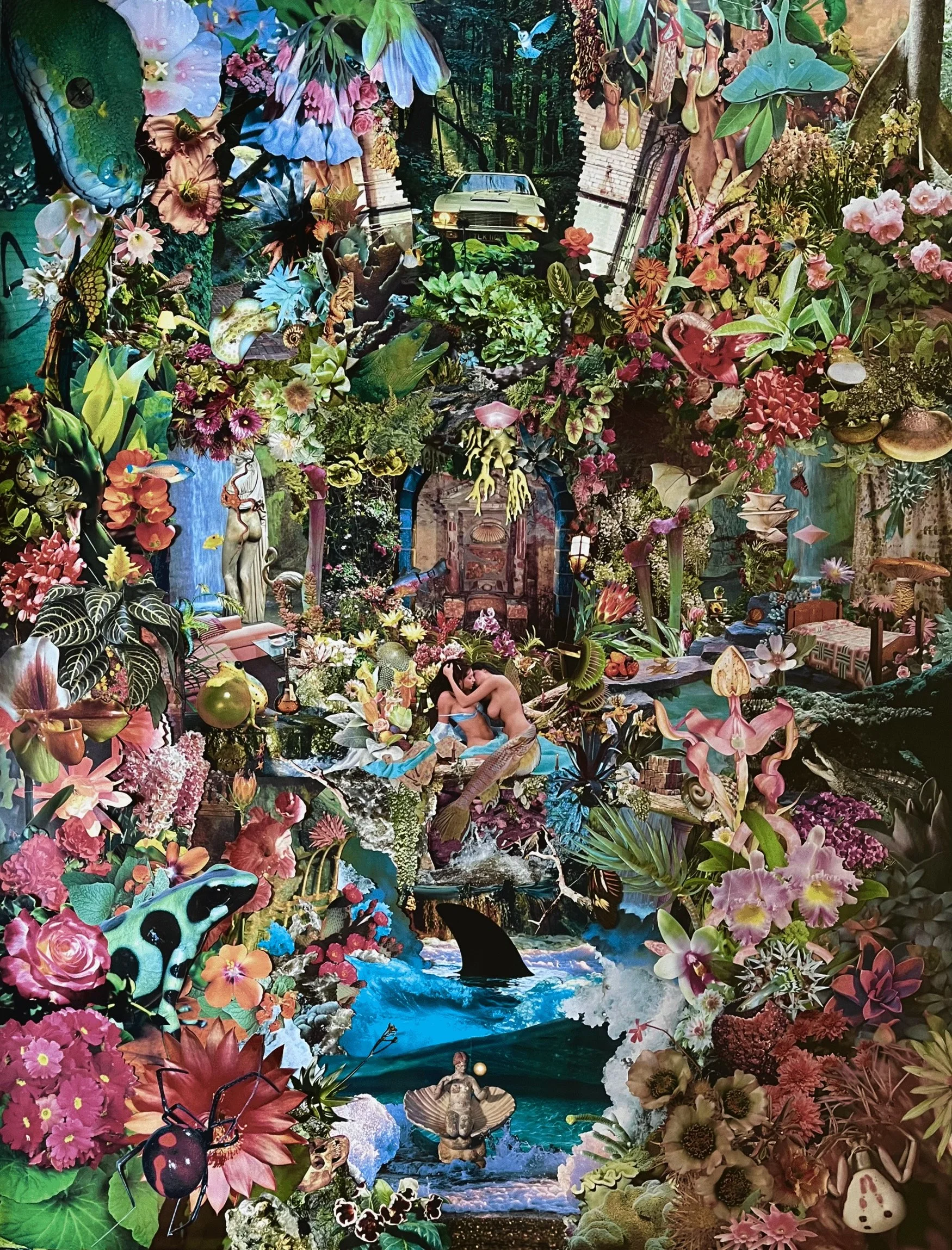
Kiss for Road, 2023. Analog collage on paper, 45 x 60 inches
Interview with William Lukas
October 2025
Hi William! What are you working on in the studio right now?
My latest series, Night Swim. It’s a bioluminescent visual mixtape. A meditation on liminal, nocturnal longing and mono no aware – "the pathos of things" – the fleeting, precarious nature of life and acceptance of its impermanence. It’s a very shoegaze-inspired, end-of-summer, saudades-laden collection. The works are composed of found imagery that I scanned and color graded, then printed and hand-cut. I also tried to recreate the newly discovered “olo” color by experimenting with FedEx’s printer settings.
What are the primary themes of your work right now?
There are recurring queer and ecological themes in my work. I am enchanted by the beauty of unmaking and remixing, of freeing images from their publications’ “origins” – which is often the white male gaze and/or American imperialism and consumerism. My aim is to harmonize disparate pieces so that when taken in as a whole, in totality, like a symphony, they might incite awe. Or carnality. Or a secret third thing – like hope. My work is concerned with what French philosopher and psychoanalyst Félix Guattari called “chaosmosis” – the process by which new meanings and subjectivities are born out of colliding, disruptive ethical and aesthetic forces. I make fine art out of literal trash.
I would say my largest delight (or affront, in some cases) to viewers could be color itself. At some point in the past five years, you may have come across that bleak viral graph showcasing color “disappearing” from the world. The UK-based Science Museum Group released a study in 2020 tracing the mass erasure of color in 7,000 daily life objects, spanning 21 categories, across 220 years (1800–2020). Gentrification [grey] and “beigeification” have mutated neighborhoods, public spaces, and social media feeds into villainously normie and carceral havens. But it doesn’t have to be this way.
What is on your mind a lot recently?
Our current epoch of mass dehumanization. Social speedup. And A.I. slop. I think many people are longing for some sort of cultural haptikós – a return to the sensuous and tactile. Will artists choose to create physical oases of care and wonder outside The Matrix? Or are we simply destined to be sad content mills, indentured to algorithms and their overlords? I think that’s why so many people are down for analog collage: it is counterpoint to digital ennui.
What gets you in a mindset conducive to making work?
First, coffee. Then, beats. Jay Som, TTSSFU, and Faerybabyy are currently on heavy rotation.
What criteria do you follow for selecting materials? How long have you worked with this particular media or method?
I upcycle orphaned print media from bygone eras: vintage posters, encyclopedias, old auto, travel, and plant care magazines. I look for specific hues and textures created by the analog CMYK color separation process of high-speed letter presses (1960s & ‘70s), and the glossier, high rez finishes of digital desktop publishing (late 1980s). I look for specific images of corporeal and organic subjects, images that have hard lighting or are out-of-focus. In my abstract pieces, I create cutouts from the backdrops of fashion editorials where you’ll find strong gradients or color blocking.
I will compile and arrange, and then continuously rearrange hundreds of individual cutouts of a certain color palette, and world-build for a few months before actually getting the gluestick out.
This year marks a decade of working in analog college. While my point of view has always felt consistent, it’s only really been within the last couple of years that I feel like my style – my technical, auratic qualities to convey voice – have more fully crystalized, become more distinguishable. More aligned with what I’m trying to accentuate in the world.
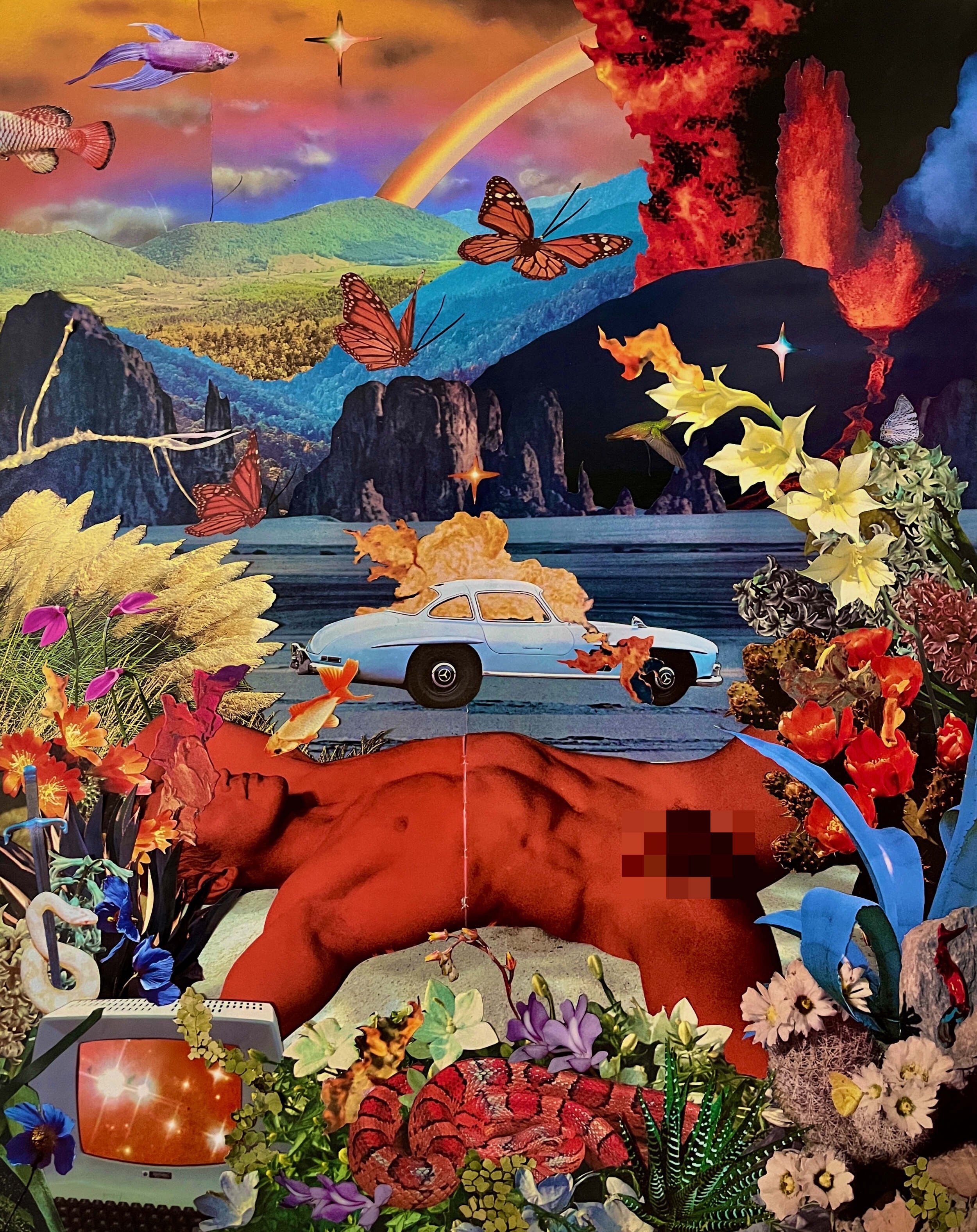
Secret, 2025. Analog collage on canvas, 20 x 26 inches
Can you talk about some of the ongoing interests, imagery, and concepts that have informed your process and body of work over time? How do you anticipate your work progressing in the future?
Analog collage encourages me to engage with history and “aura” – the unique spectral imprint of the artist on the physical work. I believe the tactile nature and punk détournement inherent in analog collage has potential to resist our dominant neoliberal culture of "likeability" and “agreeableness" – art and politics that are void of teeth and passion. South Korean philosopher Byung-Chul Han has explored this phenomenon widely. To me, there is something quite visceral and confrontational about analog collage. It rejects modernity’s screen-mediated melancholy and incites the senses. And I love that.
In the coming years, I hope to collaborate more frequently, and experiment more with format and scale. Perhaps an artbook or large installation is in the queue. I also want to get back into writing and drawing.
Can you share some of your recent influences? Are there specific works—from visual art, literature, film, or music—that are important to you?
I owe so much to my friends and family. They push me to go harder and level up. While my entry point into analog collage was largely informed by the 2010s DIY scene/zine culture, there are nods to earlier influences in my current work: as a kid, I was really into Fern Gully (1992) and Schim Schimmel’s eco-surrealist children’s books; when my parents brought me to museums, I was mesmerized by the explosive grandiosity of Baroque biblical oil paintings.
Political theorists Alexis Shotwell, Achille Mmembe, Silvia Federici, Mark Fisher, and Franco “Bifo” Berardi, and eco-horror lit like Paradise Rot by Jenny Hval and the Southern Reach Series by Jefff VanderMeer have influenced how I think about my relationship to the body, capital, and “nature.” When playing with lighting, color, and composition, I often draw from Nicolas Winding Refn’s atmospheric, hyper-stylized films (Drive (2011), Neon Demon (2016)) and 1970s surrealist cinema (Zabriskie Point (1970), The Holy Mountain (1973)).
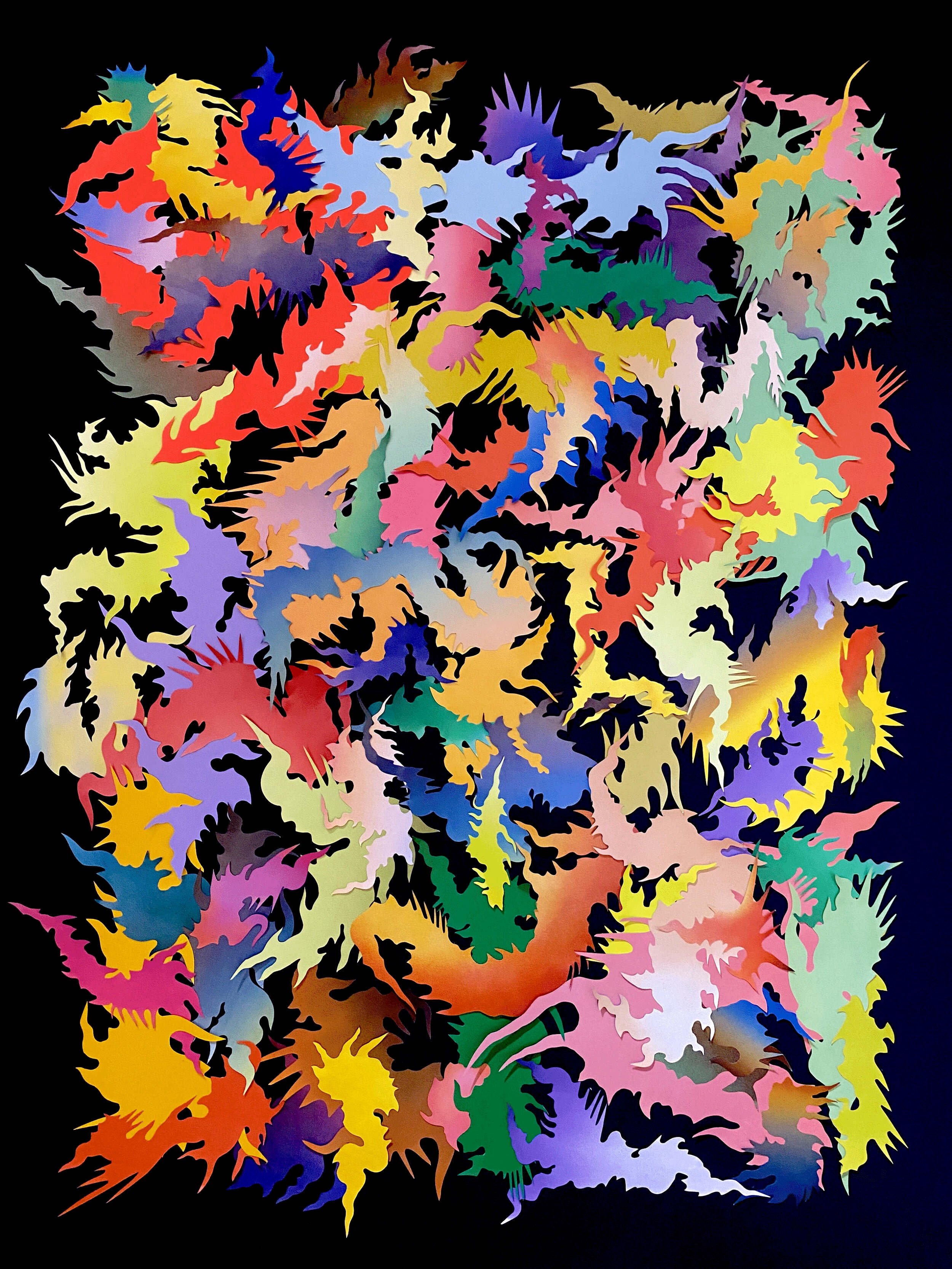
Demon Bae, 2022. Analog collage on canvas, 22 x 28 inches
Who are some contemporary artists you’re excited about? What are the best exhibitions you’ve seen in recent memory and why do they stand out?
Amanda Ba. Kent Monkman. Carlos Martiel. I think about Salman Toor’s 2022 No Ordinary Love (Baltimore Museum of Art) all the time. His expansive use of a green color palette to narrate and convey emotional range is brilliant.
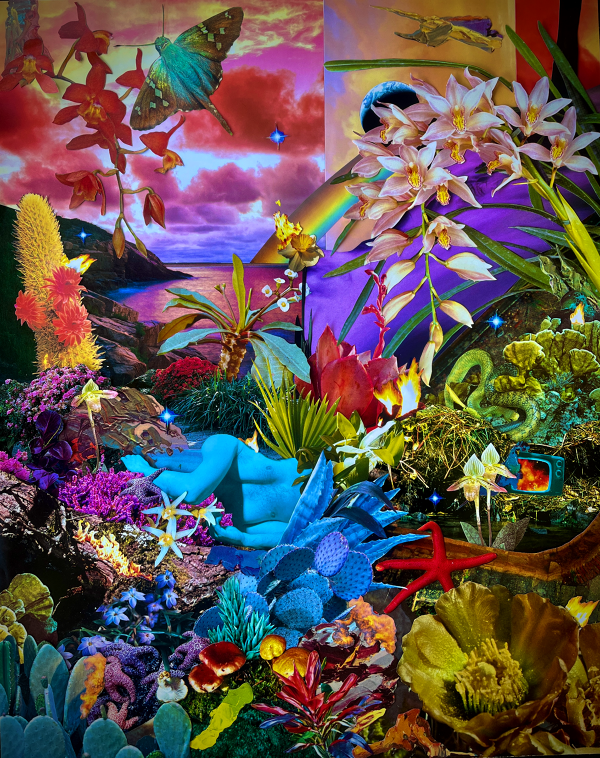
Fever, 2025. Analog collage on canvas, 16 x 20 inches
Do you have any tips or advice that someone has shared with you that you have found particularly helpful?
Embrace surprise! Do the opposite of what people would expect from you.
Thank you for taking the time to talk with us!
To find out more, check out williamjlukas.com