
Olivia Baldwin
I make abstract, two and three-dimensional paintings propelled by color and movement. Temporarily static, the works are multi-sided and often intended to be rechoreographed. I build the work with leather, clay, wire, piping, and other found, recycled, and inherited materials. I’m interested in the stories that materials and objects carry, where they came from, and whose hands or generations they have passed through. Informed by a tactile sensibility, I gather, cut, weave, bind, and embed materials, often arriving at nonlinear processes, like covering copper wire in clay only to watch it crack. A current of grief runs through the objects I make. Using leather, piping, wire, and paint, I mend and reinforce parts of the new forms and render these repairs visible. Hardware plays a similar role in the work—upholstery tacks, snaps, and brads become steccato anchors and hinges, marking the work's construction. I’m suspicious of linear processes. Not having an expected outcome requires me to be present with the work and open to its expanded possibilities. Color is both playful and poisonous. I embrace clashing and incongruous colors and the thrill of trying to make them fit together.
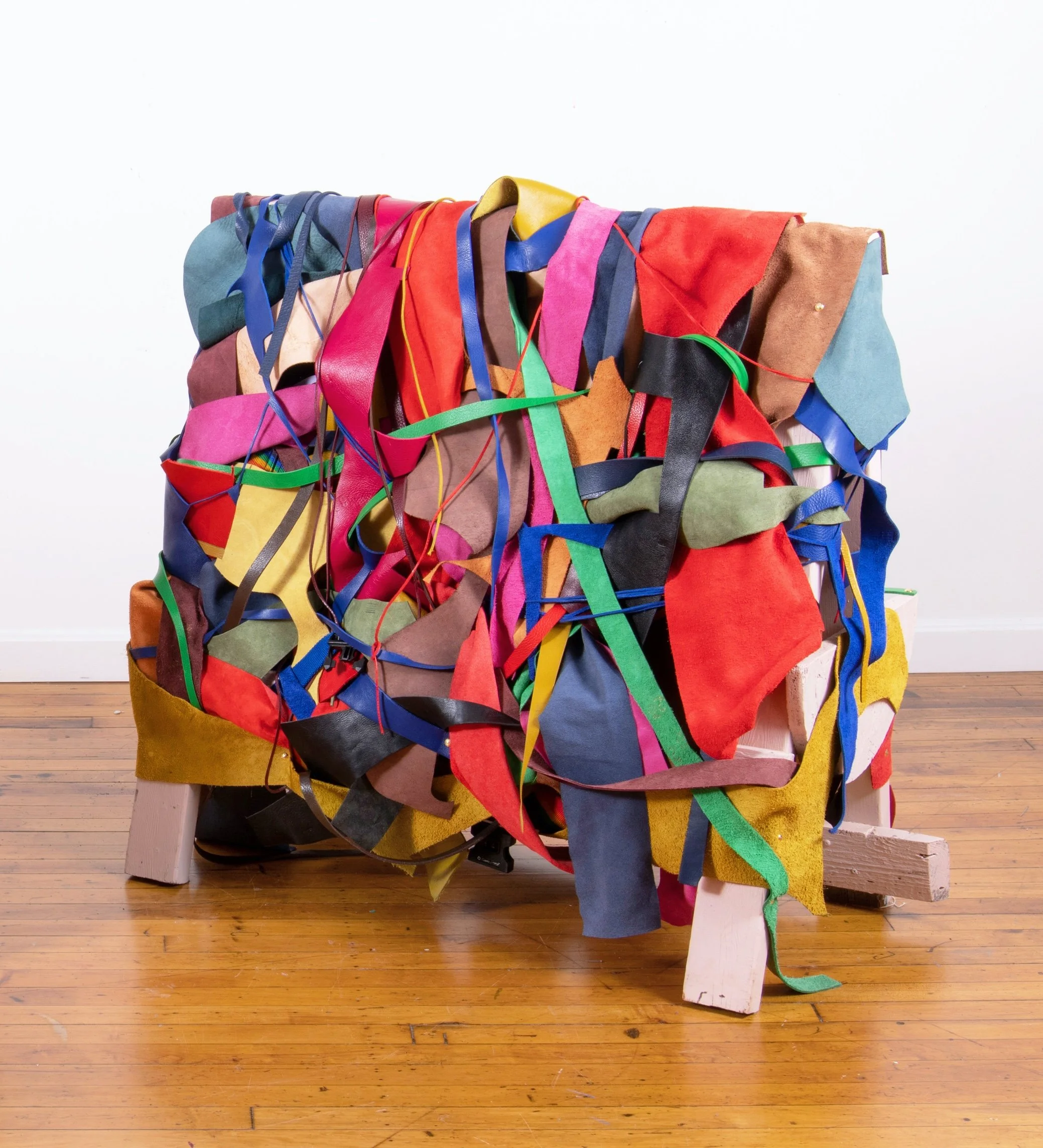
Horse 2, 2025. Scrap leather and suede, luggage straps, upholstery tacks, sawhorse, 36 x 36 x 24 inches
Interview with Olivia Baldwin
Hi Olivia! Can you tell us a bit about your background and how you became interested in becoming an artist? Who or what were some of your most important early influences?
I grew up in the Boston area in a house filled with art and music. My mother was a fashion designer and a skilled seamstress and my father was a musician and educator. They were my earliest influences. My aunt and uncle made me an easel when I was maybe five. Creativity was an imperative, but not one that was stated; it was just present. My brother and I grew up making big messy things, writing, performing, and cooking. I remember the day my mom showed me her art books in the basement, her sewing room. It felt like a whole world.
Where are you currently based and what initially attracted you to working in this place? Are there any aspects of this specific location or community that have inspired aspects of your work?
I live in Providence, RI. My husband and I moved here in the fall of 2020. I had finished graduate school that spring and we wanted to be in a place with more art than the rural Connecticut village where we had spent a few years. Before moving, we’d had good experiences with Providence’s art, music, and writing scenes. Now we’ve been here five years and we’ve laid down roots. There’s a vibrant creative community of artists and writers and I feel lucky to be in their sphere.
About a year and a half ago, I began working with leather that had been my mother’s. It was a continuation of an impulse to use my mother’s materials in my work after she died in 2021. But it was a finite amount and felt precious in a way. Some friends saw the woven paintings I was making and one day my friend Marisa Finos, a sculptor, shared that Lindquist, which designs and makes beautiful vegetable tanned and naturally dyed leather objects in Providence, was offering free scrap leather. Since that time, they’ve been super generous and the scarcity of material I initially felt no longer exists. I’m trying to do it justice.
The Creative Reuse Center, a nonprofit in East Providence with lots of amazing donated materials and remnants, is also a key source for me.
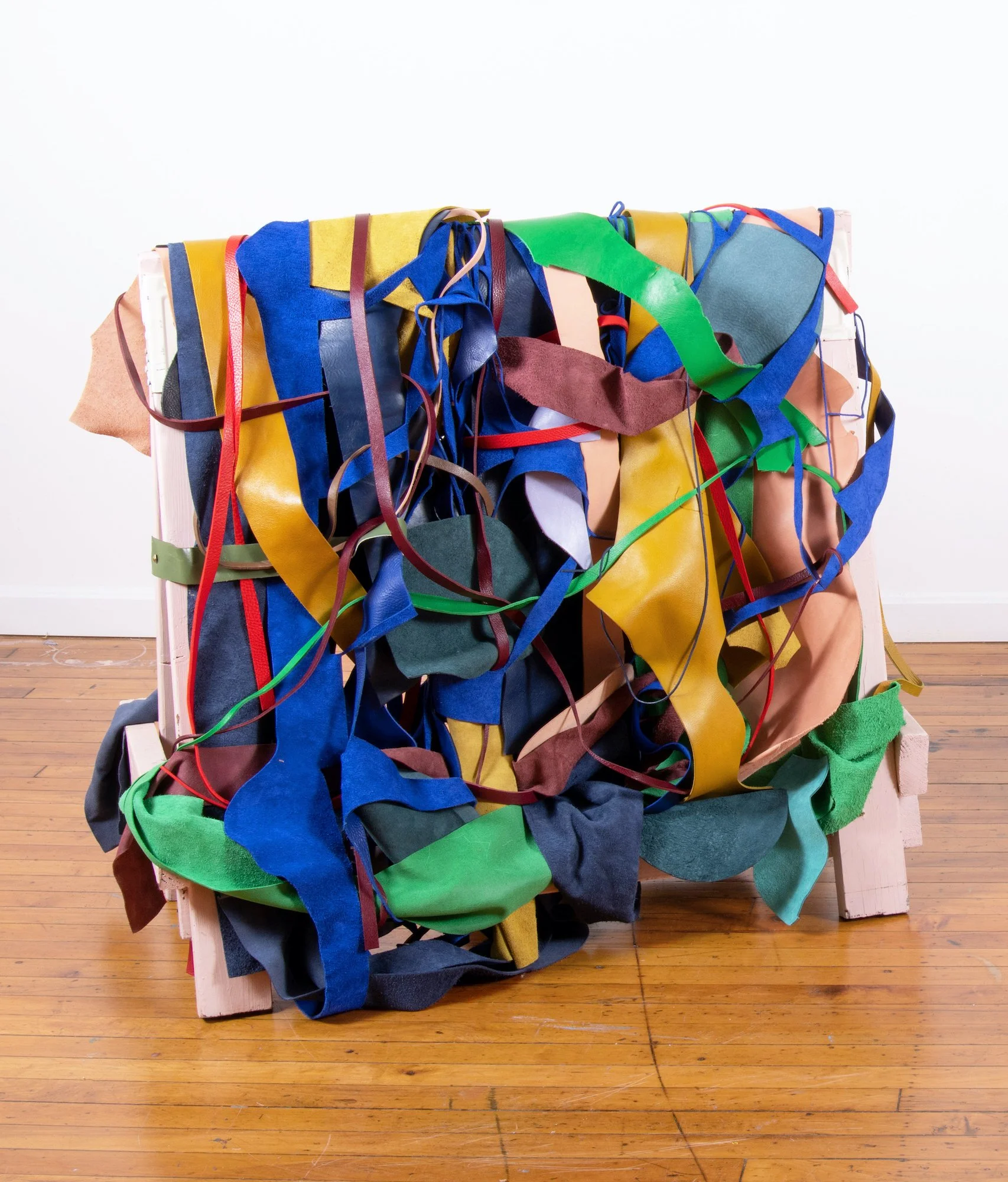
Horse, 2025. Scrap leather and suede, upholstery tacks, sawhorse, 36 x 36 x 24 inches
Can you describe your studio space? What are some of the most crucial aspects of a studio that make it functional? Do any of these specific aspects directly affect your work?
My studio is in a mill building in Pawtucket, RI, right next to Providence. It’s windowless with high ceilings and lots of wall space. I heard good things about the owner and called him every month until he had an opening. Before this one, I had a free studio through a teaching job with ceilings just a couple inches above my head and before that, a shared studio with one functional wall and a lot of sawdust. It’s always interesting to see how the work changes with place and space. My current studio has allowed the work to grow in all directions.
What are you working on in the studio right now?
Right now I’m weaving and bolting leather to a deconstructed boxspring. My friend Kelsey Miller, a multimedia artist, was breaking down a boxspring and had stripped the padding from it when she realized it was exactly the sort of form I would love and had been seeking. It’s structural but also sort of ambiguous. Lately I’ve really enjoyed working with found armatures like this one and the sawhorses.
What are the primary themes of your work right now?
I’m always thinking about relationship; how we live in relationship to one another and what all that means, how it manifests visually, and of course, the give and take involved. I also connect this to grief, which has been a throughline in my life. My dad died suddenly when I was eight and my mom died four years ago after living with cancer for 10 years. Through all of that my mom had this incredible gratitude and will to live and I think a lot about that, and how we continue to live in relationship, even after loss.
Color is fundamental to my work and my studio practice. I see it as both material and shape in the work. It’s integral to my decision-making and often dictates the formal concerns that give it structure.
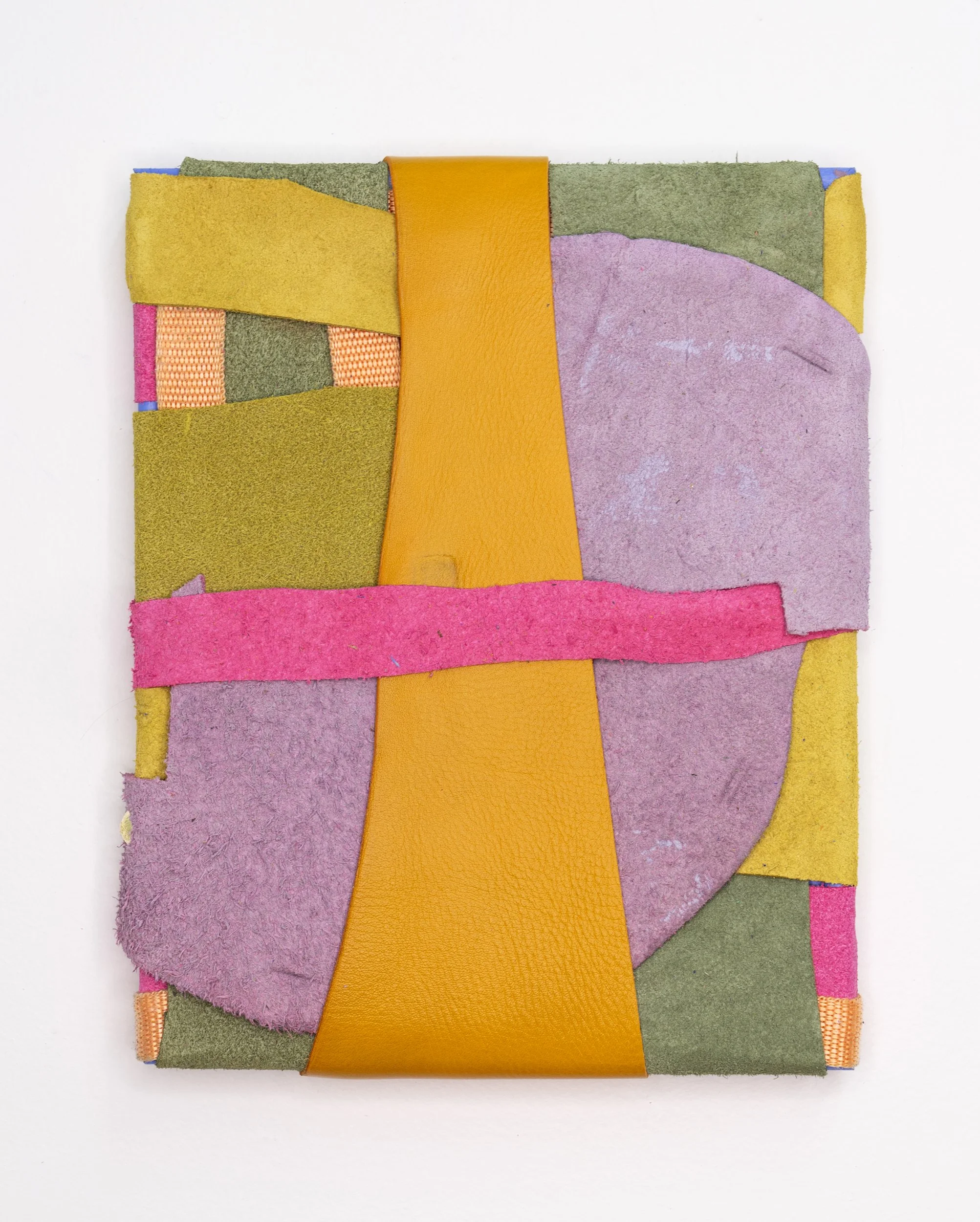
Contact 19, 2025. Scrap leather and suede, upholstery tacks, dog leash, acrylic, 10 x 8 inches
What is on your mind a lot recently?
A couple days ago I was listening to a podcast with curator Naomi Beckwith about Senga Nengudi, whose work I love, and Beckwith used some great descriptors including a “movement-based practice” in describing someone’s work who had been trained as a gymnast. She articulated something I’ve struggled to name in my work. Years ago, I was in a show with Sidney Mullis at Collar Works (Troy, NY) and she referred to sculpture as “spatial choreography” which I also love.
I’ve been a mover since I was a kid and I was an athlete growing up. I need to move a lot to think clearly and feel like myself, and since my work isn’t explicitly about bodies, I’ve struggled to articulate this relationship. But when I started moving three-dimensional material around, or at least creating three dimensions, I hit upon a kind of knowing that I couldn’t get to just through painting. I think part of this is some kind of osmosis related to my mother and her own tactile, material affinities, and part of it is tied to my relationship to movement.
Inevitably, I’m also thinking a lot about connection and community in the face of the horror and brutality of this moment.
What is a typical day like? If you don't have a typical day, what is an ideal day?
My ideal day involves rising early, some kind of movement, then taking our dog for a walk, heading to the studio for the day, and making and/or eating some kind of tasty meal with family and friends.
What gets you in a mindset conducive to making work?
Movement! I just started taking a dance class for the first time in 20+ years, and it’s loosening me up in ways I hadn’t known I needed. And music, podcasts, audio books, snacks, and phone calls. Many of my close friends and family live far away. I try to eat a good meal before I hit the studio, and I usually make a cup of tea before I start working.
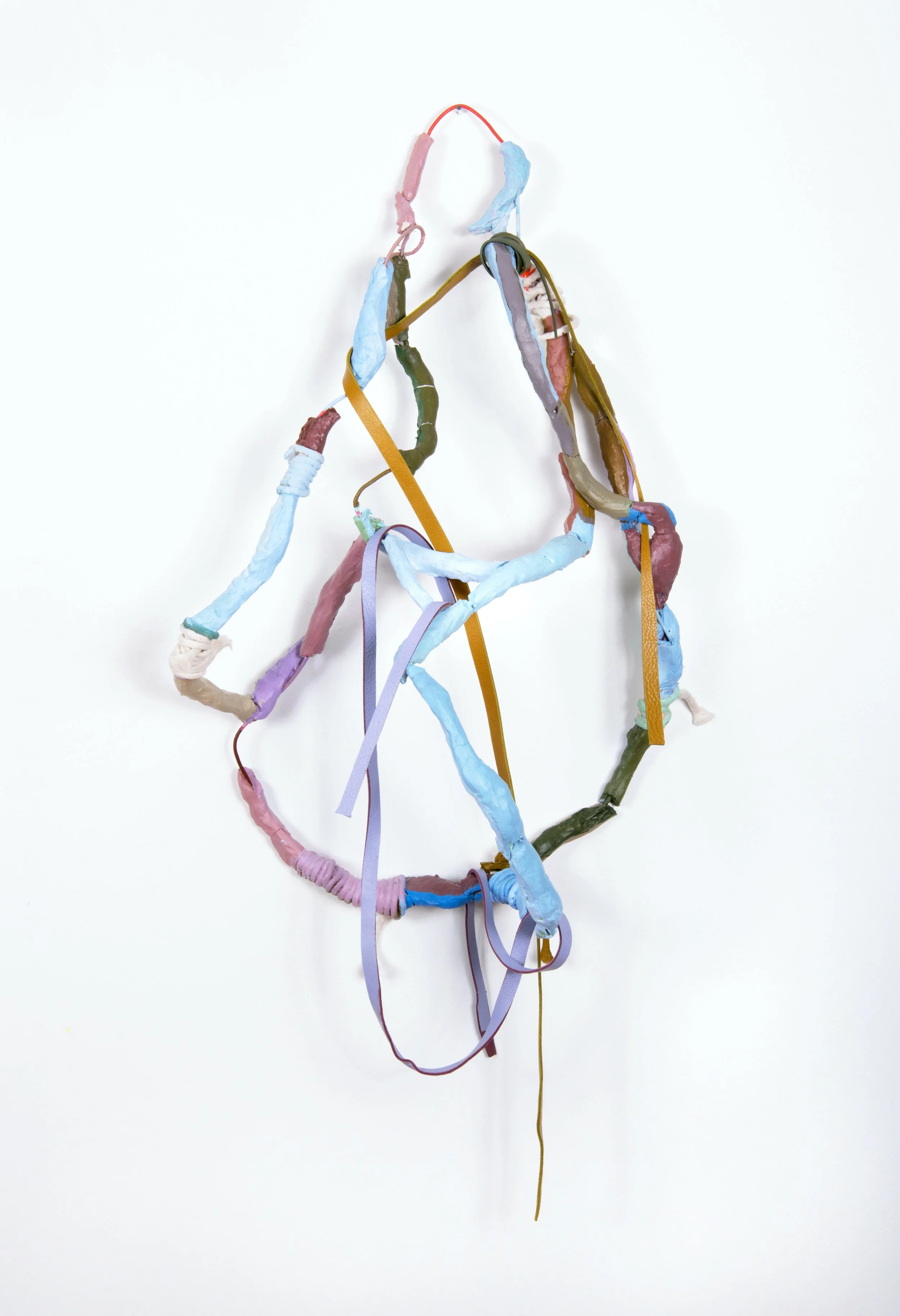
Contact 5, 2024. Inherited mixed grain leather, upholstery tacks, cotton, 12 x 10 inches
What criteria do you follow for selecting materials? How long have you worked with this particular media or method?
I’m interested in remnants and material histories. Over the past 10+ years, much of what I’ve used has been found, inherited, or given to me in some way. I spent several years working with scrap wood from a farm and a saw mill near where I lived in the Hudson Valley, and eventually, friends started leaving wood on my doorstep.
I’ve worked with leather for the past year and a half, and I still feel there’s a lot for me to learn. I use upholstery tacks, brads, and snaps to secure and connect the leather, both because I want these connections to be visible, with the hardware visually punctuating the forms, and because I want to preserve the history of these objects as remnants. I don’t want to disguise them as something else. Recently, I’ve been experimenting with oils on leather as a way of introducing a bit more light into the work, but it’s a work in progress.
Of course, leather carries so many associations. The fact that I’m working with animal skin is something I think about, and I’m still thinking through exactly what this means for me. I had a farm stint in my early twenties where I moved about 20-25 beef cows between grazing fields, ensuring they had enough water, and so on. I’m not saying I have much experience with cattle, but I do have some context. In the years between then and now, I made many forms that resembled hides, but it always came as a surprise. It feels like there’s something cyclical at play.
Can you walk us through your overall process? How long has this approach been a part of your practice?
I work on several things at once. Right now, I have a few stretched woven leather works of various scales in progress, alongside the deconstructed box spring. When I’m responding to an armature like the box spring, it’s a gradual and intuitive process, in which I’m crouching and crawling on the floor, hand weaving elements, securing them as I go, and frequently backing up. I try to use the scrap leather from Lindquist in the shapes that I receive, but I will cut them as needed. For a while, I wouldn’t cut any. It was an unconscious constraint I adopted. I have these tendencies, and they’re often more prohibitive than constructive. In college, for a period, I tried to use as little white as possible in my paintings, which is just a bad idea.
I try to take a lot of photos of the work as I’m making it. It gives me a bit more distance and helps expose gaps and shortcomings that I’m otherwise too close to the work to recognize.
I’m a color maximalist and sometimes I give myself color constraints. I give thought to the found materials and armatures I use.
The work is otherwise very process-driven. I tend to make sense of it after the fact. When I try to work from a sketch or a more decisive plan, I feel constrained and the work suffers.
Can you talk about some of the ongoing interests, imagery, and concepts that have informed your process and body of work over time? How do you anticipate your work progressing in the future?
Color and materiality are constants in my work. I’m comfortable with fragmentation and find the challenge of puzzling things together satisfying. I love poetry and draw inspiration from its hinges, gaps, and forms. I don’t do well with linear processes. Often, once I find a system for making a particular kind of work, I lose interest and feel compelled to pivot.
In the future, I anticipate color and materiality will remain core to my work. There’s much more I want to learn, and lately I’ve missed painting.
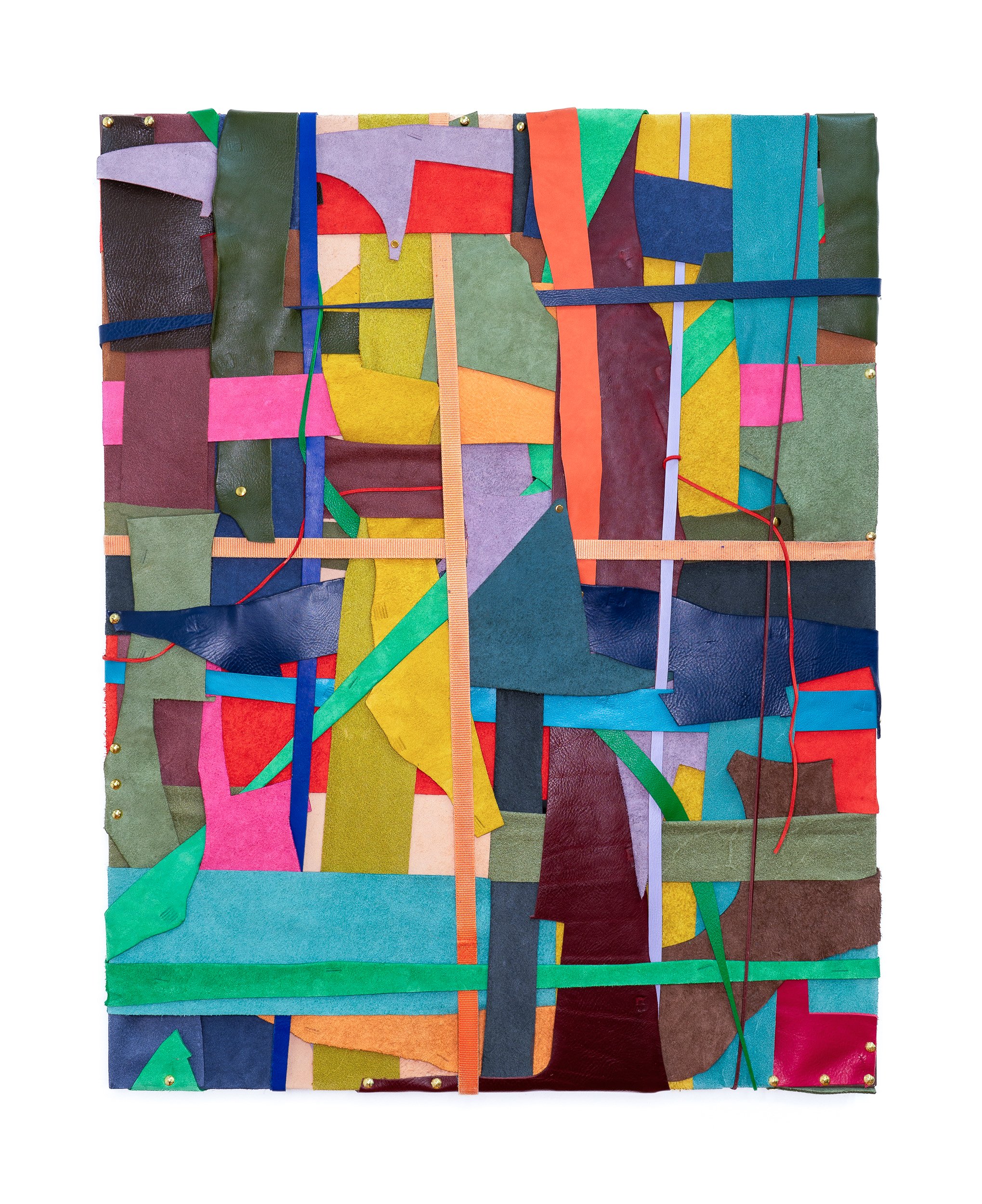
Second Side, 2024. Wire, clay, acrylic, leather, welting, 44 x 24 x 13 inches
Do you pursue any collaborations, projects, or careers in addition to your studio practice? If so, can you tell us more about those projects, and are there connections between your studio practice and these endeavors?
I curate a gallery in Brandeis University’s Women’s Studies Research Center and I value the opportunity to collaborate with artists and work closely with students. I also teach studio art at Babson College, where I get to work with really wonderful business and engineering students (from Olin College). I’m constantly learning from my students. Some of my recent installation-based work, even the Horse series to a degree, are informed by still lifes I built for my drawing students.
Over the years I’ve also been lucky to be a part of a community art space, a couple of festivals, and many smaller artist-run projects, all of which inform my approach to community and my belief in sharing opportunities and investing in one another’s practices.
Can you share some of your recent influences? Are there specific works—from visual art, literature, film, or music—that are important to you?
Teresa Baker, Helen O’Leary, Sangram Majumdar, Anna Hepler, Sonia Gomes, Annabeth Rosen, Meghan Brady, Yevgeniya Baras, Sophia Flood, Salman Toor, Aubrey Levinthal, Jennifer Packer, Eleanor Anderson, and friends’ work.
Claire-Louise Bennett’s Pond, Carole Maso’s Ava, Bhanu Kapil’s The Vertical Interrogation of Strangers, Lydia Davis, Etel Adnan, many of Maggie Nelson’s books, Lauren Elkin, and friends’ work.
Adrianne Lenker and Big Thief, Waxahatchee, Frazey Ford, Leif Vollebekk, Otis Redding, Dan Reeder, John Prine, Umm Kulthum, Tems, and Anaïs Mitchell. I’ve been listening to Amaphupho by Trinix Remix and Onset Music Group on repeat, especially during tougher runs and redundant studio tasks. Also Superlover by Allison Russell, Luther Dickinson, and Birds of Chicago, and Bleachers’ cover of The Whole of the Moon.
Who are some contemporary artists you’re excited about? What are the best exhibitions you’ve seen in recent memory and why do they stand out?
I just saw the Ruth Asawa retrospective at MoMA and it moved me. It’s a massive show and I was struck by how she stuck with certain strategies of making for many decades, and how these bodies of work continued to evolve, how she might turn a gesture on its head. I loved learning more about her community work with youth and seeing her flower drawings. The show left me hungry to draw.
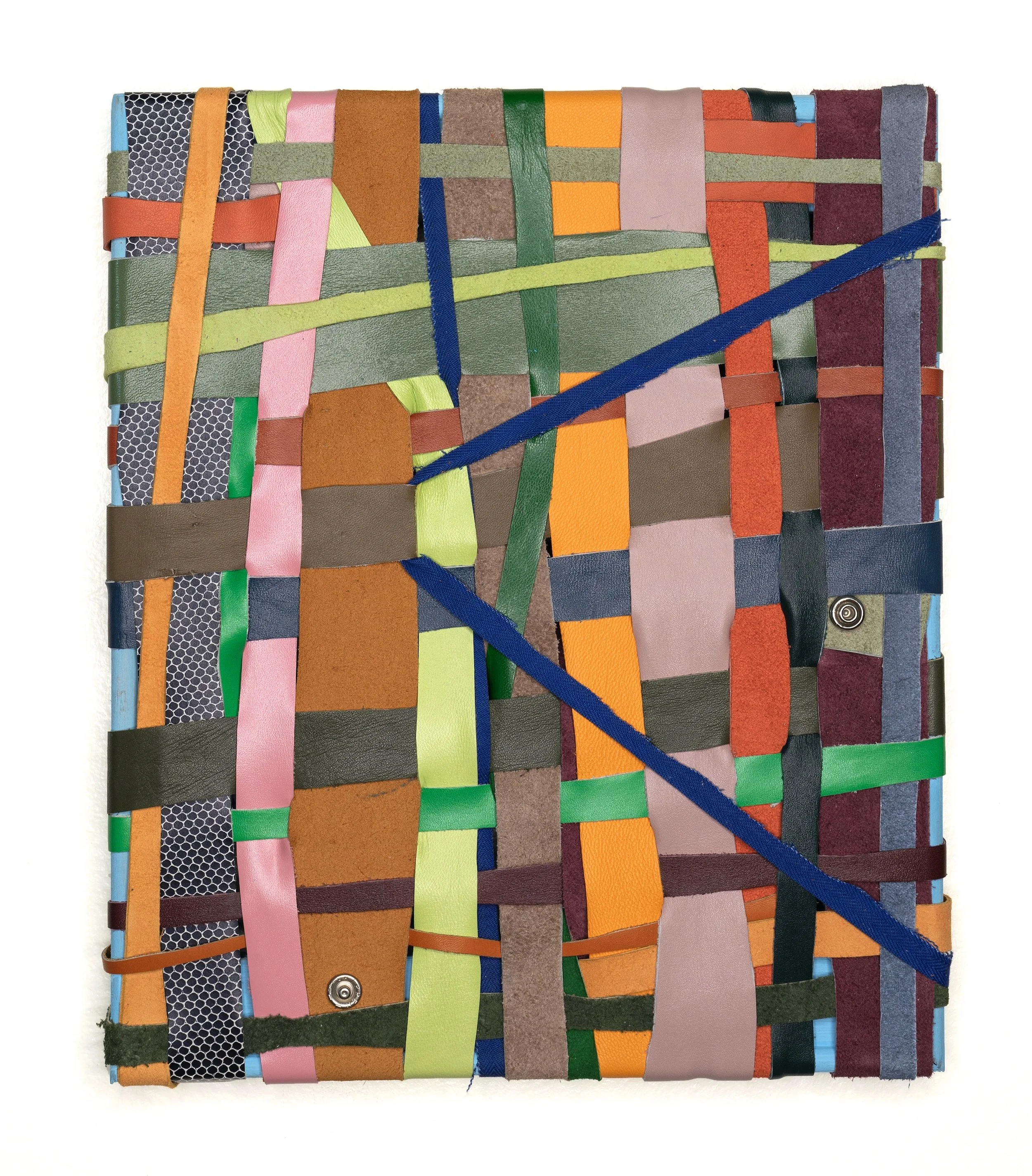
A Long Lead, 2025. Scrap leather and suede, upholstery tacks, brads, acrylic, dog leash, 38 x 30 inches
Do you have any tips or advice that someone has shared with you that you have found particularly helpful?
My mother used to say that a painting needs poison. My grandmother used to say that dirty hair helps a braid stick. Some kind of friction or oppositional impulse is essential in making art.
Fall loose! That came from a soccer coach many years ago in a Boys & Girls club gym, but I think about it often. Fall loose so you can get back up easily. I think of falling in relation to failure. Fail loose so you can get up easily and get back to work.
I feel lucky to know a lot of people who gather together in community and make things happen on their own when they aren’t happening externally. I think it’s essential to build a community, support a community, invest in one another’s practices, and create the kinds of spaces we want to be a part of.
What’s coming up next for you?
I’m working toward a two-person show opening in January 2026 with Babs Owen at OVERLAP (Newport, RI), and a couple of exciting group shows in the Fall of 2026.
Anything else you would like to share?
Thanks for this opportunity!
Thank you so much for sharing your work and talking with us!
To find out more about Olivia and her work, check out her website.