
Mia Brown-Sequin
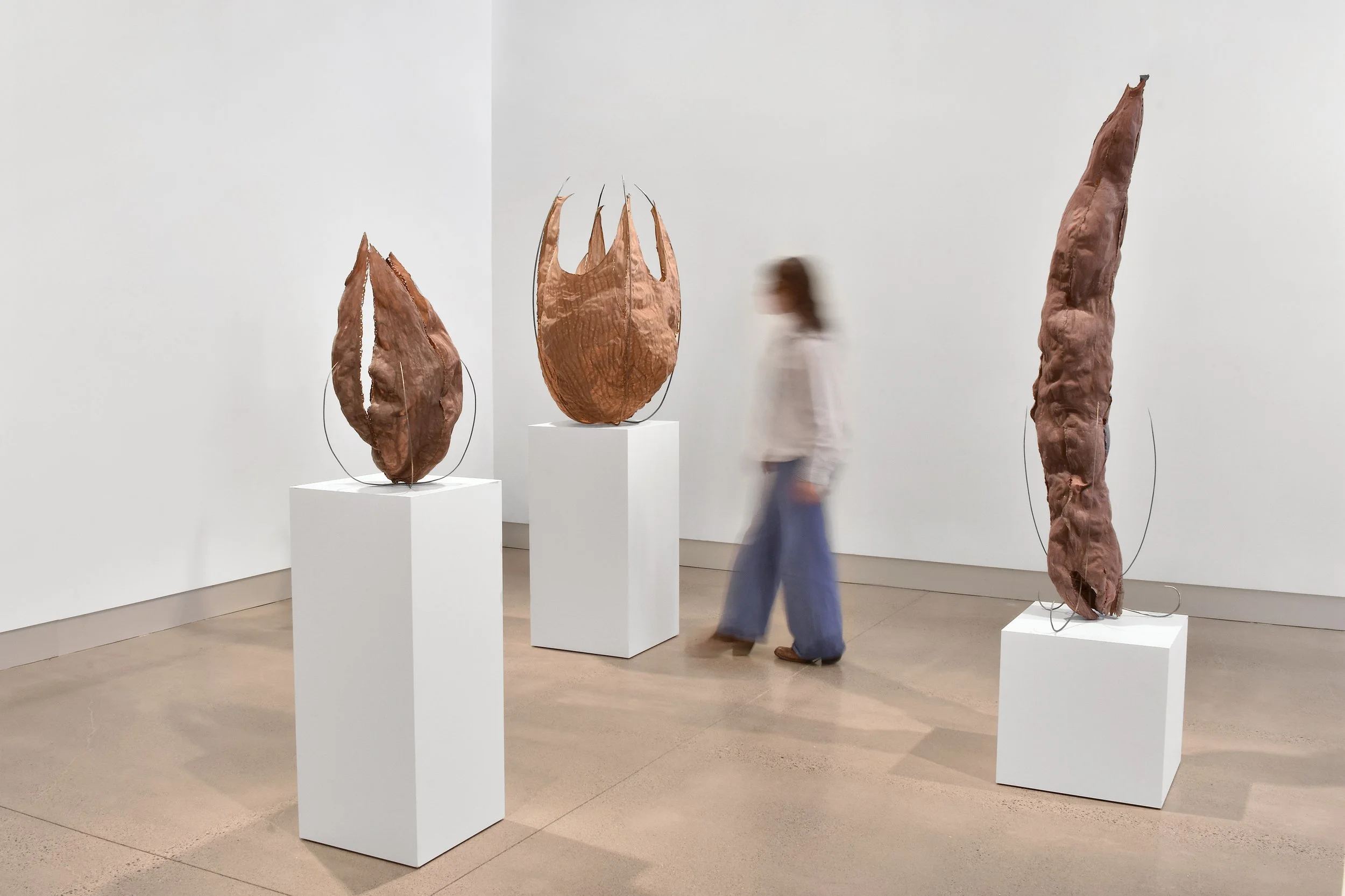
Morphology, 2026, Installation View
Interview with Mia Brown-Seguin
Questions by Sidney Mullis
You come from a sculpture background and arrived at papermaking through your own curiosity and discovery. What first drew you toward papermaking as a way of building forms in space?
Before discovering papermaking, I made sculptures with human hair, ice, soil, and grass. I was interested in transforming raw materials into everyday objects, questioning industrial production and our growing distance from the things we consume. I was interested in the stories materials carry and drawn to the familiarity of fiber.
Flax processed in a hollander beater reminds me of stacking bales of hay and mucking stalls. My time as an equestrian and farmhand instilled a deep connection with land and materiality. Working with fiber deepened this connection and sparked curiosity about traditional craft and its communities. Fiber exists across cultures in utilitarian, ritual, and artistic forms, from clothing and basketry to burial practices and domestic objects. I admired these traditions and sought ways to push the boundaries of fiber, transform the mundane, and redefine sculptural casting.
Papermaking allows me to reimagine organic material as sculpture. Pulp behaves unlike any other sculptural casting material. It is delicate, deceptively strong, and defiant of conventions. It aligns with the questions I was already asking about labor, permanence, and our relationship to the natural world.
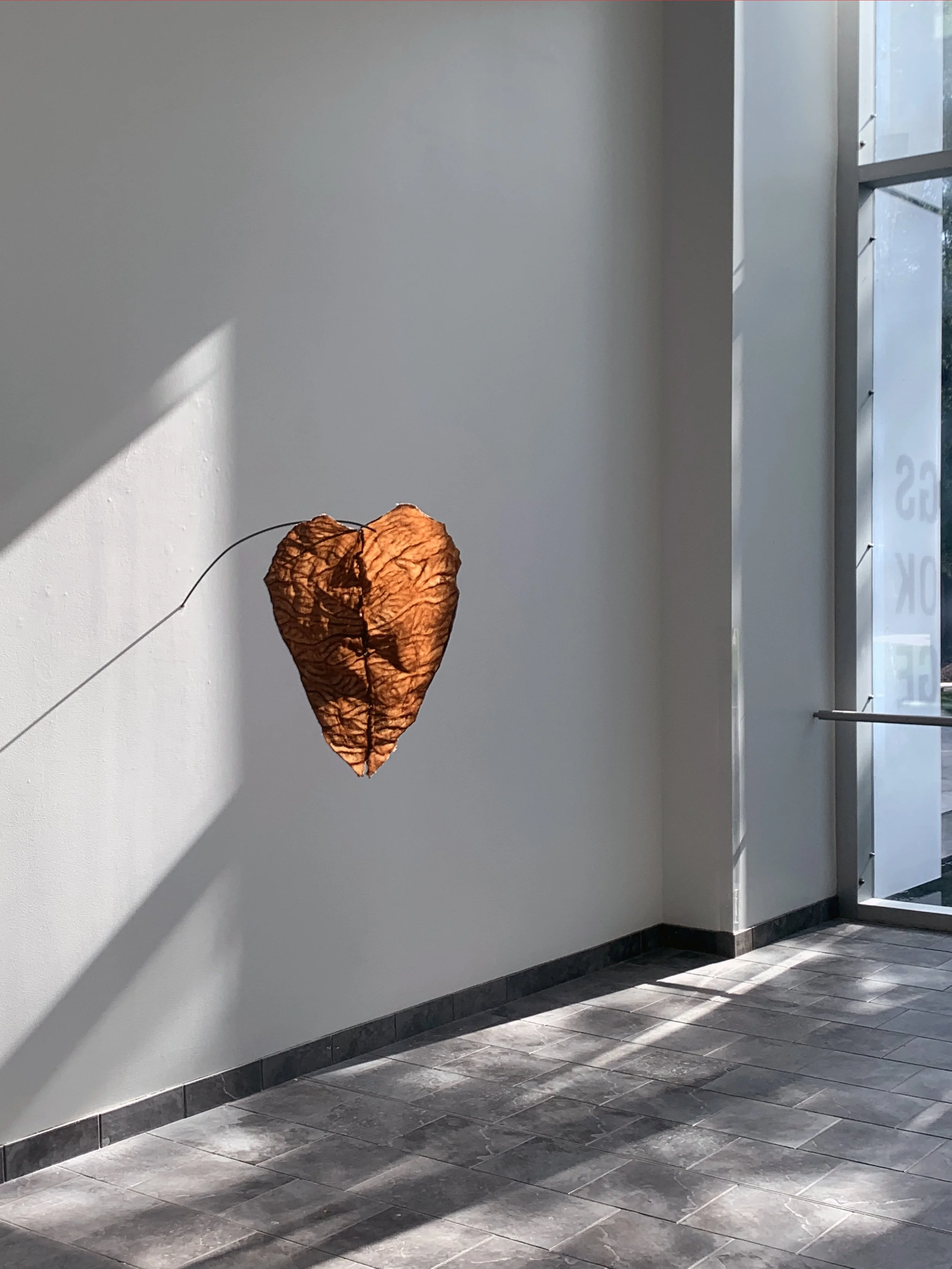
Seed Coat, 2025. Laminate Cast Handmade PaperSculpture, Hemp and Abaca Fibers, Steel, 24 x 18 x 12 inches
For years, you’ve developed a distinctive process for creating large, hollow paper forms that combines overbeaten paper pulp, large hand-pulled sheets of paper, sewing, and muslin. Could you walk us through how that process developed?
When I began working with handmade paper, I was simply curious about its translucent qualities and casting potential. I wanted to create regenerative sculptures that embody circular economies while fostering reciprocity and sustainability, while achieving bodily forms that read like flesh, silicone, or parchment.
When processing fiber into a pulp, there are many variables that can be controlled. A shorter fiber, like cotton linter, beaten for a short period of time, remains soft, yet has the potential to cast precise detail. A longer fiber, like the bast fiber of flax, processed for long periods of time, yields translucence, shrinkage, and strength.
I tested recipes and different sculptural applications, struggling to find a mold material and workable balance that provided translucence and cast detail. Then I discovered that handmade paper can release from bisque-fired ceramic. I created organic ceramic forms and wrapped them in sheets of wet paper, meticulously releasing the paper from the mold once dry and reconstructing the forms. As I tried to scale up, more challenges arose. My ceramic journey left me wondering if the handmade paper product was the sculpture or if the mold itself may have been.
It wasn't until my first time at Penland School of Craft that I began patterning soft sculpture forms with muslin. I had the ability to form larger sheets and learned the chemistry behind the mystical qualities of paper. This breakthrough allowed me to scale up and create hollow, handmade paper forms without internal armatures or adhesive.
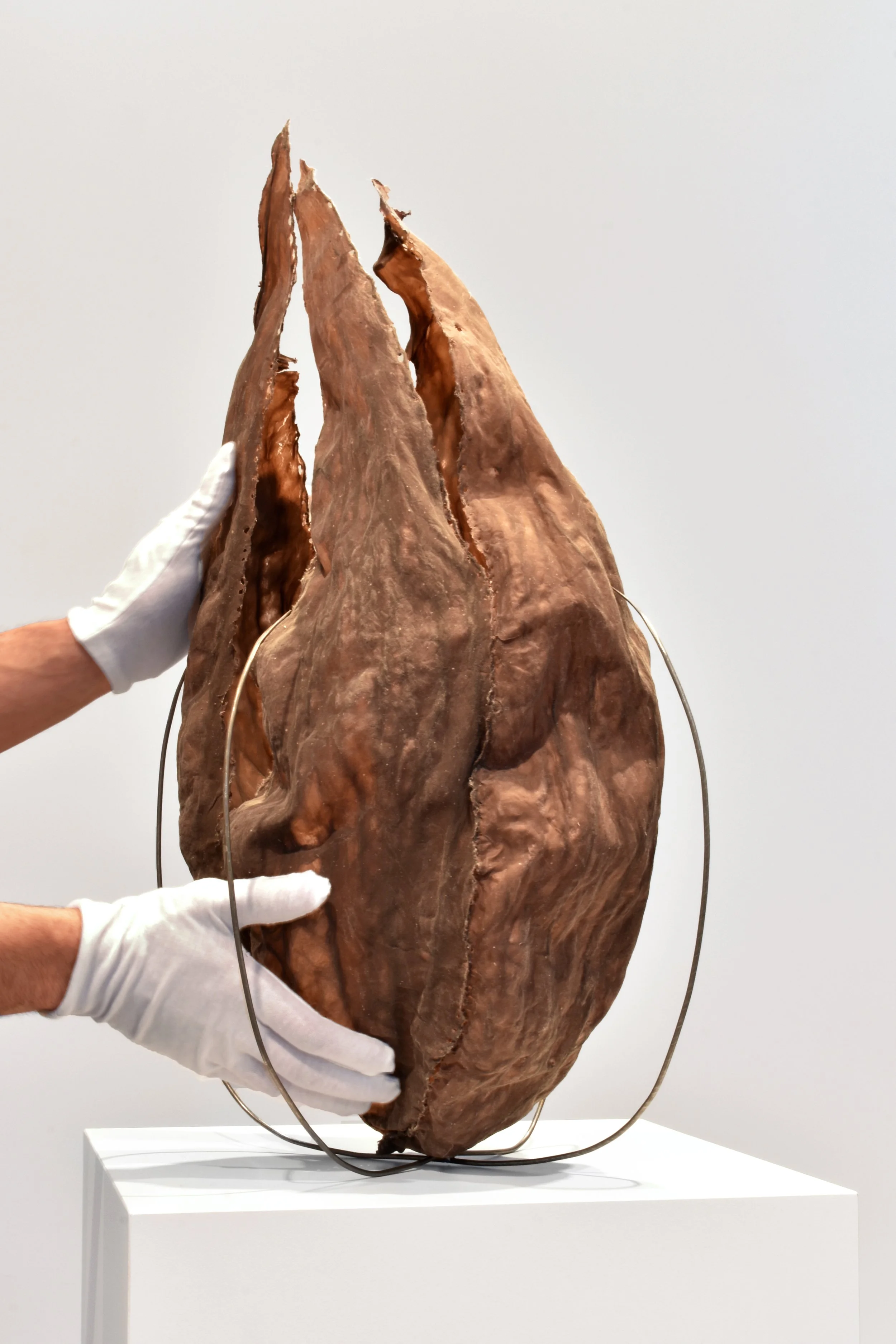
Devils Claw (detail), 2026. Handmade Paper Sculpture with Welded Steel Base, Abaca and Hemp Fibers, 16 x 16 x 25 inches
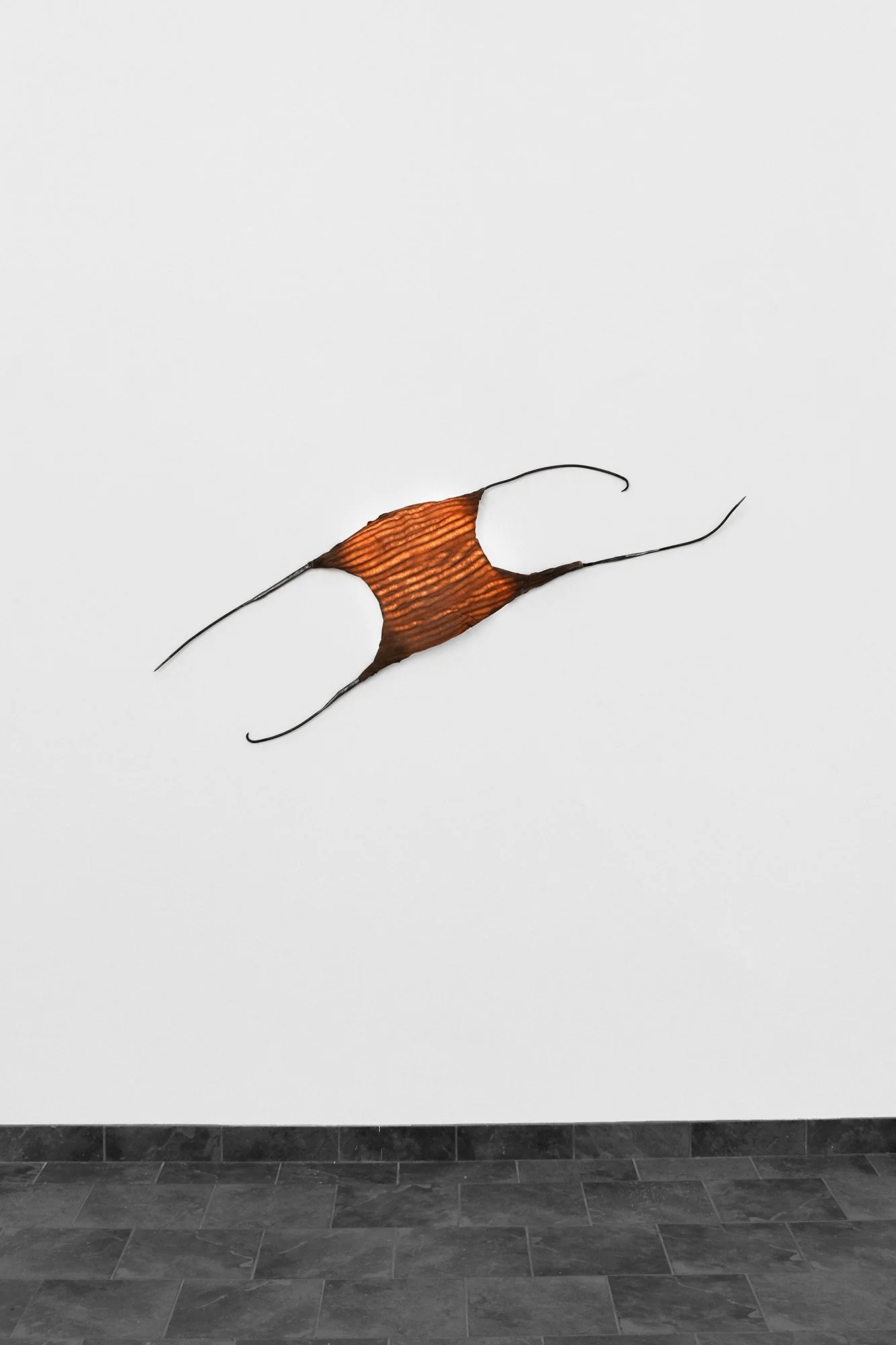
Mermaid's Purse, 2024. Laminate Cast Handmade Paper Relief Sculpture with Welded Steel Armature and LEDs, Abaca and Hemp Fibers, 3 x 1.5 x 0.5 feet
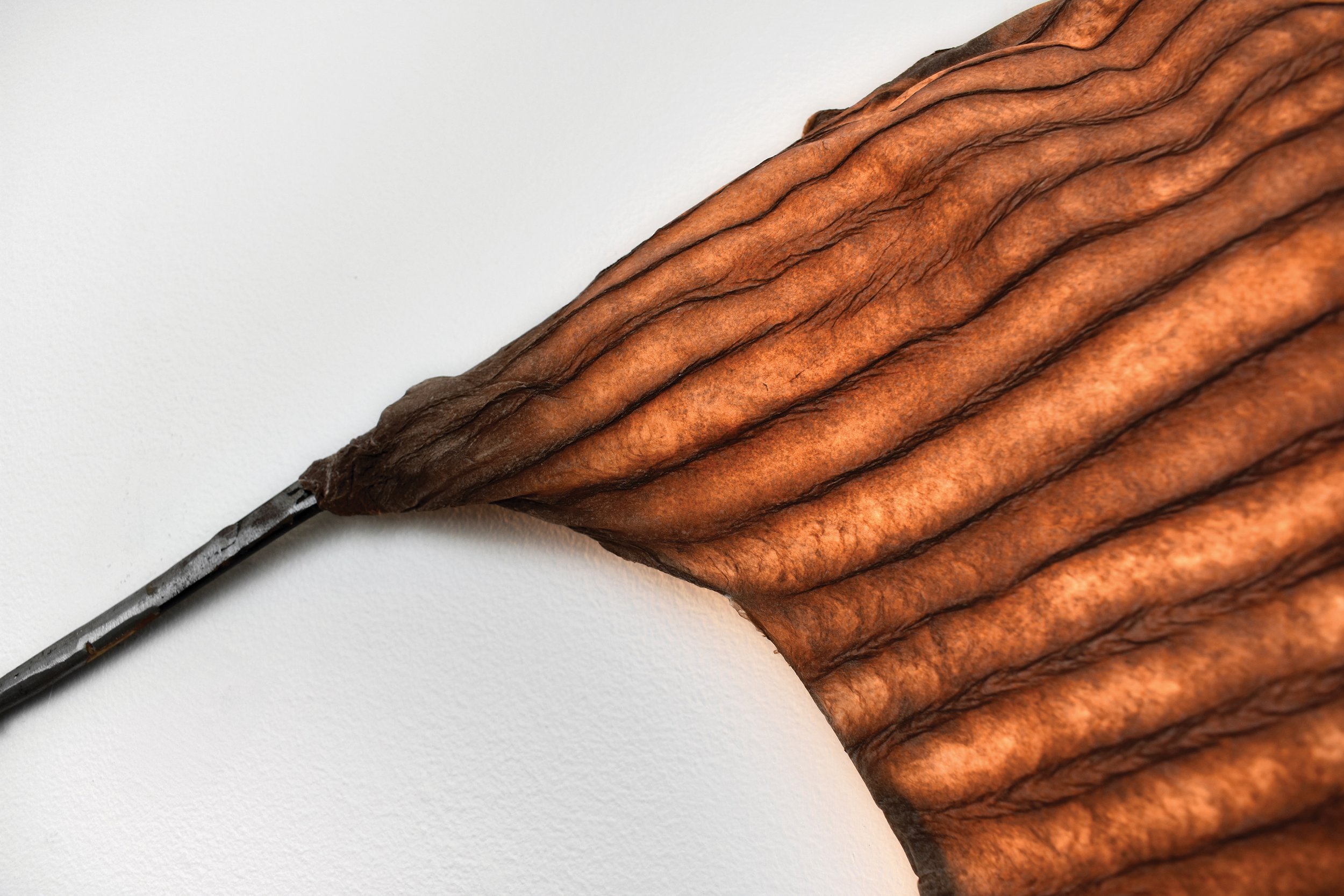
Mermaid's Purse, 2024 (detail). Laminate Cast Handmade Paper Relief Sculpture with Welded Steel Armature and LEDs, Abaca and Hemp Fibers, 3 x 1.5 x 0.5 feet
Many of these large paper forms begin with muslin structures that temporarily support and shape the work. Recently, you cut apart those muslin molds, pulped them, and transformed them into 866 sheets of paper. What did it mean to pulp the muslin and allow it to transition from mold back to flat sheet?
Serving as keys, shells, and molted skins of my sculptures, the muslin pattern pieces felt nearly as meaningful as the sculptures themselves. It was important to me that this byproduct of my practice could be repurposed while carrying meaning into a new life.
Toward the end of my residency at Contemporary Craft, I processed nearly ten pounds of muslin, cutting it into small squares, then beating it in the hollander beater. I formed 866 sheets of handmade paper in the span of two weeks. The countless hours spent processing fiber and sheet forming were cathartic.
As my sculptures resemble seeds and pods, I think of them as vessels of fate. Processing the archive of molds became a ritual of dissemination. It is a way of allowing past forms to germinate into future work.
Your practice occupies a space between papermaking and sculpture, drawing from the histories and techniques of both. What possibilities have emerged from working between those disciplines?
Working between papermaking and sculpture has allowed me to move fluidly between two communities that have historically operated under different systems of value. As a conceptual artist, working in dialogue with craft histories illuminates the themes of gender, labor, and materiality that run through my work. As a handmade paper sculptor, engaging with fine art and sculpture communities provides me with a platform to elevate the field of papermaking and advocate to preserve its tradition.
Your sculptures often evoke seed pods, shells, eggs, vessels, or botanical forms without fully becoming any one thing. What draws you to forms that remain suspended between recognition and invention?
Recognizing and naming species in the environment is beautiful. It fosters stewardship, reciprocity, understanding, and appreciation. At the same time, the impulse to classify in the name of discovery challenges me. My work exists in conversation with both art and science. It draws on ideas of symbiotic relationships, ecology, sustainability, and environmental politics. I am particularly interested in the role of institutions in collecting and archiving knowledge and in constructing systems of taxonomy.
Lately, I have also been reading and watching a great deal of science fiction. I have always thought of my artistic practice as a way of searching for understanding. The boundary between what exists and what is imagined, what is true and what is fabricated, fascinates me. My sculptures inhabit that uncertain space. They are intended to read as symbols of fertility, beings that may or may not have been classified, identified, or even discovered yet. In that sense, they exist within an entirely independent archive.
“...Truth is a matter of the imagination. The soundest fact may fail or prevail in the style of its telling: like that singular organic jewel of our seas, which grows brighter as one woman wears it and, worn by another, dulls and goes to dust. Facts are no more solid, coherent, round, and real, than pearls are. Both are sensitive.”
—The Left Hand of Darkness, Ursula K Le Guin
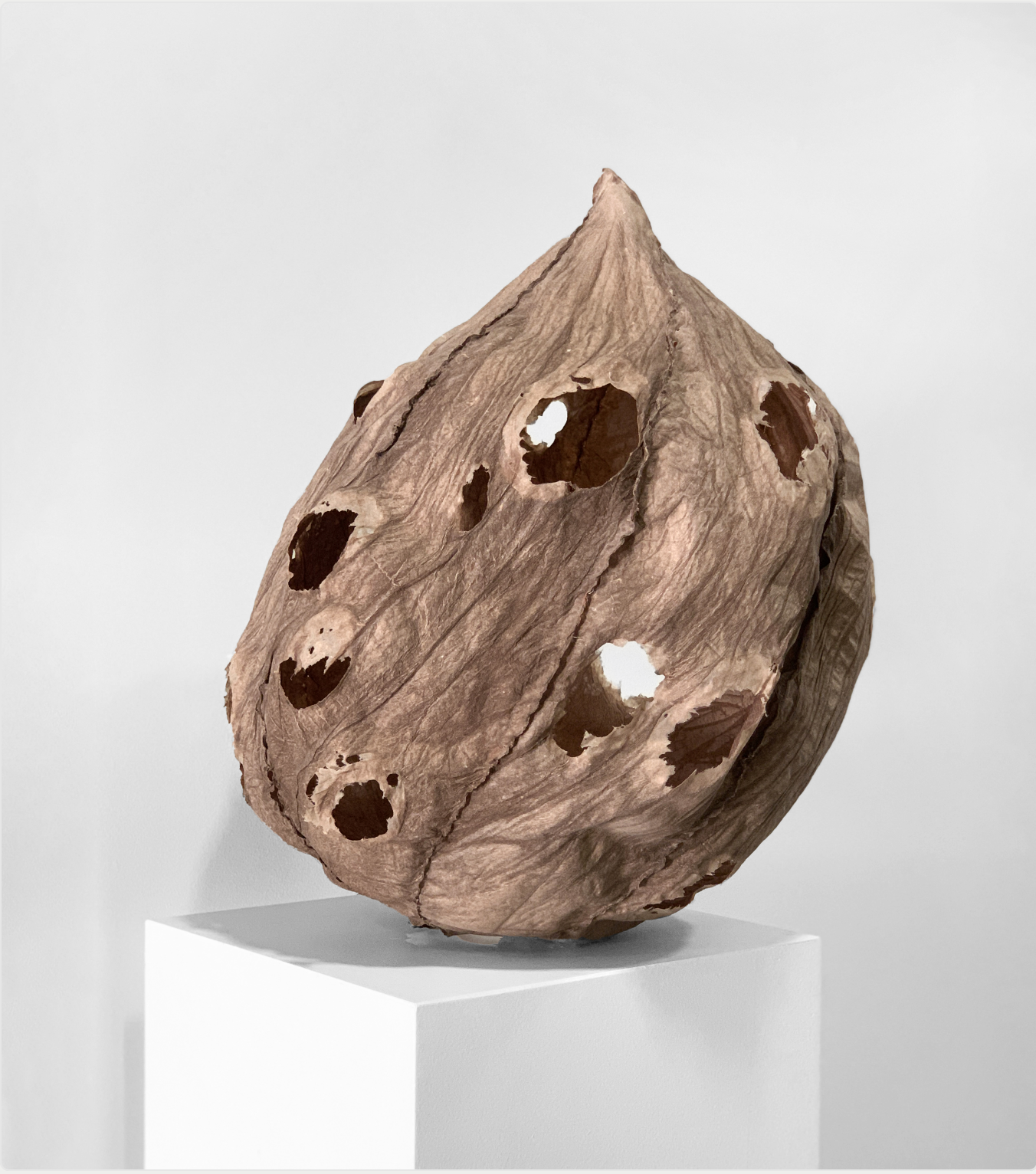
Blister Pod, 2025. Laminate Cast Handmade Paper Vessel, Abaca and Hemp Fibers, 28 x 26 x 26 inches
Paper is often associated with delicacy and impermanence, yet your sculptures possess a strong physical and spatial presence. What interests you about creating forms that feel simultaneously vulnerable and resilient?
As hollow vessels made from handmade paper, my sculptures embrace a sense of vulnerability that reflects the uncertainty of what they may become. Yet when these symbols of fertility are scaled larger than life, they occupy space in ways that feel unfamiliar and commanding. Their presence challenges both the material possibilities of handmade paper and cultural expectations of the feminine.
As my work has evolved, I have become increasingly interested in plants' defensive armor. In Devil's Claw and Pseudoproboscidea parviflora, for example, handmade paper forms rest above welded metal involucres of sharp, thorn-like elements. The juxtaposition of delicate paper and rigid metal allows me to explore questions of power, strength, protection, and resilience.
Whether working with the Hollander beater, charging a vat, or forming large sheets of paper, your practice often involves sustained physical labor, attention, and endurance. How has the body shaped the development of the work?
Papermaking has long been my purpose in life. Some folks wake up excited to walk their dog. I wake up thinking about making more pulp. The repetitive acts of forming sheets, stitching by hand, listening to water trickle from a freshly pulled sheet, and simply being attuned to the studio allow me to process what I cannot find the words for.
Long studio days are where I find solace, yet the physically demanding endurance of making has changed my relationship to my body. Working at the scale and intensity I tend toward requires me to be attuned to my body’s needs. Sheet forming is like a dance, and yes, it requires stretching.
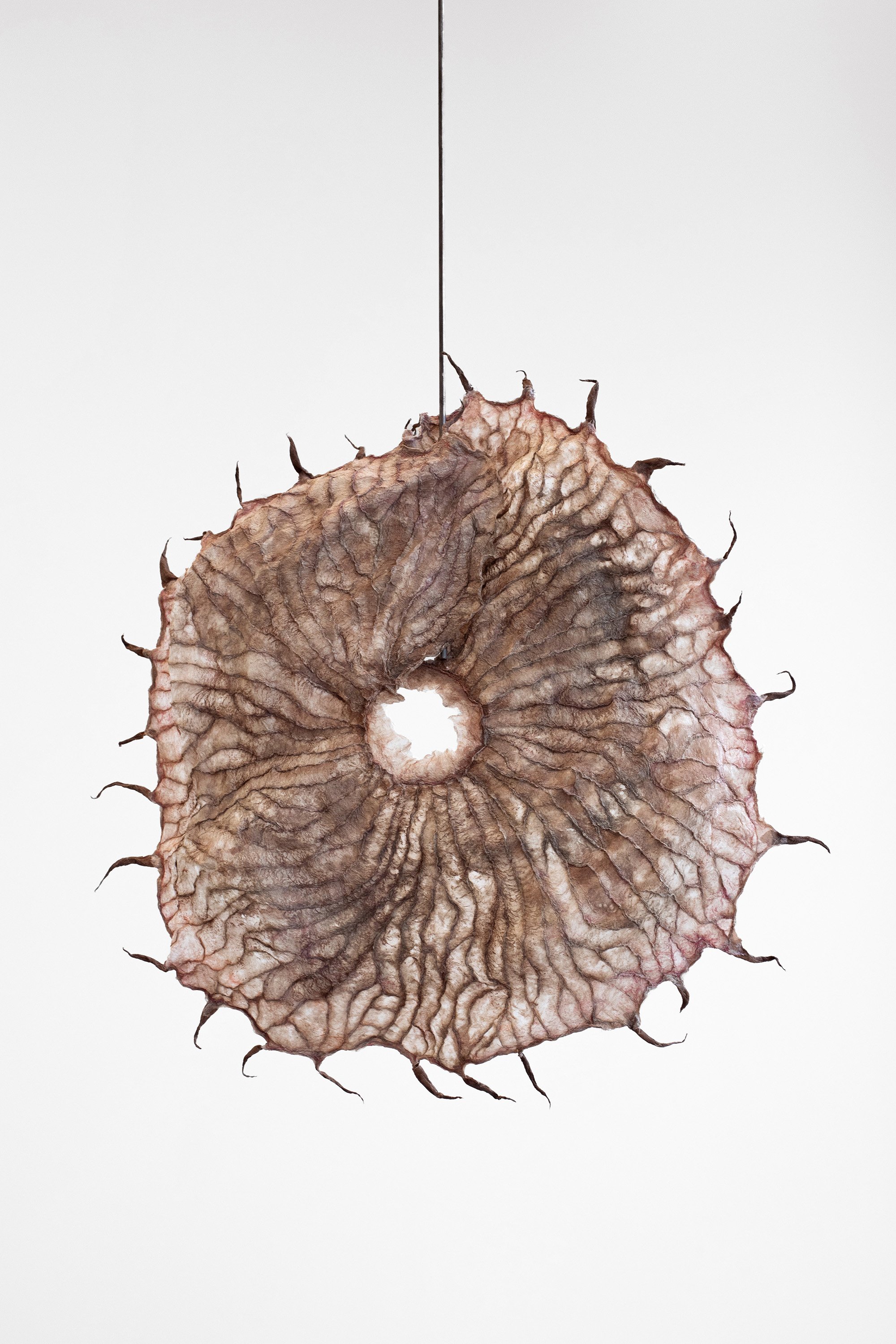
Lunar Seedling, 2025. Handmade Paper Sculpture, Abaca, Cotton and Hemp Fibers, 4 x 2 x 0.5 feet
Many of your projects emerge through direct engagement with specific places and material ecologies, from processing flax in Rome to researching Devil’s Claw in Arizona and working with plant materials in Longwood Gardens. How does collaborating with a place and its materials guide the direction of a project?
When I find myself in an unfamiliar place, my inclination is to explore, to walk, hike, or swim. In my adventures, I sketch forms and structures in plant material, small creatures, or even in the reflection of the water. My observations from the environment become springboards, furthered by research into a species’ characteristics and oral traditions, and solidified by personal narrative or connection.
You've spoken about a childhood marked by movement. At the same time, your work repeatedly returns to seeds, pods, vessels, shelters, and forms that seem poised between departure and arrival. How has that experience shaped the questions you ask through your work?
Pods, eggs, and seeds emerge in my work as symbols of the vessel in a perpetual search for home. Home is both the fertile soil of the riverbank, the landing ground, and the people who nurture it. As a child, I was caught in the eddy, moving between three homes, my mother’s and father’s, both of which were often in flux, and my grandparents, a constant. I struggled to feel at home in any of these spaces and longed for familiar relationships and closeness. Years later, I continue my search, fueled to make work through the dissonance, unrootedness, and unpredictability of fate.
Until recently returning to Ithaca, a formative place in my practice, I had not yet considered the role of the origin, genesis, birthplace which may evoke home even more so than the landing ground.
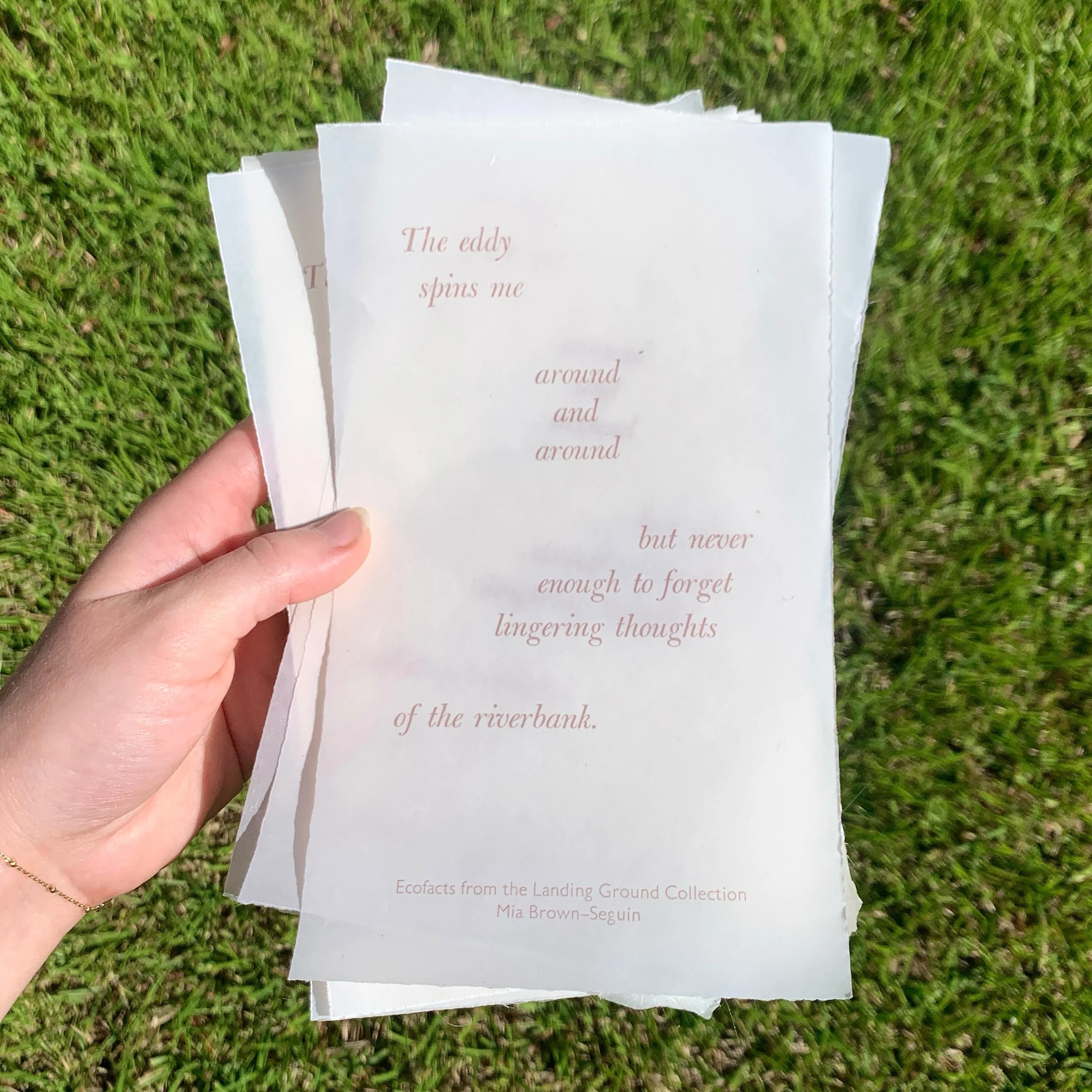
The Eddy, 2025, Letterpress Print on Handmade Paper, High Shrinkage Abaca Fiber, Edition of 44, 4.75 x 8 inches
Throughout your work, fibers are transformed, materials are reused, forms evolve, and seeds repeatedly appear. What has working this way taught you about finding a landing ground and the possibility of beginning again?
I am a hopeless romantic when it comes to fate. I believe that I am always in the right place at the right time. Despite undeniable luck, I find myself longing for the “Landing Ground”, a symbol for home and stability.
In 2025, I wrote and printed The Eddy, an edition of letterpress prints on handmade paper, capturing this sensation of perpetual searching and longing. This poem was paired with Ecofacts from the Landing Ground Collection, a body of sculptural handmade paper works installed at the Bedford Gallery in Farmville, Virginia.
The eddy
spins me
around
and
around
but never
enough to forget
lingering thoughts
of the riverbank.
As I find myself beginning again, I have accepted that, much like the regenerative nature of my sculptures, I must free myself from the past to create energy for the future.
I also want to share some of my recent and favorite reads with you (and the audience if you would like to share!) because they are incredibly relevant to what I am thinking about.
Susannah and the Snowbears, Kathleen Ann Goonan
Betrayals, Ursula Le Guin
The Pond, Bentley Little
The Carrier Bag Theory of Fiction, Ursula Le Guin
With Her Own Hands: Women Weaving Their Stories, Nicole Nehrig
Wild Dark Shore, Charlotte McConaghy
Holy Shit: Managing Manure to Save Mankind, Gene Logsdon
How Value Shifts and Circulates in Today’s Fragmented Art World, Elisa Carollo
Braiding Sweetgrass, Robin Wall Kimmerer
Thank you so much for sharing your work and talking with us!
To find out more about Mia and her work, check out her website.