
Melissa Dadourian
My work crosses the intersection of painting, object-making, and installation. I use materials such as hand-dyed fabrics, knitted thread, wood, clay, and paint to explore themes of domesticity and abstraction through shape, color, and texture. I often use a vintage knitting machine to create shaped surfaces to paint on, emphasizing process, repetition, and labor. In my work, I embrace contradictions. These contrasts—even as nuanced as softness and firmness, or looseness and tightness—create dynamic tensions. I explore the social potential of textiles, drawing on their deep historical and cultural significance while incorporating elements of abstract painting and the Supports/Surfaces movement. Textiles are closely tied to labor, craft, and the domestic sphere—areas often undervalued in traditional art narratives. By using materials like vintage threads, hand-dyed fabrics, burlap, and repurposed curtains, I engage with these histories, challenging the boundaries between fine art, craft, and domestic work.
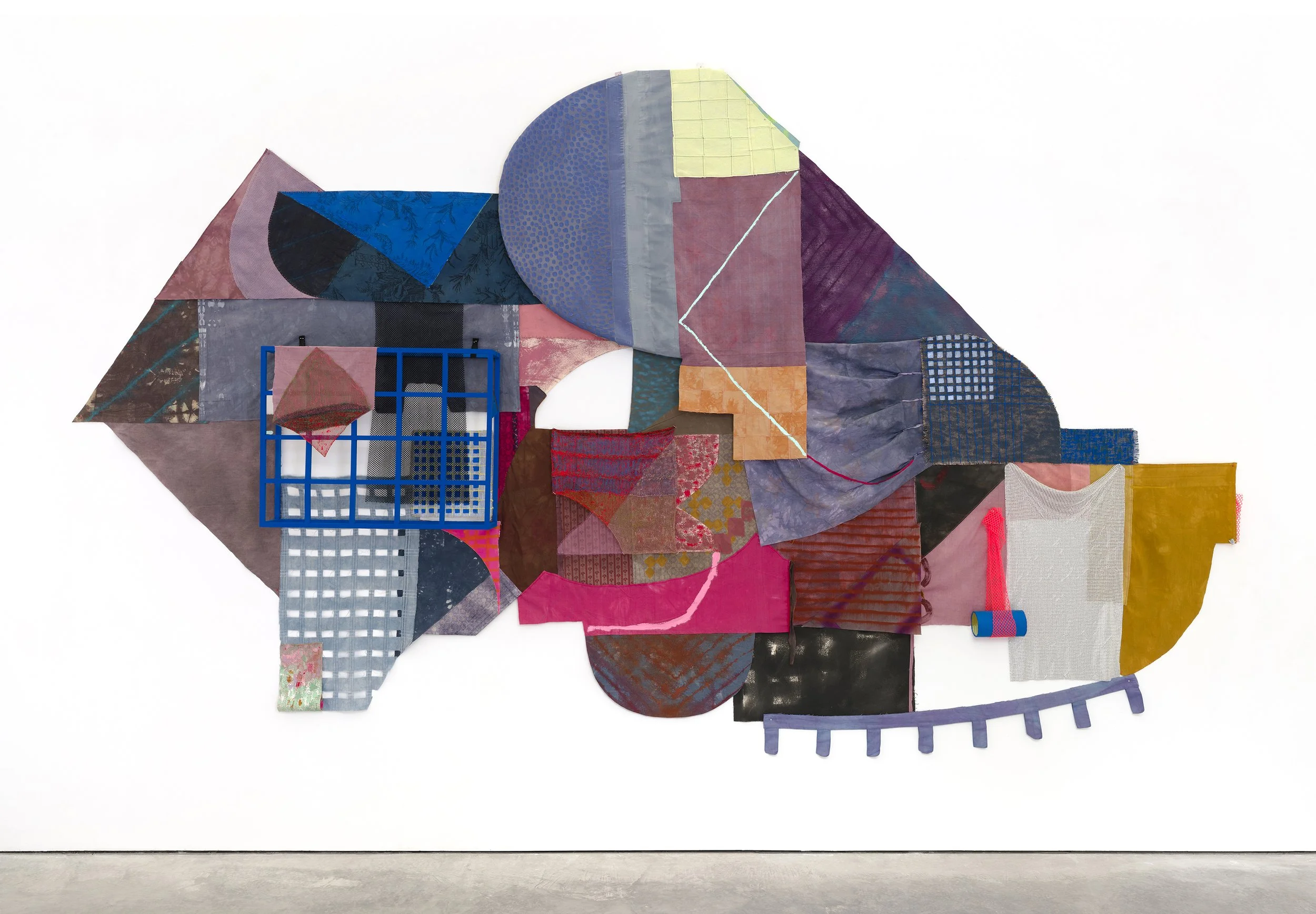
Cries and Whispers, 2025. Flashe, fluid acrylic, fabric dye, knitted thread, wood, curtains, vinyl, foam, chain mail, canvas, map pins, T-pins, 98 x 168 x 7 inches
Interview with Melissa Dadourian
Hi Melissa! Can you tell us a bit about your background and how you became interested in becoming an artist?
I grew up in the suburbs of Massachusetts in an Armenian American home. I used to be obsessed with dollhouse furniture and made many objects using things I found around my house. I looked at a lot of carpets and art from the Middle East that my grandparents brought back, and I began sewing out of necessity to make beds for miniature animals that accompanied my dollhouses.
Who or what were some of your most important early influences?
Many years ago I saw the work of Leonore Tawney at MoMA and was completely enamored by her woven work. I had never seen anything like it. It was work that took up space and I immediately had an emotional connection with it. I loved how the material hung from the ceiling/wall. It seemed so radical. Not until maybe 20 years later did I begin to use fiber as a medium and understand that Tawney’s work helped me to realize my own work.
In art school I saw a museum show of Broodthayers and I remember being surprised and almost shocked seeing his work made of materials that were nakedly themselves. Materials taken directly from the home or nature like egg shells and mussel shells. Also, Joseph Beuys’s butter work and his felt installations. These artists gave me permission to use anything and everything to make art.
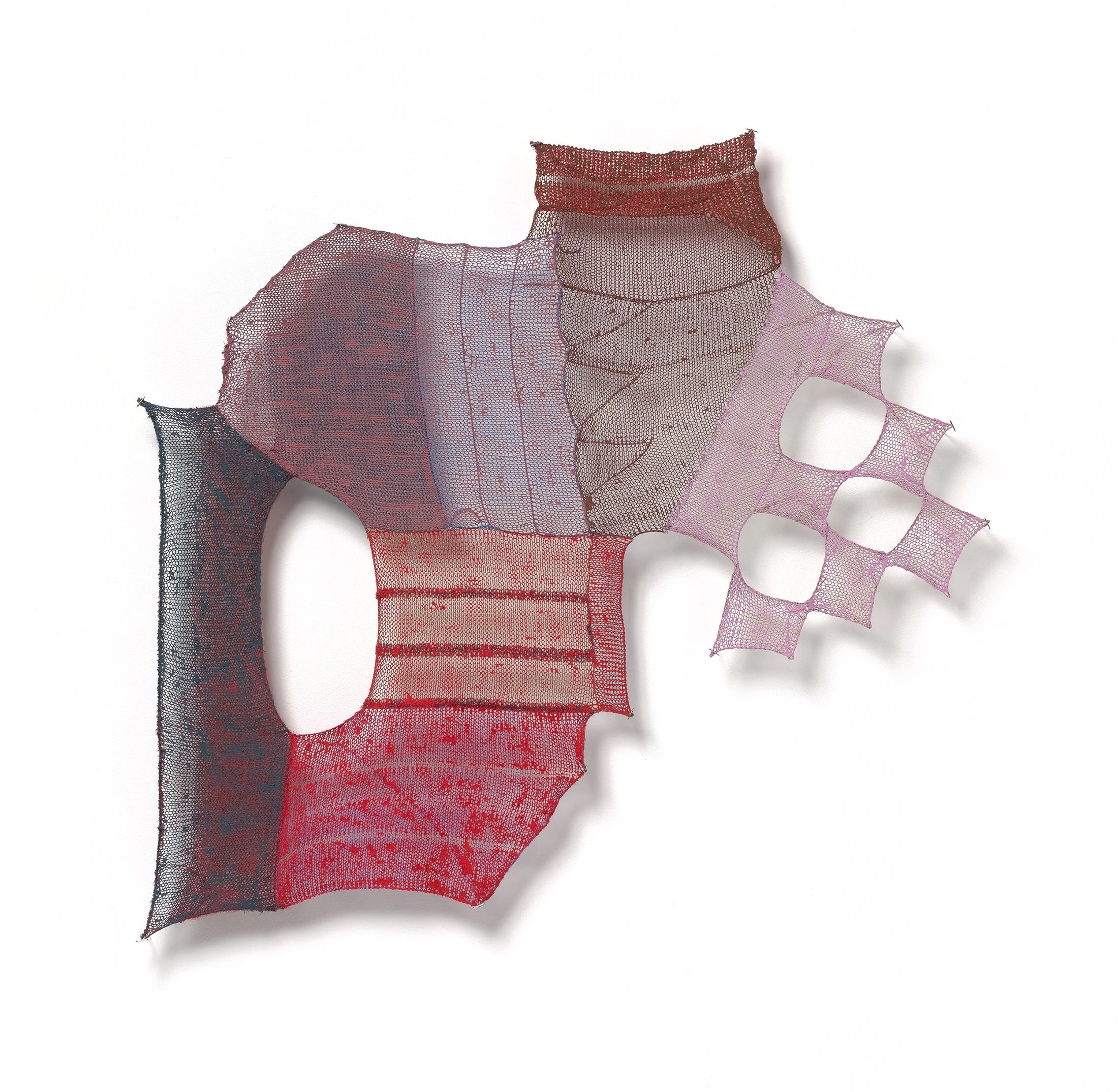
Tilted Grid, 2024. Dlashe on knitted thread, T-pins, 34 x 36 x 2 inches
Where are you currently based and what initially attracted you to working in this place?
I am based in both Brooklyn and the Hudson Valley. My current studio is in a wooded area in Woodstock, NY. I love being surrounded by trees and the sounds of nature. It helps to keep me grounded and focused on the work.
Are there any aspects of this specific location or community that have inspired aspects of your work?
I love how nature can really get you out of your own head. There are practical things to do and then there are the trees that are just there.
I have installed pieces using trees as armatures and allowing nature to make its mark on the work. Seeing colorful panels of vinyl stretched in between trees creates a new lens to see nature.
Can you describe your studio space?
My studio is about 600 square feet of space and has a sort of atrium space in the middle that divides it. I have zones in my studio. One for my vintage knitting machine and sewing machine with shelves of various yarns. Another small zone for ceramics with a kiln and slab roller. Another for storage of work including flat files (filled to the brim.) and a large area in front, where I do most of my installations. This open space has windows at the top with a 16 foot wide wall I use for hanging work.
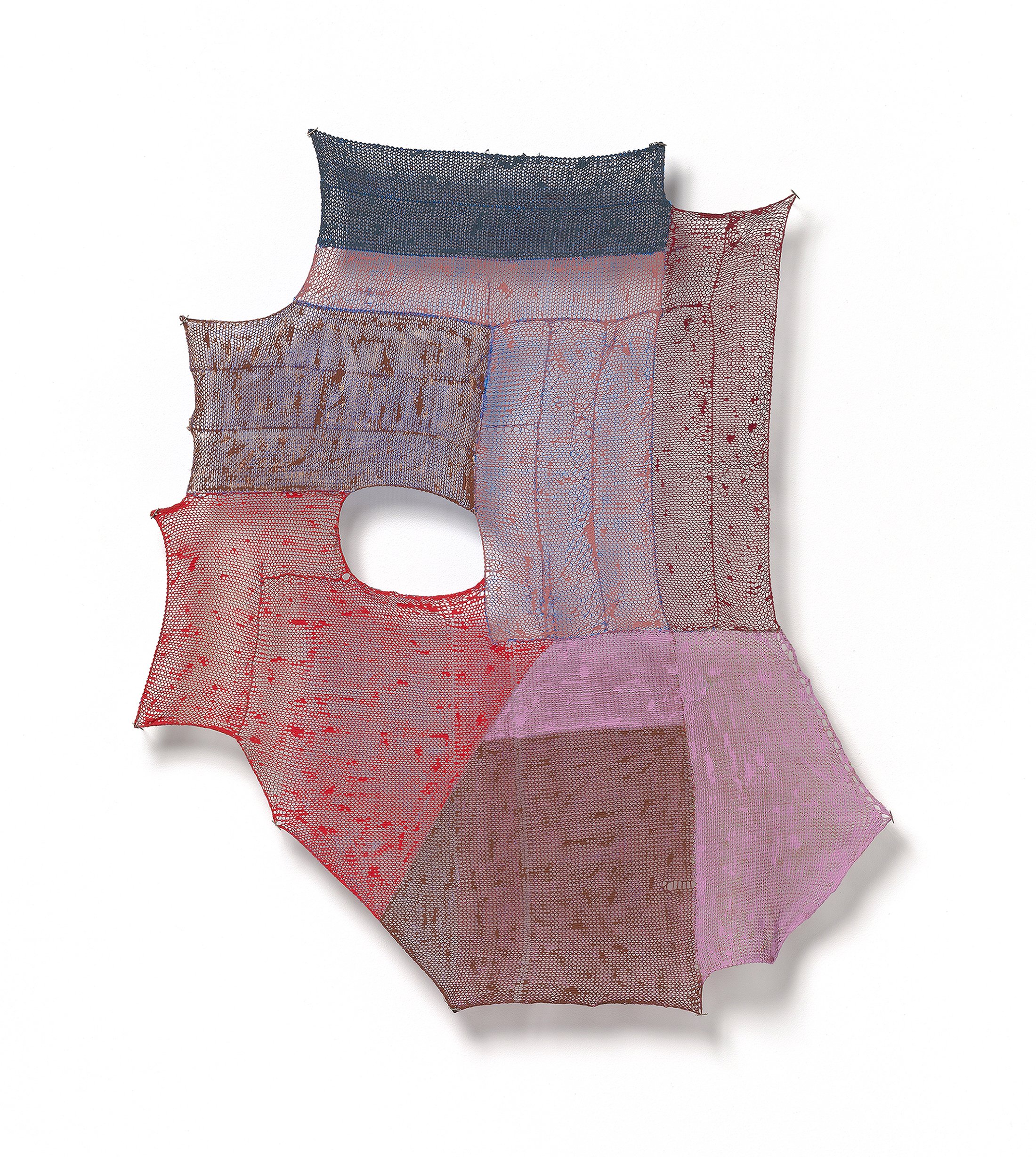
Pink Foot, 2024. Flashe on knitted thread, T-pins, 35 x 31 x 2 inches
What are some of the most crucial aspects of a studio that make it functional? Do any of these specific aspects directly affect your work?
I like to spread out on the floor or a large table. I get easily distracted in home environments and I start to do other things like a cooking project or cleaning. I have two teenagers but when they were little they would spend a lot of time in my studio making their own work or organizing the various materials I would have around; fabric scraps, spools of thread and yarn, rock collections.
I also use shelving to store materials that have been saved for decades—you really never know when you will need those fake flowers again.
What are you working on in the studio right now?
I just got back from a residency at the Haystack School of Crafts which I absolutely loved! I am working on a series of twin or mirrored pieces.
What are the primary themes of your work right now?
I’m interested in the social potential of textiles and their deep cultural, familial, and historical significance.
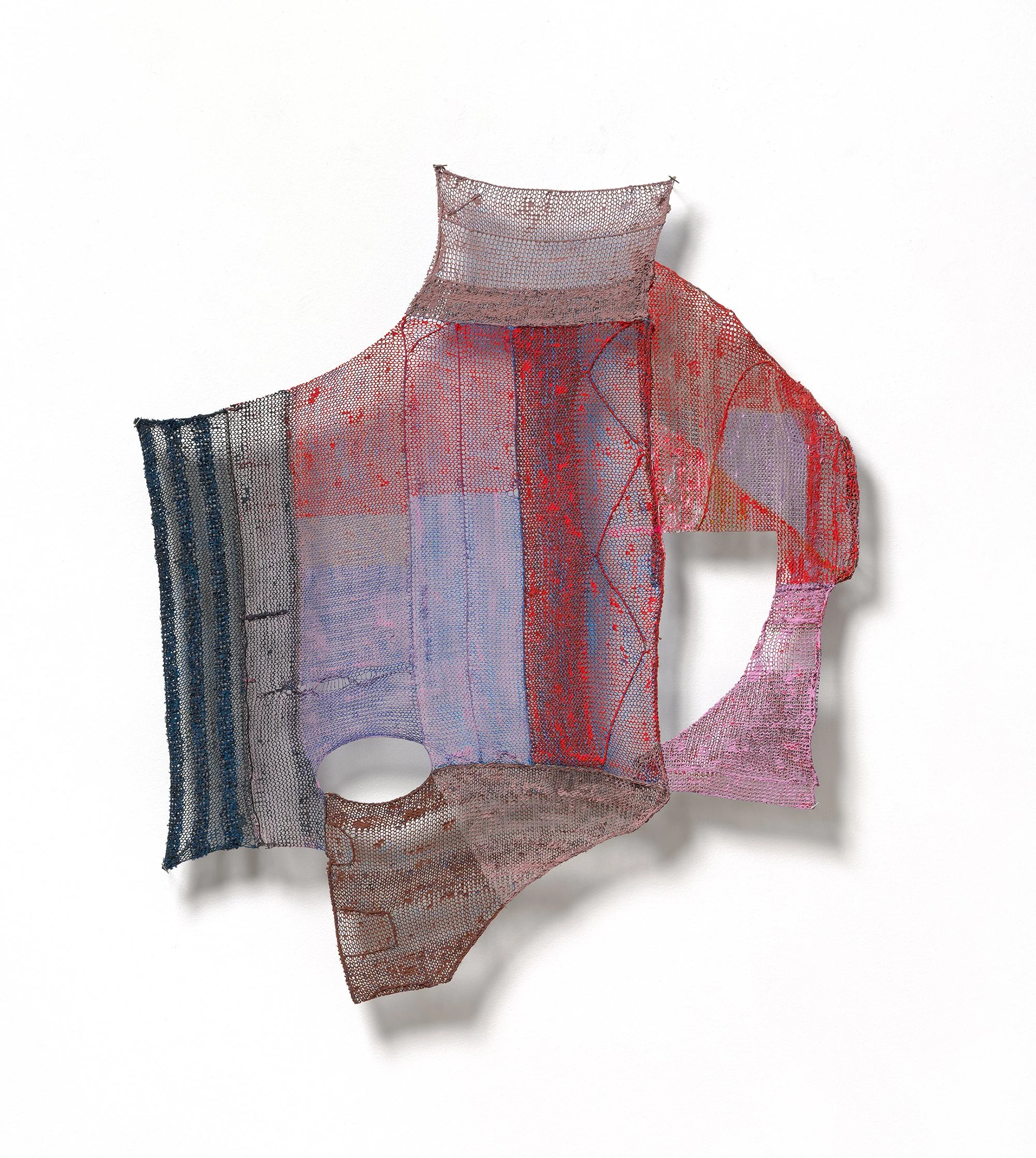
Red Stripe, 2025. Flashe on knitted thread, T-pins, 35 x 35 x 2 inches
What is on your mind a lot recently?
I have been thinking a lot about the Rorschach tests that were given to me as a kid and the things we can invent within abstraction. Abstraction as an entrance into a world. I love the idea of personification of inanimate objects.
What is a typical day like? If you don't have a typical day, what is an ideal day?
I work mostly in my upstate studio and in order to get to the studio I need to walk a short way in a wooded area. It's a good way to clear my busy mind of thoughts of chores and caregiving. Cleaning the slate of the domestic and going into my own created world where I have control (or not) of the things around me.
What gets you in a mindset conducive to making work?
My favorite thing is to be at a residency where all I have to do is work and really focus on that. I need total immersion to begin a project or series. Often I need a deadline to give me that final push to complete work.
Making simple shapes on my knitting machine can spark ideas or just get excited about new color combinations.
What criteria do you follow for selecting materials? How long have you worked with this particular media or method?
One of my main materials is serger thread, which I first bought 12 years ago to create installations of female figures with pins and red thread. Since then, I’ve collected every color the company produced before the line was discontinued, now I source it through eBay. I also work with repurposed curtains that I hand-dye. Years ago, my mom offered me the old curtains from our family attic, and after some time, I began experimenting with dyeing and cutting these familiar fabrics. Since then, I’ve received many more bags of curtains to transform and reuse.
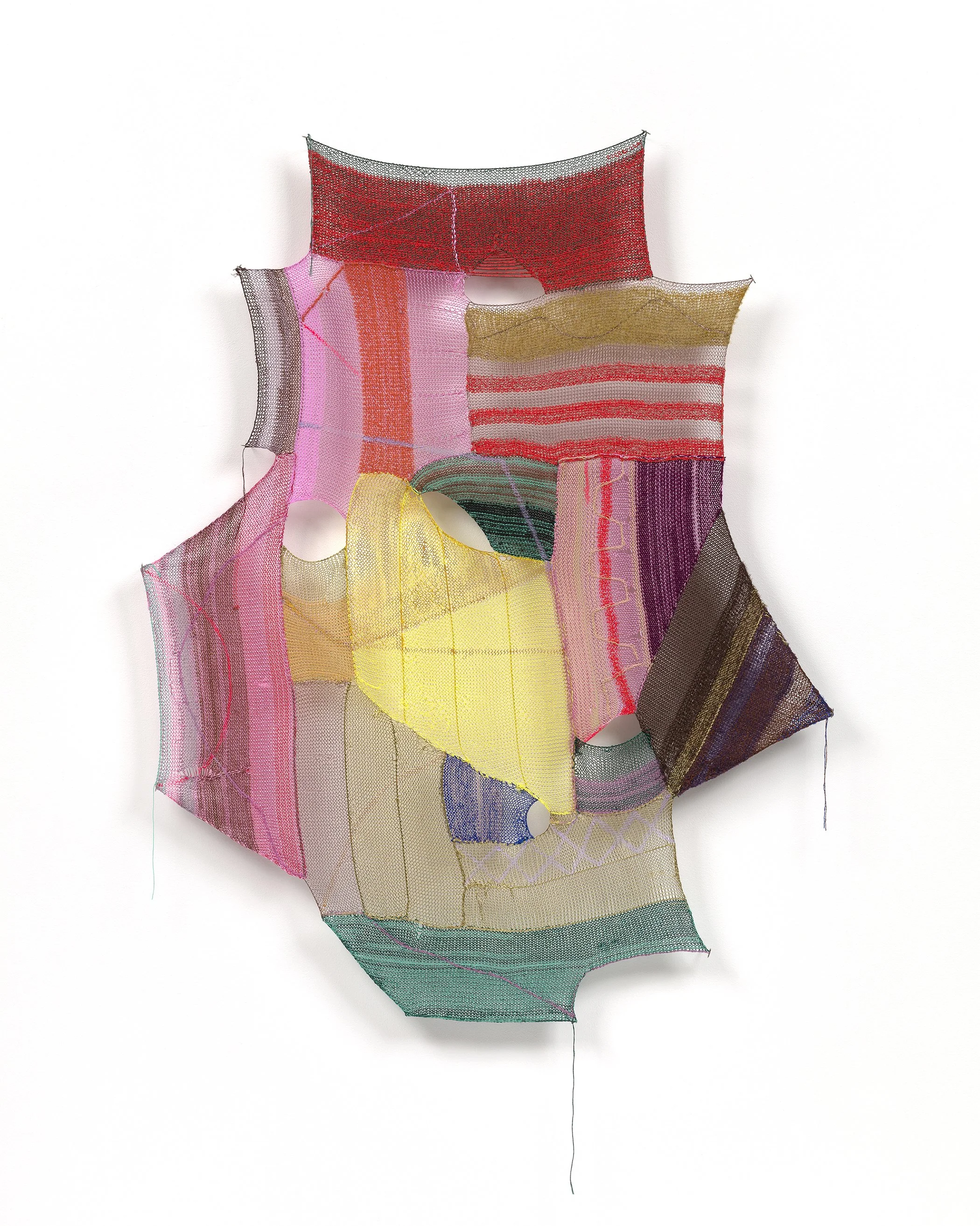
Tall Stranger, 2023. Acrylic on knitted thread, 50 x 36 x 2 inches
Can you walk us through your overall process? How long has this approach been a part of your practice?
I currently use a vintage analog knitting machine to create my woven paintings—a process I began exploring in 2013 during a residency at the Textile Arts Center in Brooklyn. What started as small “drawings” made with thread and yarn has since expanded into large-scale installations and paintings. Over time, working with textiles has become a way for me to understand the world and myself.
Can you talk about some of the ongoing interests, imagery, and concepts that have informed your process and body of work over time? How do you anticipate your work progressing in the future?
My grandparents were genocide survivors who escaped what was, at the time, Armenia, in 1913. Being Armenian and surrounded by imagery and patterns found in carpets, paintings and various textiles is ingrained in my psyche. The comfort and history hand woven textiles offer has informed and influenced my work. It has become a part of my visual language.
I lived in Italy for a chunk of time in my twenties and thirties. Arte Povera seamlessly made its way into my thinking. As well as the Supports Surfaces movement, in general.
Do you pursue any collaborations, projects, or careers in addition to your studio practice? If so, can you tell us more about those projects, and are there connections between your studio practice and these endeavors?
I used to run a sort of renegade gallery space and have always been interested in advocating for artists. I have been fortunate to receive some commissions and large scale projects that enabled me to invite collaborators to assist in the making. One specific project was a 8,000 square foot mural that I designed for a Roosevelt Island Pool. I also enjoy doing artist talks at Universities and engaging with students.
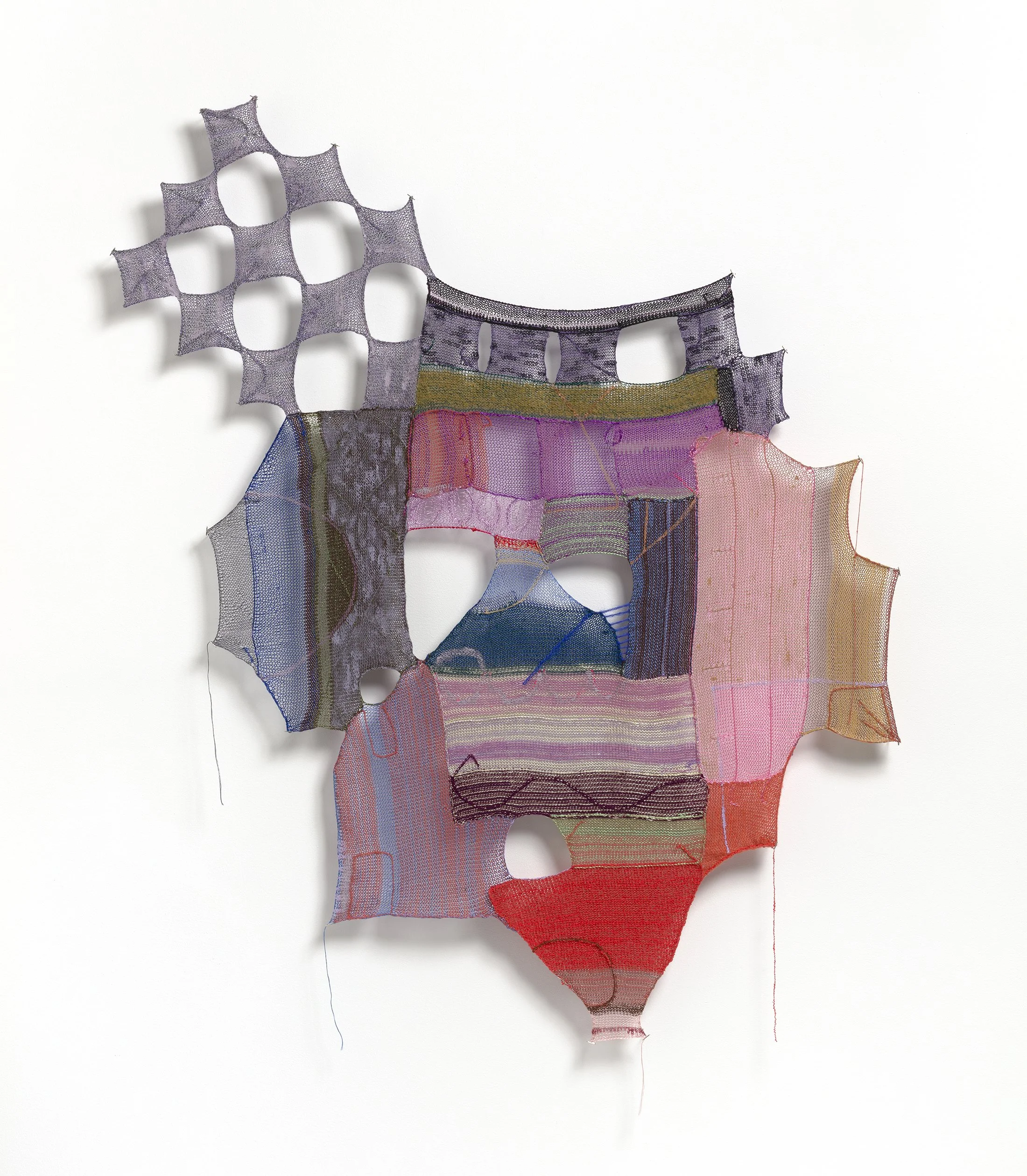
Third Eye, 2024. Acrylic on knitted thread, T-pins, 54 x 44 x 2 inches
Can you share some of your recent influences? Are there specific works—from visual art, literature, film, or music—that are important to you?
I am always interested in art or film that highlights the domestic or the female in a rebellious position. I recently watched Chantal Akerman’s film “Jeanne Dielman, 23, quai du Commerce, 1080 Bruxelles” which blew me away. And I always like to revisit Martha Rosler’s 1975 film “Semiotics of the Kitchen”.
Who are some contemporary artists you’re excited about? What are the best exhibitions you’ve seen in recent memory and why do they stand out?
I look at a lot of artists who use paint in different ways. I love the work of Phyllida Barlow and Etel Adnan who seem to really embrace the use of color and the idea of beauty in ugliness as a form of rebellion. I am also a huge fan of Jessica Stockholder and Frank Stella. Some more contemporary artists that I look at often are Yevgeniya Bara's paintings, Wells Chandler crocheted work, Josh Faught’s woven installations, Rosmarie Trockel’s knitted paintings, Pepe’s crocheted public works and Kristen Mills’ recent cardboard kitchen installation were all inspiring.
Do you have any tips or advice that someone has shared with you that you have found particularly helpful?
Always make the art you want to see and not what others want to see.
What’s coming up next for you?
After a busy year of showing my work a bunch I am focused on working in the studio to develop a new series. I am also organizing, for the second year, a mini affordable art “faire” with two other artists in the Hudson Valley called GLÖGG GLÖGG. It is a way for people in the community to be able to buy art while supporting artists by collecting their work.
Anything else you would like to share?
I am thrilled and honored to be included in Maake 17. I have applied every year since 2017!
We are thrilled you are part of this issue! Thank you for sharing your work and talking with us!
The find out more about Melissa and her work, check out her website.