
Matthew Mahler
The VOID series is made up of painted rectangles in aspect ratios often associated with digital screens—16:9, 16:10, and 4:3. These shapes act like windows, offering glimpses of information and inviting viewers to make their own connections through subtle shifts in color and tone. I work on black burlap, a material that connects back to earlier projects. Using tape and stencils, I set up temporary boundaries that help guide the paint—but never fully contain it. Pigment often spills or bleeds across the edges, softening the lines and introducing a sense of unpredictability. The result is a kind of layered image, where frames nest within frames—a quiet nod to mise en abyme. Each one is shaped by the colors, values, and tones of the space around it. I want these works to feel both seductive and disorienting—familiar, yet uncertain. They exist somewhere between clarity and ambiguity, encouraging viewers to reflect on what’s real and what’s perceived. At its core, this series explores shifting boundaries—between image and surface, control and chance, the digital and the physical. It asks us to notice how those lines blur in the way we experience the world today.
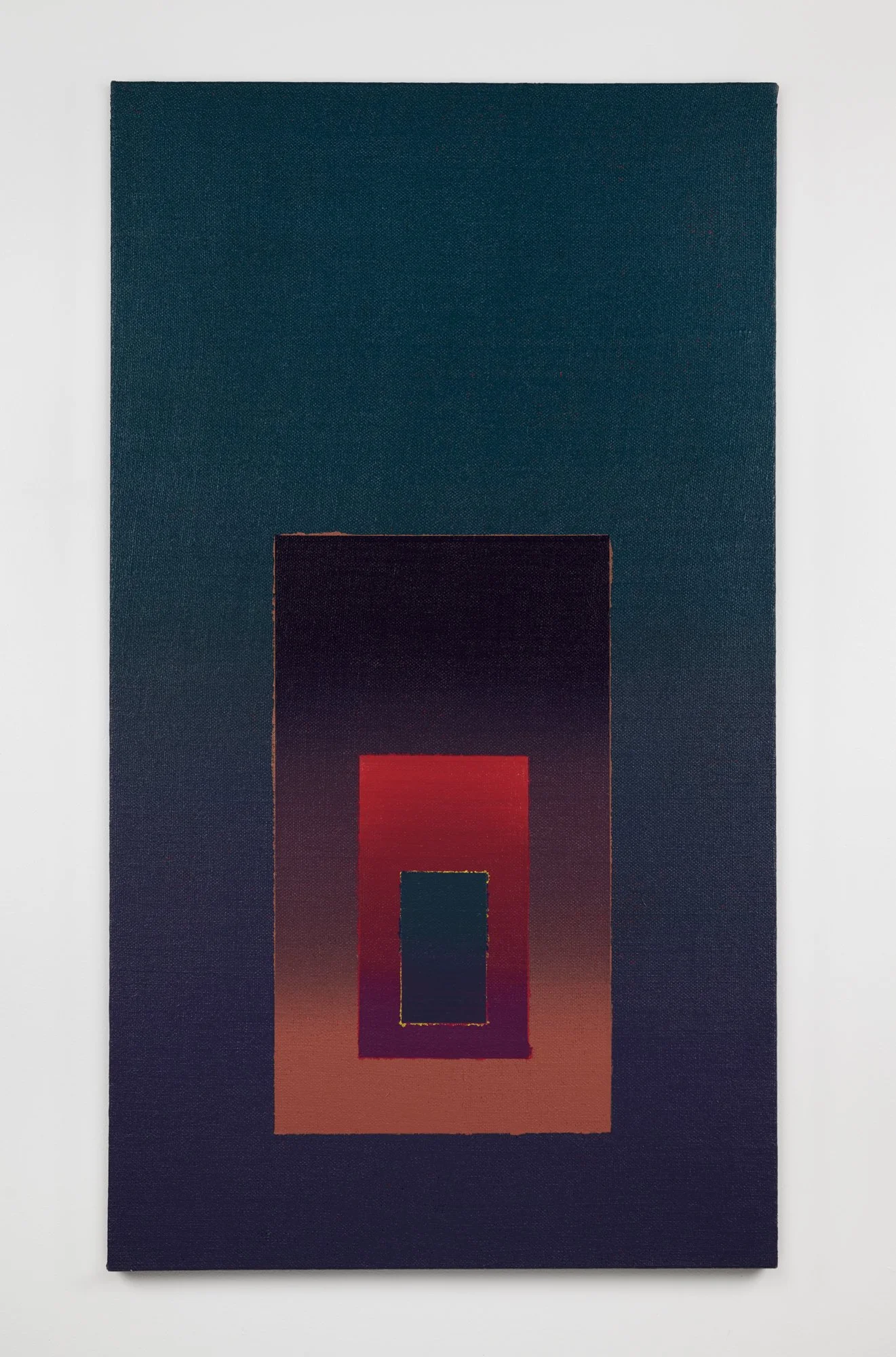
Screen Shot (Echo Of An Echo) 2023. Acrylic on Black Burlap, 48 x 27 inches
Interview with Matthew Mahler
November 2025
Hi Matthew! Can you tell us a bit about your background and how you became interested in becoming an artist? Who or what were some of your most important early influences?
Sure. I grew up in the suburbs of New York City on Long Island, the son of two teachers. I spent a lot of time entertaining myself—playing outside, exploring, and often drawing. It wasn’t until high school that I became consciously aware of my interest in making art and creating things in general.
My friends were definitely early influences; many of them were creative in one way or another. I also drew inspiration from the subcultures I discovered during that time. I was heavily influenced by the graphics used in early ’90s skate and surf culture, as well as the DIY ethos of the hardcore scene that was so alive on Long Island and in New York. Those visual languages and communities played a huge role in shaping my creative direction.
Where are you currently based and what initially attracted you to working in this place? Are there any aspects of this specific location or community that have inspired aspects of your work?
After finishing my undergraduate studies, I moved to Ridgewood, Queens—a working-class neighborhood right on the Brooklyn border. Although I chose it initially out of convenience, I’ve ended up calling the same apartment home for almost twenty years, and I’ve rented various workspaces within a five-mile radius of where I live.
I wasn’t especially picky about where I landed; I just knew I needed to be closer to the city for my work to grow. As someone in my early twenties, the neighborhood offered a level of stimulation and energy that simply didn’t exist where I grew up, and that immediacy had a real impact on my development as an artist.
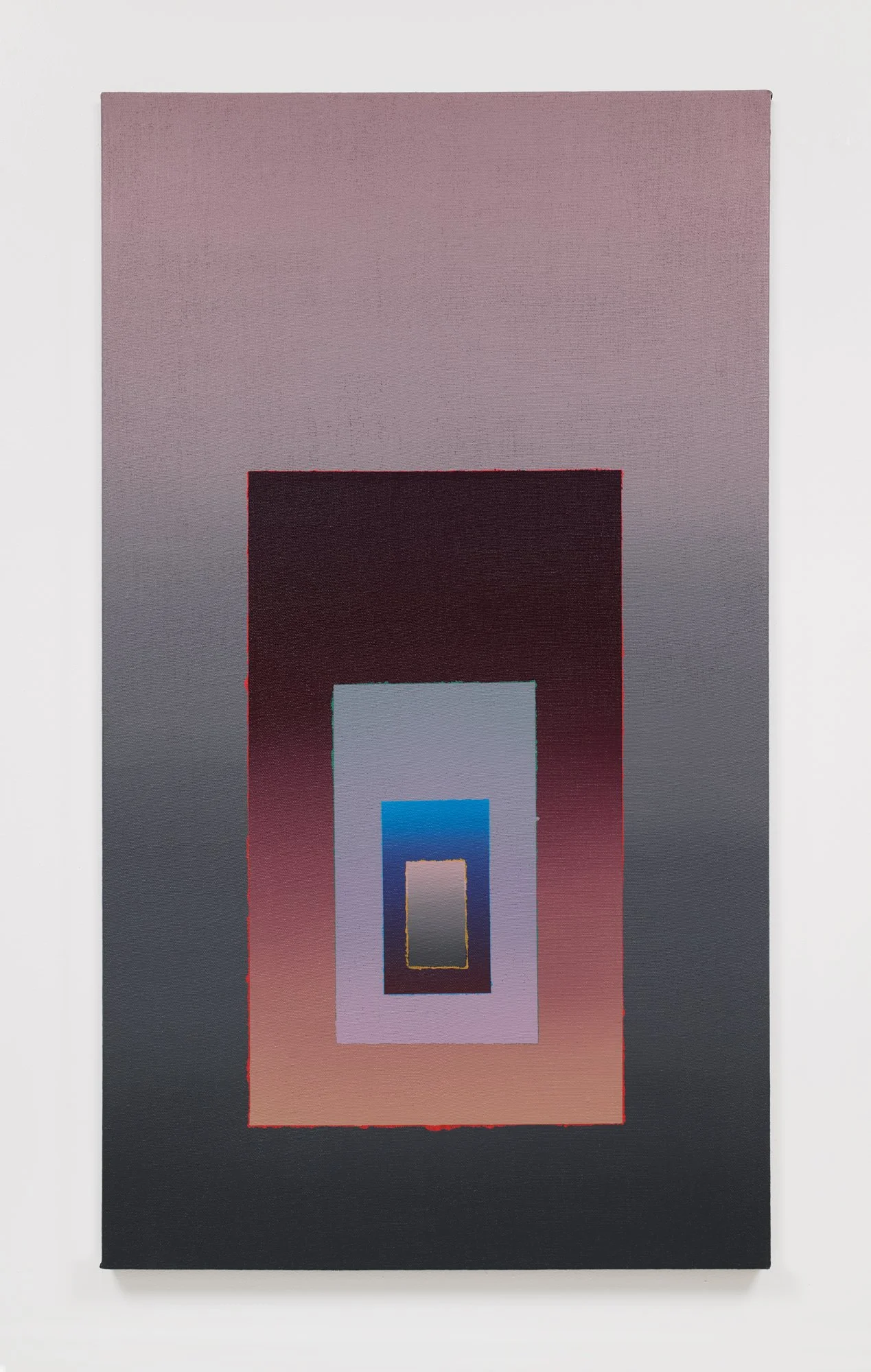
Screen Shot (Feeling of a Feeling), 2025. Acrylic on Black Burlap, 64 x 36 inches
Can you describe your studio space? What are some of the most crucial aspects of a studio that make it functional? Do any of these specific aspects directly affect your work?
Absolutely. I’ve been in my current studio building for the past seven years. I rent a modest workspace—about 220 square feet—in an industrial building in Greenpoint, Brooklyn. It has a skylight, which makes a huge difference. Space, in general, is critical to my practice, though it always feels like I never have quite enough. I usually work flat on a large table, and when I’m dealing with bigger surfaces, I’ll set up sawhorses to support them.
What are you working on in the studio right now?
I’m currently working on two bodies of paintings. One continues the series that was recently published, where I’m further exploring color relationships and the boundaries they create. The other is a more experimental series, visually and conceptually, and it also draws inspiration from the digital world.
What are the primary themes of your work right now? What is on your mind a lot recently?
Right now, the primary themes in my work stem from our shared cultural moment with digital technology and the way it continues to reshape our viewing habits. Like many people, my practice was profoundly affected by the pandemic. As an art educator, I spent nearly two years teaching remotely, which required me to digitize all of my in-person strategies—something I had rarely relied on before.
I’ve always been a physically engaged person, drawn to direct, human interaction, and I found the shift to digital communication extremely limiting. For all of its conveniences, the more time I spent in front of a screen, the more disconnected and hollow I felt.
My current paintings are very much a response to that experience. They’re an attempt to visually examine—and perhaps quantify—a collective moment shaped by hope, seduction, and a certain degree of delusion. Through them, I’m thinking about how technology reframes perception, and what it means to navigate a world where the digital and the real are increasingly intertwined.
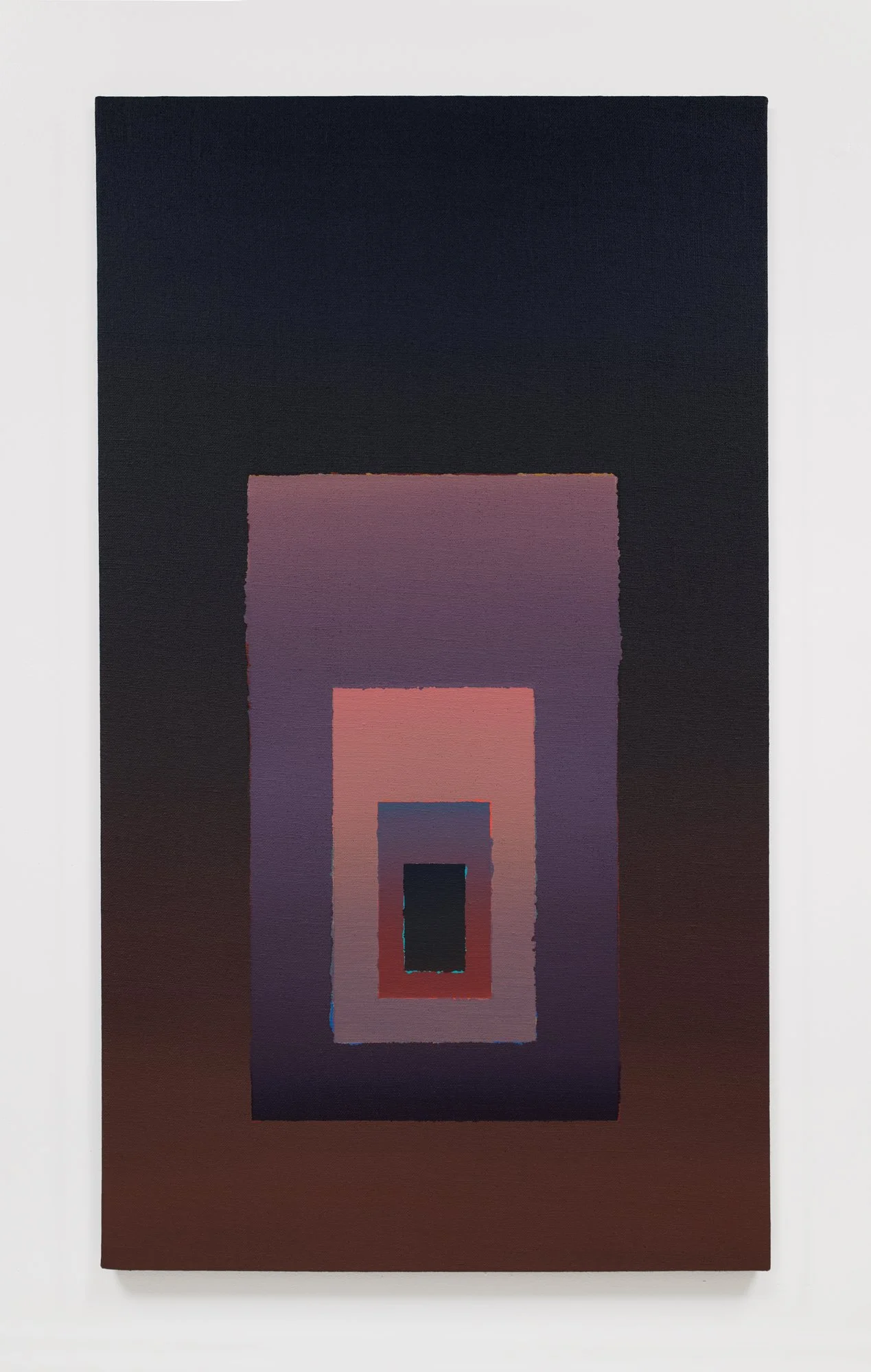
Screen Shot (Memory of a Memory), 2025. Acrylic on Black Burlap, 64 x 36 inches
What is a typical day like? If you don't have a typical day, what is an ideal day?
My studio time is fairly erratic these days, so I don’t really have a typical schedule. An ideal day, though, would be getting to the studio by around 10 a.m. and working straight through until 6 or 7 in the evening. I like having multiple projects in progress at once; moving between them keeps me focused and energized, and I’ve found that I work best when I can shift among different pieces as they develop.
What gets you in a mindset conducive to making work?
A quiet moment in time.
What criteria do you follow for selecting materials? How long have you worked with this particular media or method?
I’ve been painting with acrylic since 2006, after transitioning from oil largely because of my impatience—I wanted to work faster. I began working on burlap in 2017 and have used it almost exclusively ever since. Although I was initially drawn to it for its practicality, I quickly came to appreciate its generosity and its inherently generative qualities. It’s a demanding material and not well suited to many painting styles, which in a way is part of what continues to attract me to it.
For my current body of work, I use black burlap stretched over a thin grade of canvas, sizing the surface with multiple layers of matte medium before I begin to paint. This process creates a distinctive foundation that shapes both the material behavior and the visual character of the finished piece.
Can you walk us through your overall process? How long has this approach been a part of your practice?
For my “VOIDS” series, I begin by working out ideas on the computer—experimenting with gradient color relationships and generating many potential compositions before selecting a few to print and potentially scale up. Once the surface is prepped and my colors are mixed, the actual painting process tends to move fairly quickly. I’ll often make slight color adjustments due to direct color or tonal relationships that occur on the painted surface. Much of the decision-making happens during the digital planning stage.
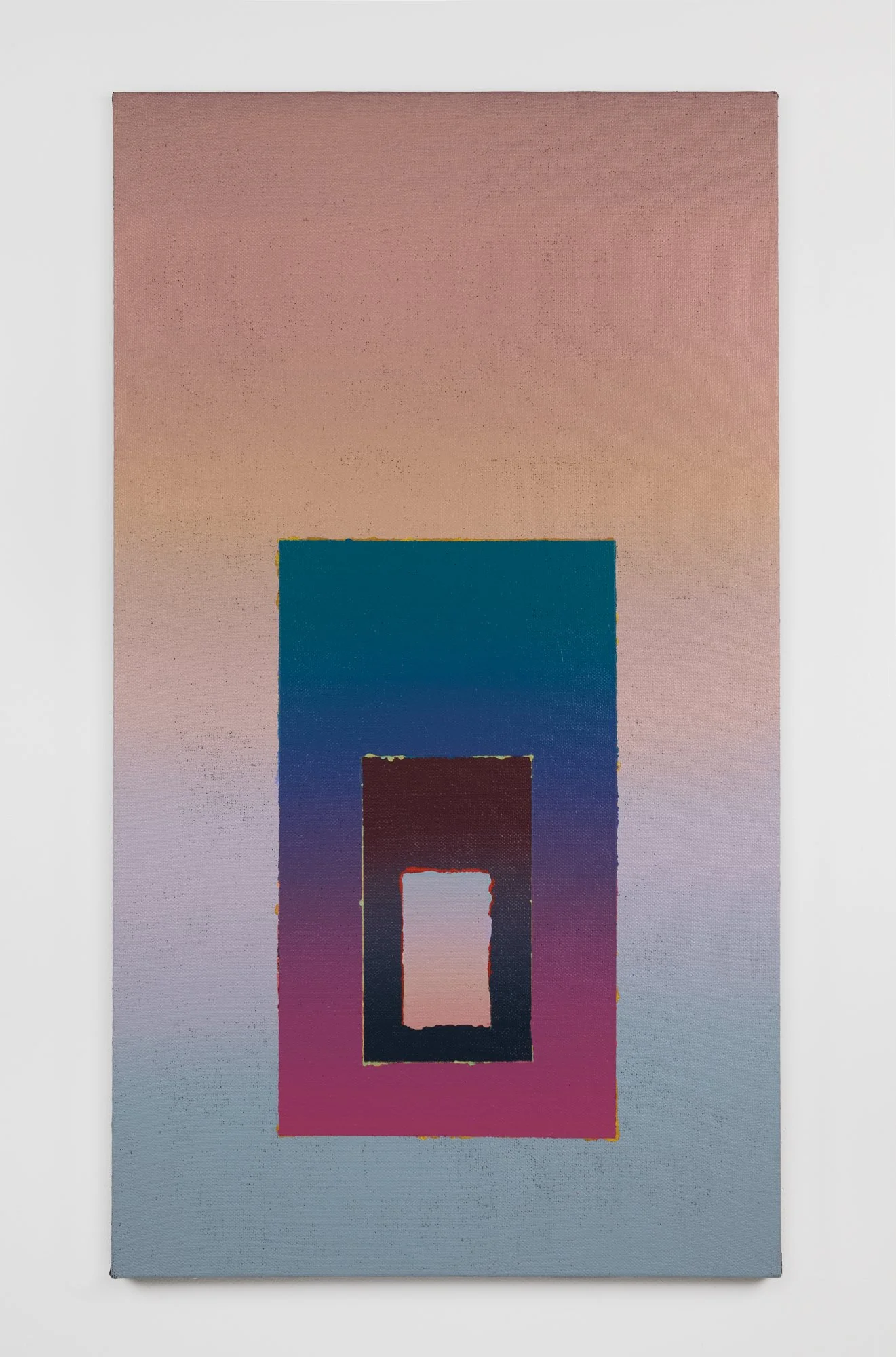
Screen Shot (Copy of a Copy), 2024. Acrylic on Black Burlap, 48 x 27 inches
Can you talk about some of the ongoing interests, imagery, and concepts that have informed your process and body of work over time? How do you anticipate your work progressing in the future?
I’ve always thought of my work as a painter as a way of interpreting the world while also offering a fresh perspective. In the past, I’ve explored different modalities and visual tropes to examine themes like commodification, collection, and consumption.
Currently, I’m particularly interested in how experiencing life through screens not only filters what we see but actively reshapes our perception of reality. I’m exploring how painting can respond to this—either by interpreting it or by offering a critique. Much like Alberti described the rectangular picture plane as a window onto the world, screens now function in a similar—but far more complex—way.
Do you pursue any collaborations, projects, or careers in addition to your studio practice? If so, can you tell us more about those projects, and are there connections between your studio practice and these endeavors?
I’ve been working as a teaching artist and college professor in New York City for about 15 years now. While teaching is time-intensive, I find it incredibly generative, as it challenges me to distill complex ideas into digestible concepts for students. The organization and strategic thinking required in the classroom often inform the way I approach my own work.
Before focusing on teaching, I spent many years in the art world as a picture framer, art handler, and most recently as an archivist for the artist Sanford Wurmfeld. Working closely with Sandy and his practice has profoundly influenced my exploration of color, shaping the sensibilities I bring to my studio practice.
Can you share some of your recent influences? Are there specific works—from visual art, literature, film, or music—that are important to you?
As I mentioned, Sandy’s work has been a major influence on my process—not only in how I organize color, but in how I consider the trajectory of a body of work. For much of my practice, I moved quickly through ideas, often abandoning them when interest waned. Archiving Sandy’s work has given me a firsthand experience of his disciplined exploration of color interactions over more than sixty years. Witnessing his vision and patience has opened my eyes to a new tempo in my own practice, encouraging a deeper engagement with process and longevity.
Who are some contemporary artists you’re excited about? What are the best exhibitions you’ve seen in recent memory and why do they stand out?
I really enjoyed the Jack Whitten show at MoMA this past spring. I’ve admired his work for some time—his “Greek Alphabet” paintings at Dia:Beacon in 2022 particularly blew me away. What inspired me most was his inventiveness and unwavering commitment to exploring what painting could be, always pushing the boundaries of the medium. While I wouldn’t say I loved every period he worked through, I find his vision and relentless focus deeply inspiring.
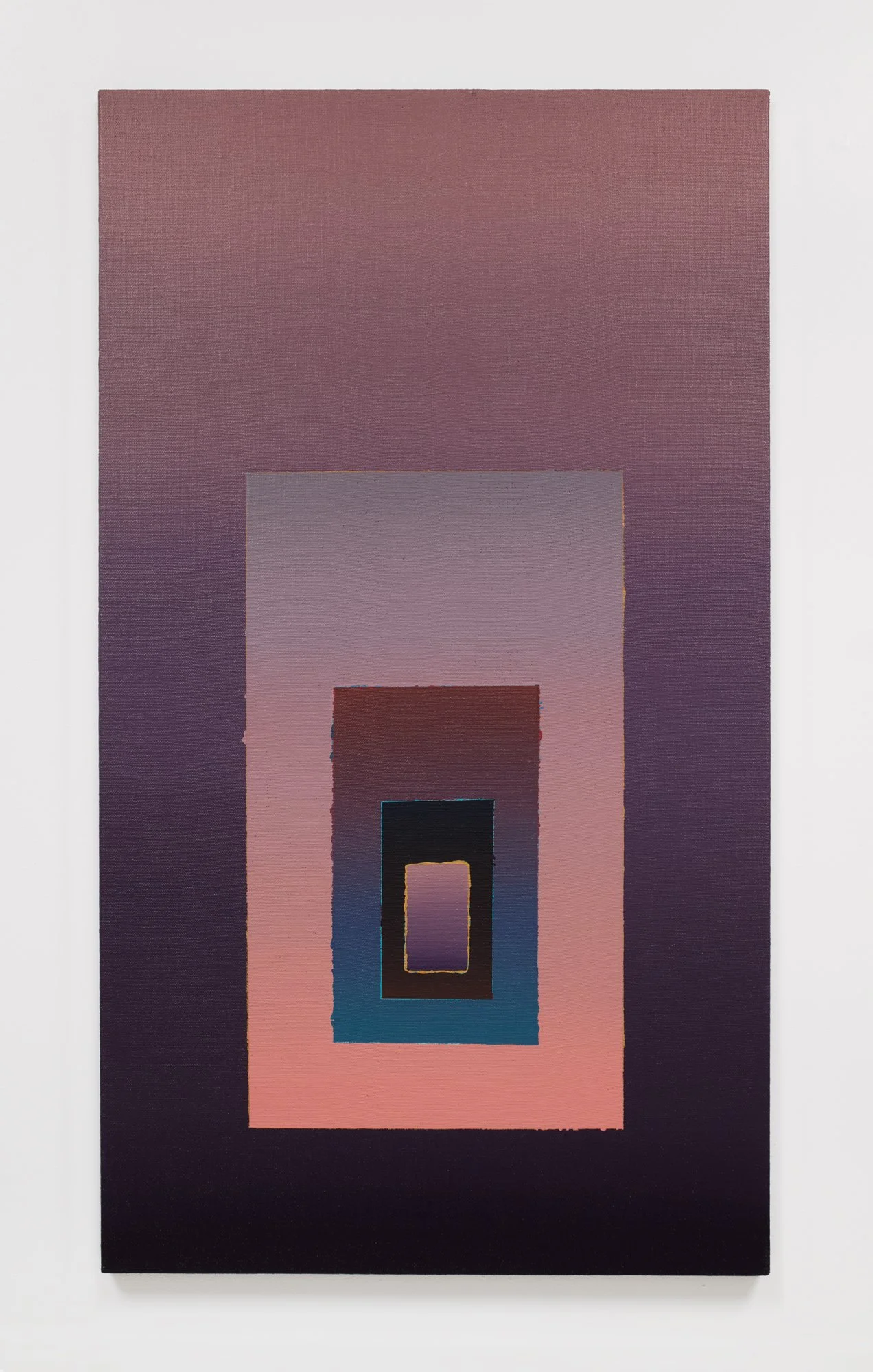
Screen Shot (Thought of a Thought), 2025. Acrylic on Black Burlap, 64 x 36 inches
Do you have any tips or advice that someone has shared with you that you have found particularly helpful?
Just keep going.
Anything else you would like to share?
Thanks so much for the opportunity to share my work and a little about my ideas and I hope people will slow down, at least momentarily, to have a closer look at the work.
Thank you so much for sharing your work and talking with us!
To find out more about Matthew and his work, check out his website.