
Mary Henderson
Having come of age at a time when girls’ interests were routinely marginalized or denigrated, I’ve been fascinated by some of the reframing around the cultural salience of girlhood that has occurred over the last few years: it’s a shift that feels momentous, but also fragile in a social and political context where girls’ recent gains in status feel increasingly under attack. The paintings in this series are about the sleepovers, ballet-carpool rides, friendship bracelets and choreographed dance routines that fill the lives of my adolescent daughter and her friends. They are also about motherhood and the split self – the sense of time travel – that I experience in their presence. As I observe them in the rear-view mirror or from the bleachers, my personal sensory memories of braces, split ends and peeling nail polish are always present.
Most of the works in this series are very small in scale and painted on paper. The scale is, in part, an outgrowth of my interest in the miniature painting tradition and its precious tokens of love and memorial. I’m also drawn to the idea of making paintings that can’t be seen with a quick glance from across a room or experienced by a large number of people at once, requiring instead a singular viewer’s active participation – a decision to stop and look. My source imagery comes from an archive of personal iPhone snapshots, taken in collaboration with my subjects. I am interested in the capacity of representational painting to capture and preserve, prioritizing singular images and drawing attention to what may have originally been casual or peripheral visual information. Because my compositions tend to center on the ephemeral, the intimate and the fragmentary, I typically work from low-resolution corners of larger reference photos. The resulting painting process is highly interpolative, and involves supplementing my source material with extensive visual research as well as direct observation. The highly-saturated and largely invented palette shifts the images away from a feeling of immediate perception and towards a more interior space informed by mood and memory.
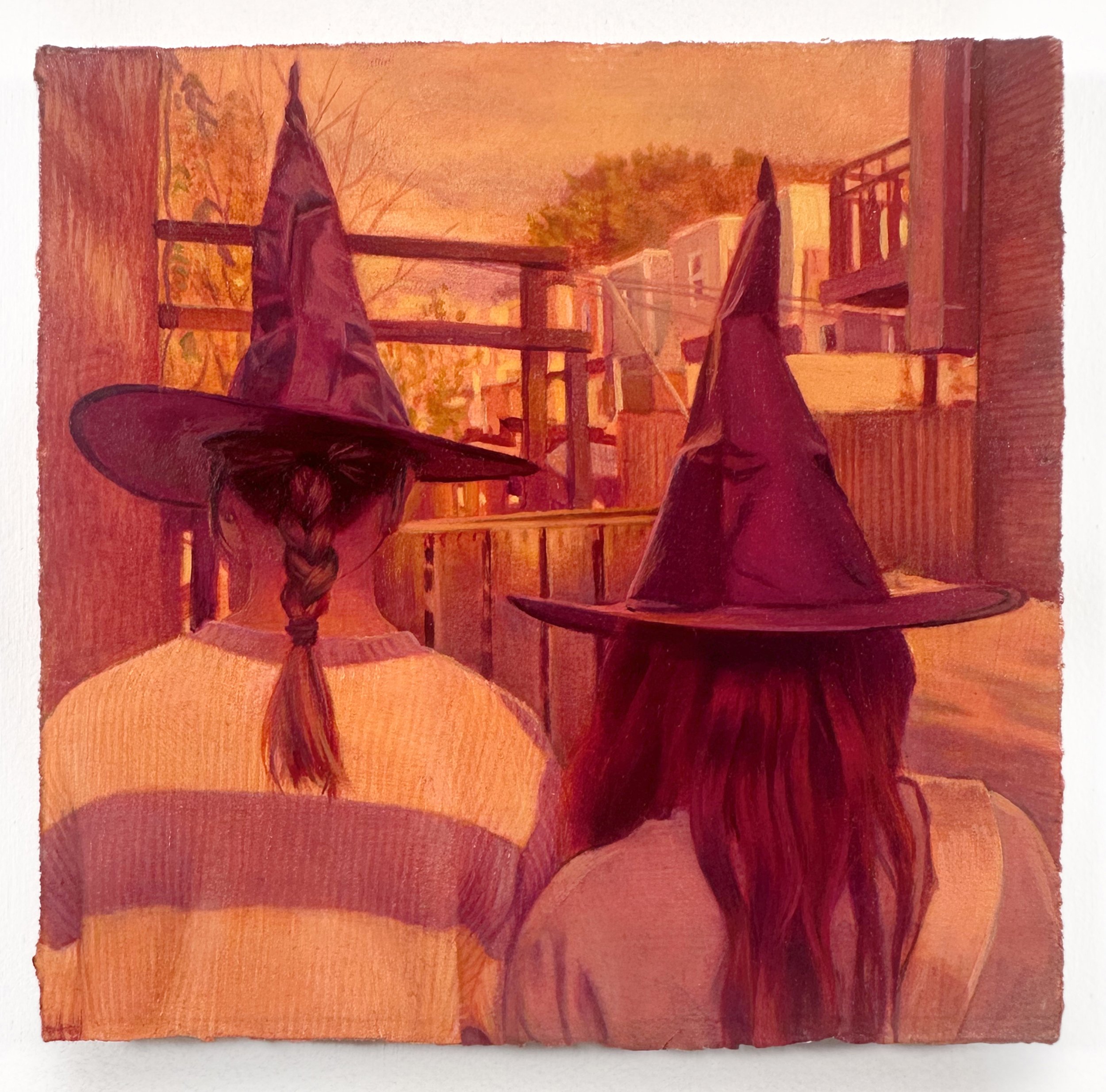
Witches, 2025. Gouache and oil on paper mounted on panel, 6x6 inches
Interview with Mary Henderson
November 2025
Hi Mary! Can you tell us a bit about your background and how you became interested in becoming an artist? Who or what were some of your most important early influences?
I went to a liberal arts school for undergrad, where I was able to split my coursework equally between studio art and art history. It was only when I had to decide on a thesis project that I came down on the studio side of things. I think that art history part of my education has been really formative for me and is really the foundation of my painting: every series of work that I’ve done has been rooted in some specific art historical era or movement – it could be ancient Roman wall painting or French Neoclassicism or 19th-century miniatures – that I was obsessing over at the moment. The inspiration for the work probably wouldn’t be obvious from its appearance, but when I’m in that space with an art-historical era, it feels so important and immersive.
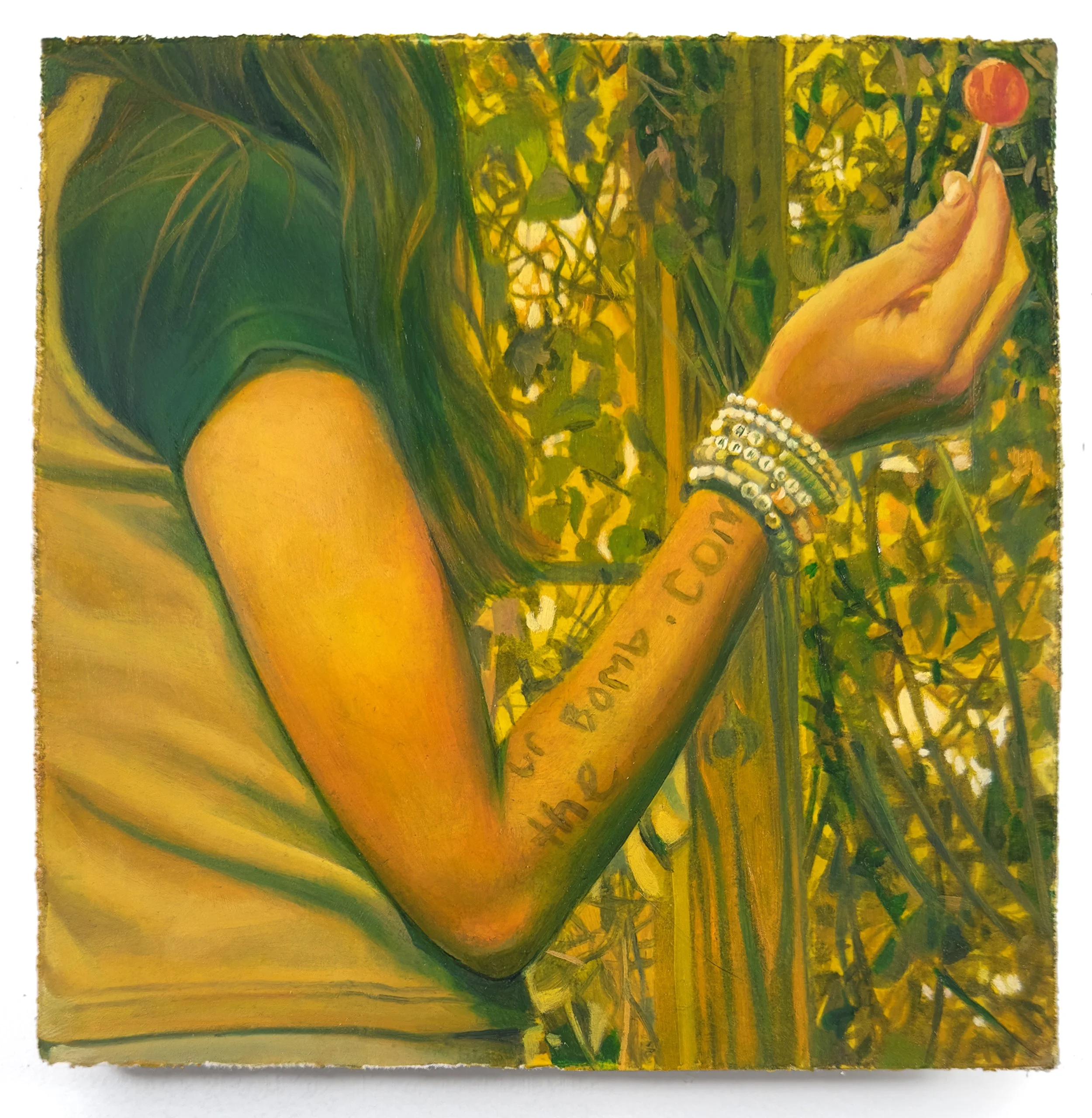
Ur the Bomb, 2025. Gouache and oil on paper mounted on panel, 6x6 inches
Where are you currently based and what initially attracted you to working in this place? Are there any aspects of this specific location or community that have inspired aspects of your work?
I moved to Philadelphia for graduate school with no intention of staying, but circumstances kept me here for one more year, and then another and another. Now I’m a Philly homeowner and public school parent. Philly has the best community of artists and artist-run spaces! It feels really nurturing here, relatively small but so vibrant.
Can you describe your studio space? What are some of the most crucial aspects of a studio that make it functional? Do any of these specific aspects directly affect your work?
I love my studio and my studio building, which is a short bike ride from my house. It’s small, part of a building with a great mix of artists. It’s split down the middle by a ¾ height wall that separates my space from my studio mate’s. I feel like it’s the perfect mix of company and privacy. His side is pristine and my side is chaos.
What are you working on in the studio right now?
I’ve been working on very small paintings on linen panels – mostly based on a neighborhood block party that happened over Labor Day weekend.
What is on your mind a lot recently?
I’ve been painting my young adolescent daughter and her friends for a couple of years. I am thinking a lot about girls and girliness and girl culture, and about that period of my own life as I re-experience those things through them. It’s such a strange moment to be considering these themes: girl culture has really been ascendant for a while, but we’re now in the midst of a deeply toxic, misogynistic backlash to that ascendancy. So there is perhaps a darkness around the edges of work that is otherwise about deep tenderness and care.
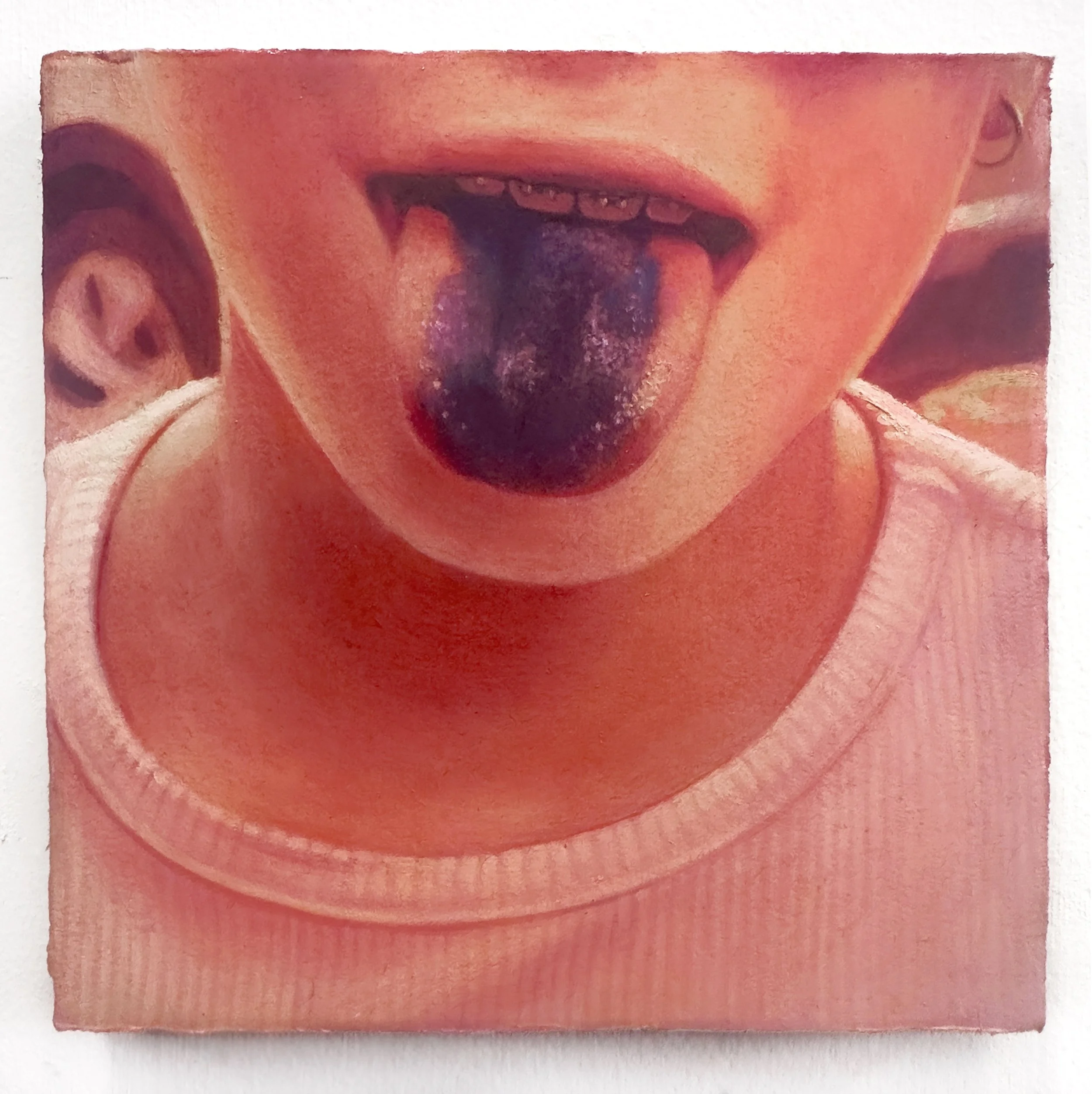
Blue Tongue, 2025. Gouache and oil on paper mounted on panel, 6x6 inches
What is a typical day like? If you don't have a typical day, what is an ideal day?
My current teaching schedule means that I usually only have Friday and Saturday in my studio during the semester. When I can, I try to bike there – it helps me feel a little more ready to work. A day painting without interruptions is the ideal day right now because it’s so rare.
What gets you in a mindset conducive to making work?
I listen to podcasts more or less continuously while I’m in the studio – mostly history podcasts, of which I retain very little. I think I’m learning things in the moment, but most of the time I’m just taking in vibes. It’s mostly useful as a low-level distraction to help me get into a focused state.
What criteria do you follow for selecting materials? How long have you worked with this particular media or method?
I think the materials side of my practice is informed by teaching painting: I spend a lot of time helping students problem solve with their work, and it definitely bleeds into what I do in my studio. I see someone structuring a painting around a particular color that isn’t part of my regular palette and want to try to make that work in a painting of my own.
I thought of my painting and works on paper as two different practices for a long time, but I began combining them around 5 years ago, making gouaches that I seal and finish with oil paint. I love the flexibility of that, and the way that some of them tip more towards the gouache side and some more towards the oil painting side.
Can you walk us through your overall process? How long has this approach been a part of your practice?
I usually work in discrete series, although each one is usually informed by something about the previous series, a particular image, or an idea about how to invert something thematically. When I start fantasizing about other paintings I’d like to make, I know that it’s time to wrap things up with whatever I’m working on.
Most of my work is based on digital snapshots, so I start by making a lot of studies in Photoshop. I’m usually thinking about how to crop things, color structure, etc., but the color, in particular, usually has to evolve a lot from my initial plans. I feel like a digital color space is just so different from painting, and what works in one doesn’t often work in the other.
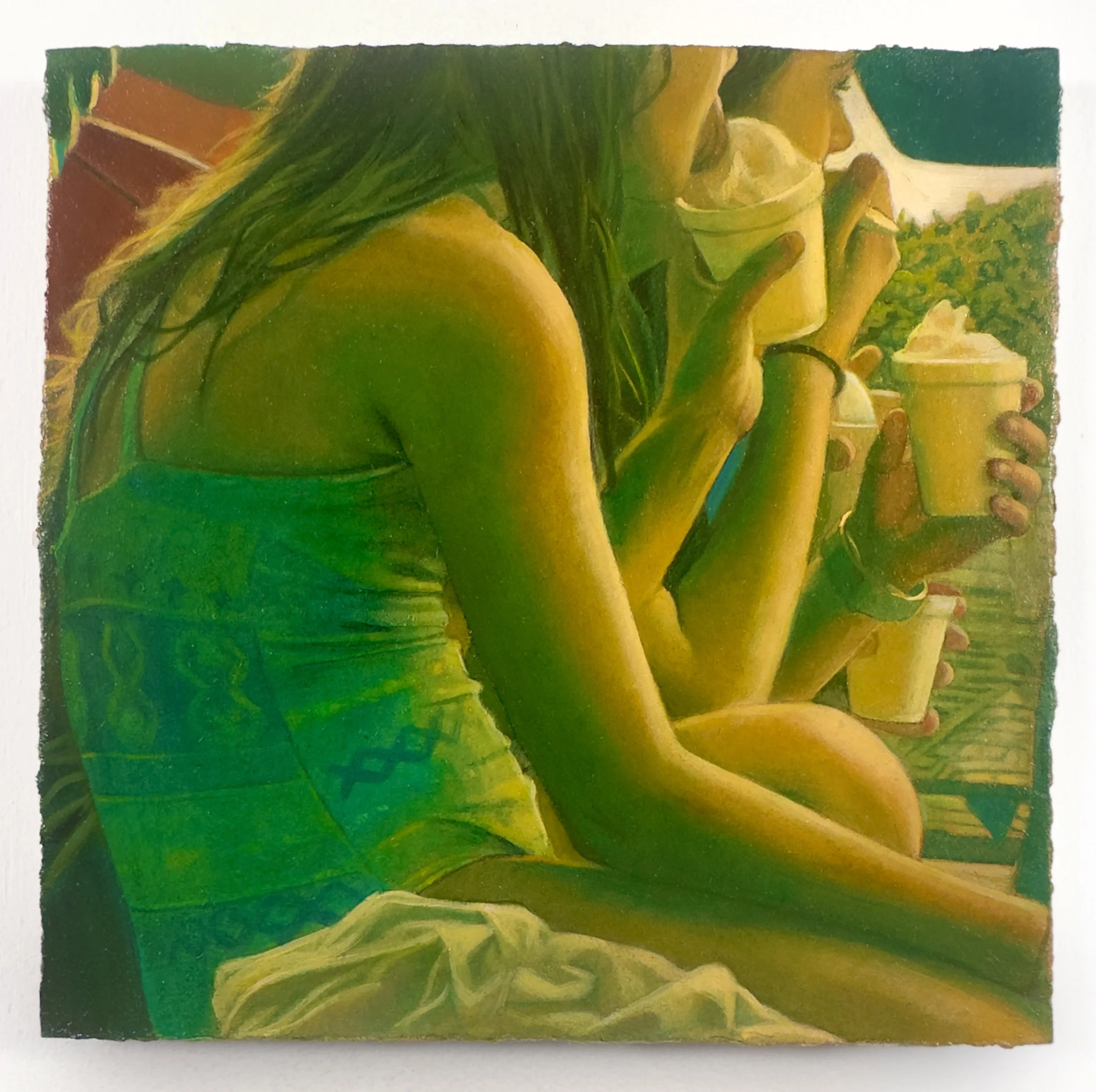
Water Ice, 2025. Gouache and oil on paper mounted on panel, 6x6 inches
Can you talk about some of the ongoing interests, imagery, and concepts that have informed your process and body of work over time? How do you anticipate your work progressing in the future?
I love the deadpan, casual quality of snapshot photography – I’ve always been interested in very ordinary and peripheral types of imagery, subjects that feel happened-upon. I spoke not too long ago with an art history student who was working on a thesis about archives and contemporary art, and we talked about the generational divide between people who had grown up around albums, or piles of physical snapshots, and people for whom those records are mostly digital. There is something very compelling to me about archives, collections and souvenirs, the way that we expect physical totems – whether polaroids or snowglobes or miniatures painted on pieces of ivory – to embody our memories. I think that’s part of the reason I’m so drawn to work at a very small scale.
I mentioned earlier that I usually start thinking about a series as I’m winding up whatever I’m currently working on. I’m not quite there yet – the next series hasn’t started to materialize in my mind – but the subjects of my current work are growing quickly, so this body of work is probably going to expire relatively soon.
Do you pursue any collaborations, projects, or careers in addition to your studio practice? If so, can you tell us more about those projects, and are there connections between your studio practice and these endeavors?
I have done quite a bit of curation, and I also worked as a public art project manager for several years. I don’t do much collaborative work, but I love being a midwife for other people’s projects.
Can you share some of your recent influences? Are there specific works—from visual art, literature, film, or music—that are important to you?
I don’t see much connection between the non-painting media that I consume and the work that I make: I’ve been reading a lot of speculative and historical fiction lately, which feels very grand and sweeping, and the furthest thing possible from what I do. But my taste in painting is much more intimate and domestic in its scope: Chardin, Vermeer, Vuillard. There are certain portraits that I go back to over and over again, like Fragonard’s A Young Girl Reading, or Durer’s Portrait of a Venetian Woman, that are just perfect in their simplicity.
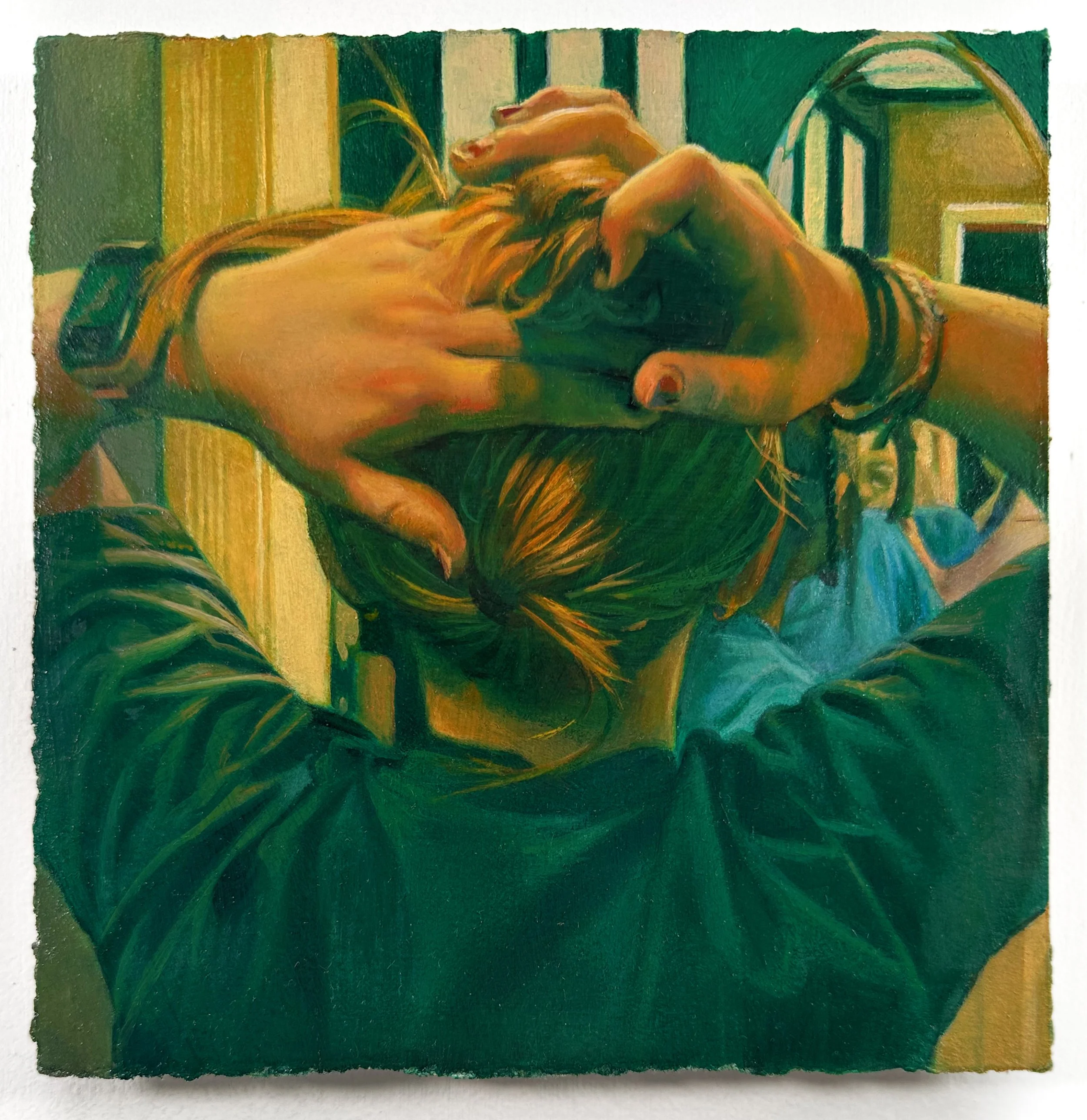
Mirror, 2025. Gouache and oil on paper mounted on panel, 6x6 inches
Who are some contemporary artists you’re excited about? What are the best exhibitions you’ve seen in recent memory and why do they stand out?
I think about the show “The Time is Always Now” at the Philadelphia Museum all the time. The work in the exhibition was fantastic, but there was also such a great energy in the space – the way people in this city responded to that show was inspiring in itself. My daughter saw it on a class trip and came home so excited to talk about it. Not long after, my family and I went to Berlin, and I saw a beautiful solo show of Toyin Ojih Odutola’s work at the Hamburger Bahnhof Museum, which was also an incredible show.
Do you have any tips or advice that someone has shared with you that you have found particularly helpful?
Make the thing no one else can be bothered to make. I don’t know who told me that but I love it.
What’s coming up next for you?
I have a couple of shows on the horizon but I never want to jinx things.
Thank you so much for sharing your work and talking with us!
To find out more about Mary and her work, check out her website.