
Katie Kaplan
Through a multidisciplinary visual art practice, my work explores the natural world as a connective medium between mystic experience and activist practices. These works consider environmental destruction and seek remediation through spiritual and cultural transformation. My process roots in printmaking and expands into textiles and sculpture, as each piece draws from various sources of research: ancient cults of psychedelic witches, experiential field mycology, queer ecology, the compost pile.
Utilizing screenprinting to create repeat patterns, I engage with decorative vernacular in a fluorescent, psychedelic palette. When I look at the more-than-human world, I see adornment not as frivolous or as demarcation of gender, but rather as a source of power, communication, and survival. Vibrant quilts display material indulgence and gratuitous color and pattern, leaning into abundance. This visual quality is an expression of my identity and sexuality, where language falls short; queerness and biophilia manifest as textures, colors, and symbols—as ecstatic joy and holy vibration. The quilting process is kin to compost: printed and dyed fabrics are reabsorbed into a new whole, each quilt made from the scraps from the last. The quilt becomes a metaphor for holobiosis and exists as a kaleidoscopic object of reconstituted visions, using the language of abstraction to represent the ineffable qualities of spirit. My artistic process initiates multiple levels of re-interpretation, a constant switching and reforming, like a mirror to the natural cycles of death and regeneration.
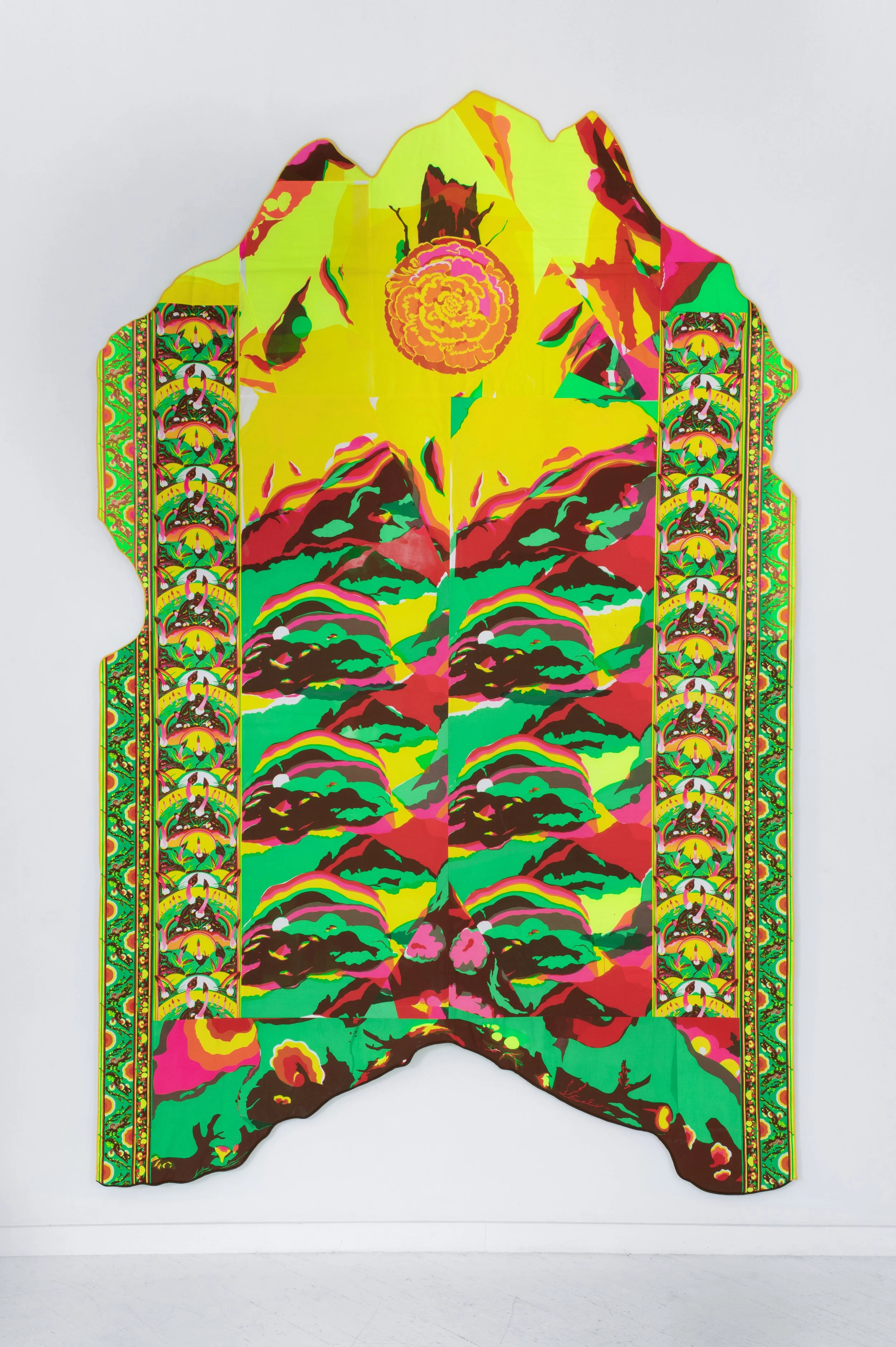
Oh Holy, Blessed Saprotrophs, 2023. Screenprint and monoprint on fabric, dye, batting, 150 x 96 inches
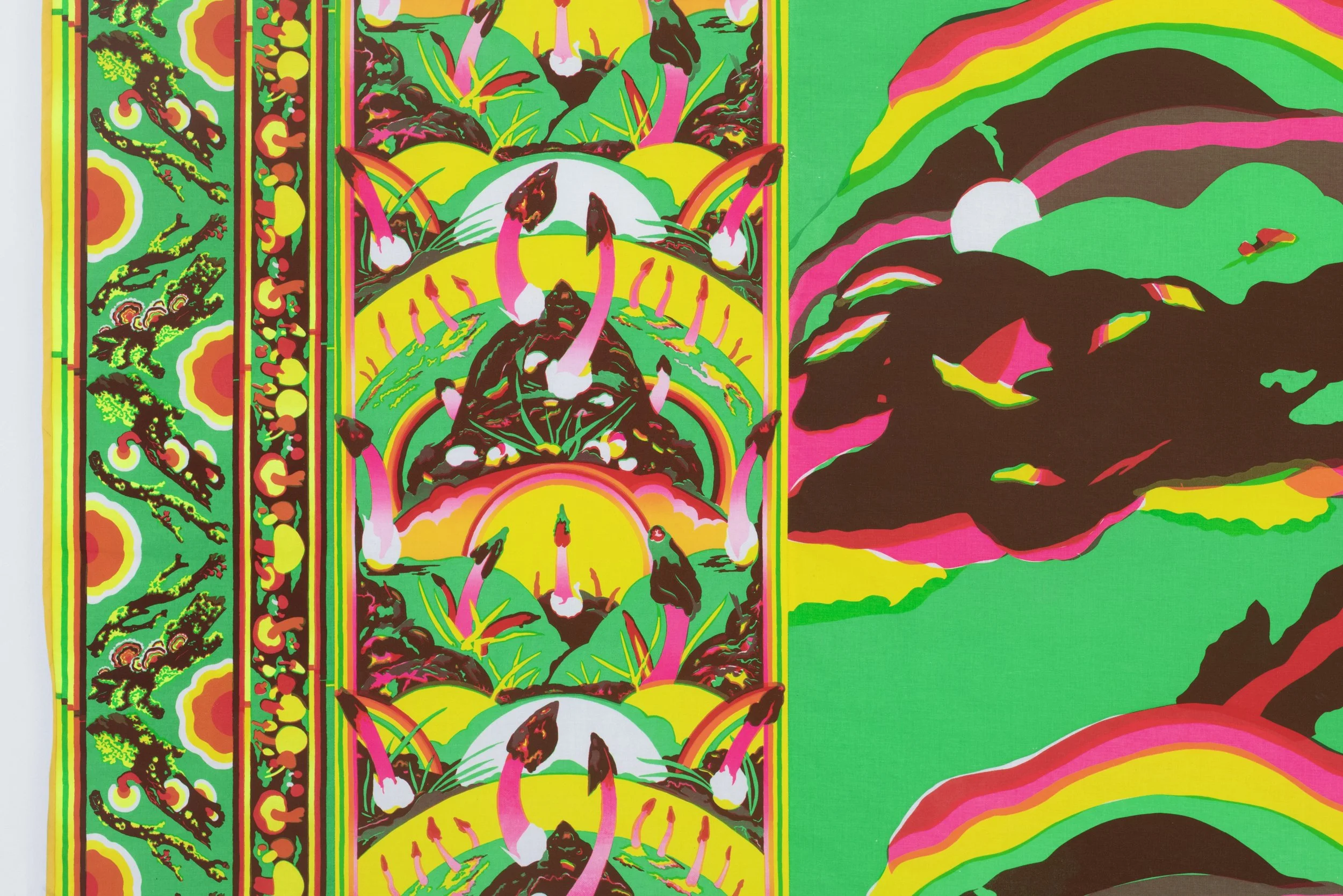
Oh Holy, Blessed Saprotrophs (detail), 2023. Screenprint and monoprint on fabric, dye, batting, 150 x 96 inches
Interview with Katie Kaplan
Hi Katie! Can you tell us a bit about your background and how you became interested in becoming an artist? Who or what were some of your most important early influences?
As a young person growing up in Pittsburgh, PA, I was greatly impacted by the arts programming that was available to me through the Andy Warhol Museum, the community print studio Artist Image Resource, and the opportunity to go to a creative and performing arts public high school. It was through these experiences that I was able to not only be supported creatively, but to be mentored by a wide variety of artists. These folks really made clear to me that choosing this path was possible–and encouraged me to do so. I am incredibly grateful for the opportunities I had at that age, and they are part of the reason that I became an art educator, in order to pass some of this on to the next generation of young artists. It is interesting to look back and see after all these years that I am still using screen printing as a primary part of my practice, which I was introduced to because of Andy Warhol’s legacy and early connection to Pittsburgh, but that I don't really see him as an artistic influence in the traditional sense. More influential in those early days were artists I worked with from Justseeds Art Cooperative, and other DIY punk printmakers and street artists I met at the community printshop.
Where are you currently based and what initially attracted you to working in this place? Are there any aspects of this specific location or community that have inspired aspects of your work?
I very recently moved to Iowa to begin graduate school, and before this recent move I lived in Philadelphia for almost a decade, which is a really special place to be an artist. The arts community there is very large and artist-driven, which means that the work produced is always plentiful and experimental, both materially, politically and collaboratively. I initially moved to Philly to attend the Apprentice Training Program at the Fabric Workshop and Museum. While I had not originally intended to stay after the residency ended, I was swept up in the city and stayed for 10 years. The ecology and landscape of Pennsylvania played a large part in driving my artistic research, and now that I live eastern Iowa, I am beginning to build relationship to the forests, waterways, and prairies I now call home, while also digging in to the reality of living in an area that is heavily dominated by the destruction inherent in industrial agriculture.
Can you describe your studio space? What are some of the most crucial aspects of a studio that make it functional? Do any of these specific aspects directly affect your work?
I’m always moving between drawing, printing, dyeing and sewing while working in my studio—it’s crucial for me to move between mediums to keep things fresh and keep momentum building, as well as to give my physical body a break from each labor intensive area. So it’s super important to me to have many projects going at once, and have different areas set up for each medium. Of course there is always bleeding of materiality between projects, with one leading into another. Since I am a printmaker, I am more often than not working in shared studios. Print shops, usually very fun places to hang out, are optimally communal spaces where mutuality, cooperation and collaboration arise naturally under circumstances of shared tools and equipment. I love making work alongside others, bouncing ideas back and forth, getting and giving technical and conceptual advice. In my practice, I'm curious about collectivity and harnessing the community nature of the print shop and the boundless capacity of the multiple to build power and form coalitions.
What are you working on in the studio right now?
Right now I’m excited to be working through some experiments in stone lithography on fabric, letterpress print object making using hand set type, and doing material tests for breaking out into some new forms in my printed textile work. I’m intentionally entering a phase where I’m more concerned with generative experiments than planning and executing finished works—which feels super necessary for my process right now while simultaneously being a little terrifying.
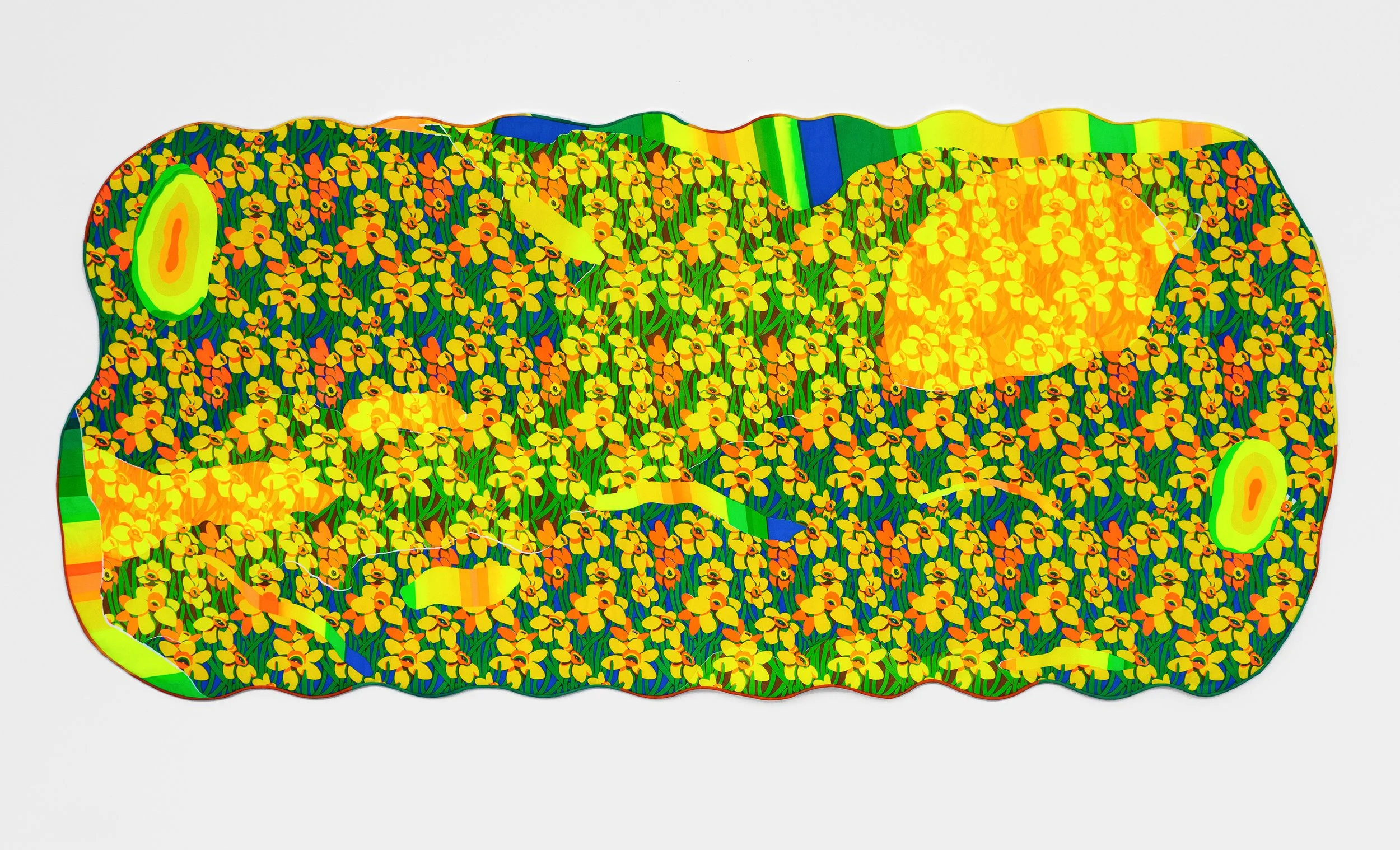
Becoming Vegetal (Have you wanted to join the woodland daffodils?), 2025. Screenprint and monoprint on fabric, dye, batting, 83 in x 110 inches
What are the primary themes of your work right now?
My practice is grounded in experiencing and interpreting ecosystems, and all aspects pertaining to plant and fungal life are the fruitful focus of my research. My current work is interested in both scientific and embodied knowledge, without prioritizing one over the other. What that looks like in practice are the buds of themes that begin with a meeting in the forest, an observation or interaction or transcendent experience, and then are built upon by some scientific, theoretical, or ethnobotanical (etc.) research. For example, recently I have been making a series of prints that focus on the golden oyster mushroom, a fungus I have encountered a great deal in SE Iowa. There is a lot of fresh scientific research being conducted right now about this mushroom as an invasive species, and I am specifically interested in ideas of feral ecologies and what the invasive/native dichotomy shows about human/nature dichotomy. I also like to recognize and capture in my work this spiritual feeling of connection, vitality, and vibration I experience when encountering mushrooms and plants.
What is on your mind a lot recently?
So much—questions of making art during a time where multiple genocides are happening across the planet, the role of the artist in the Anthropocene, the grief of environmental destruction.
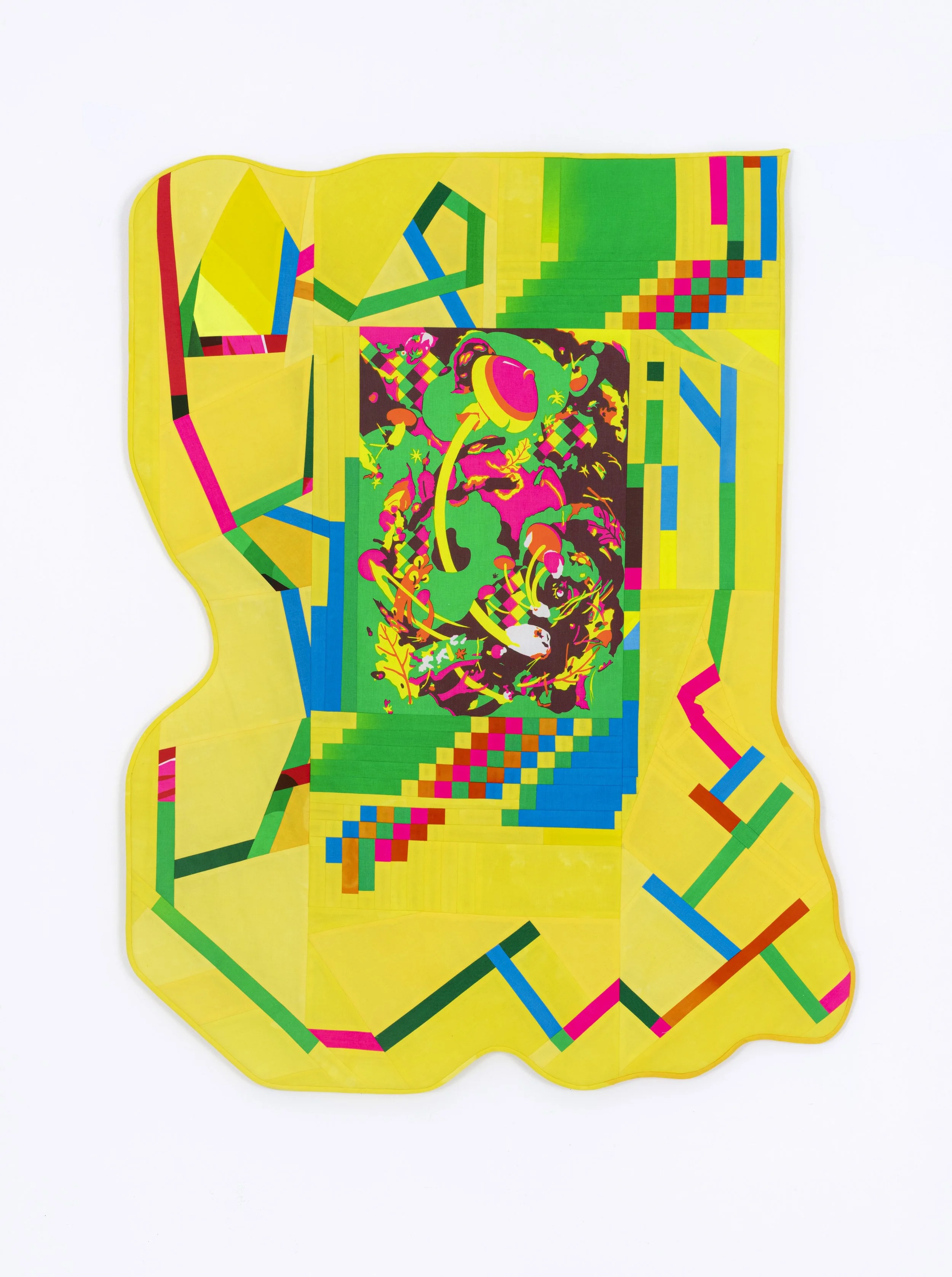
Ahead! The Shimmering Edge, 2024. Screenprint and monoprint on fabric, dye, batting, 47 x 37 inches.
What gets you in a mindset conducive to making work?
An ideal day is having nothing on my agenda except working in the studio and spending time with my family. I make a point to always take one day off a week to spend time in the forest with my girlfriend and dog–entering that space is a crucial reset I lean on throughout the week, a filling of the well, and a neurological and emotional regeneration.
What criteria do you follow for selecting materials? How long have you worked with this particular media or method?
My core is working with print on textiles. Fabrics feel expansive and full of potential for me in terms of what they can become, and what they invoke. The familiar tactile nature of a quilt can immediately form an intimacy, since every viewer is very in tune with the feel of cloth from a young age. That being said, some investigations in letterpress over the past few months have reignited an interest in working with paper as a way to create tactile ephemera. I think that moving forward some of these interactive works on paper will supplement my textile works from a background research/accessibility standpoint.
Can you walk us through your overall process? How long has this approach been a part of your practice?
In my most recent body of work, I am beginning with yards of white fabric. These fabrics are then dyed, screenprinted, cut and sewn into large quilts. Some aspects of the screenprints are carefully planned repeat patterns, hand drafted on transparencies before being exposed to screens and printed in multiple layers. In other instances, the screenprints are created more intuitively, with shapes quickly cut from paper as a fast way to lay down large shapes of color. The quilting process is reflective for me of some of the core themes in my work; it is kin to compost: printed and dyed fabrics are reabsorbed into a new whole, each quilt made from the scraps from the last. The quilt becomes a metaphor for holobiosis and exists as a kaleidoscopic object of reconstituted visions, using the language of abstraction to represent the ineffable qualities of spirit. My artistic process initiates multiple levels of re-interpretation, a constant switching and reforming, like a mirror to the natural cycles of death and regeneration. The reproductive nature of print allows for recontextualizing.
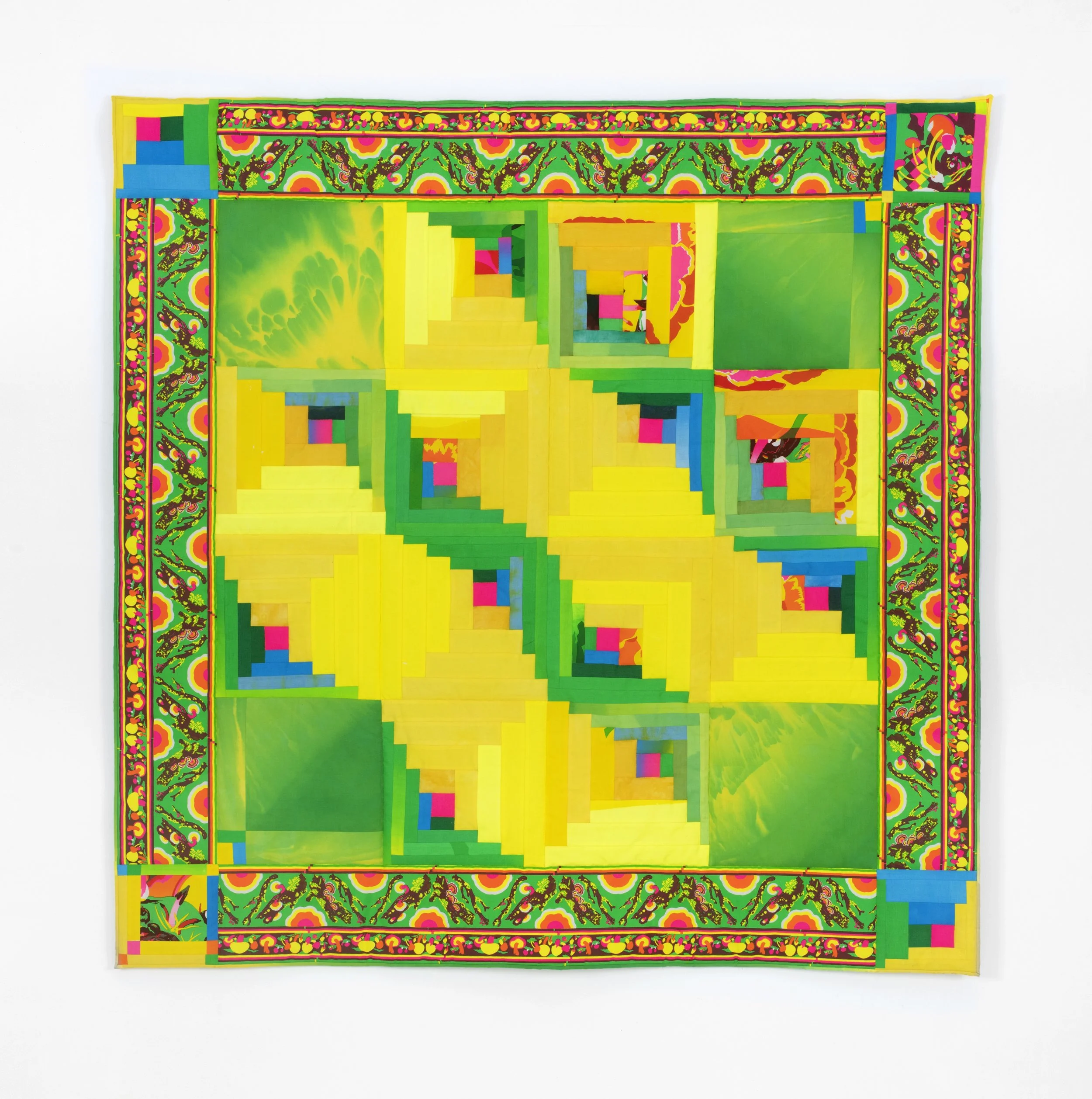
Sunshine and Shadow, 2024. Screenprint and monoprint on fabric, dye, batting, 63 x 63 inches
Can you talk about some of the ongoing interests, imagery, and concepts that have informed your process and body of work over time? How do you anticipate your work progressing in the Future?
A throughline for me has certainly been an interest in one aspect or another concerning the natural world, specifically plants and fungi—there are really endless threads there for me to pull on. Very recently I have been making work surrounding human relationship to bodies of water, which is a new avenue for me. The driving ethos in my work over the past 5 years I’d say is to give honor to the plants and the fungus, to the more-than- human. That feeling of awe and interconnectedness that I get when sharing space with forest—that mystical experience that breaks down barriers of separation—It’s this act of breaking down (like the mushrooms do) that can lead us to a renewed sense of justice for other humans, the more-than-human world, justice for our collective selves. Color is also huge for me, and is where I find the enduring pleasure of making. I go through obsessions with certain limited palettes, currently I am in a green/orange place. I find bright colors irresistible, and this visual quality is an expression of my identity and sexuality, where language falls short; queerness and biophilia manifest as textures, colors, and symbols—as ecstatic joy and holy vibration.
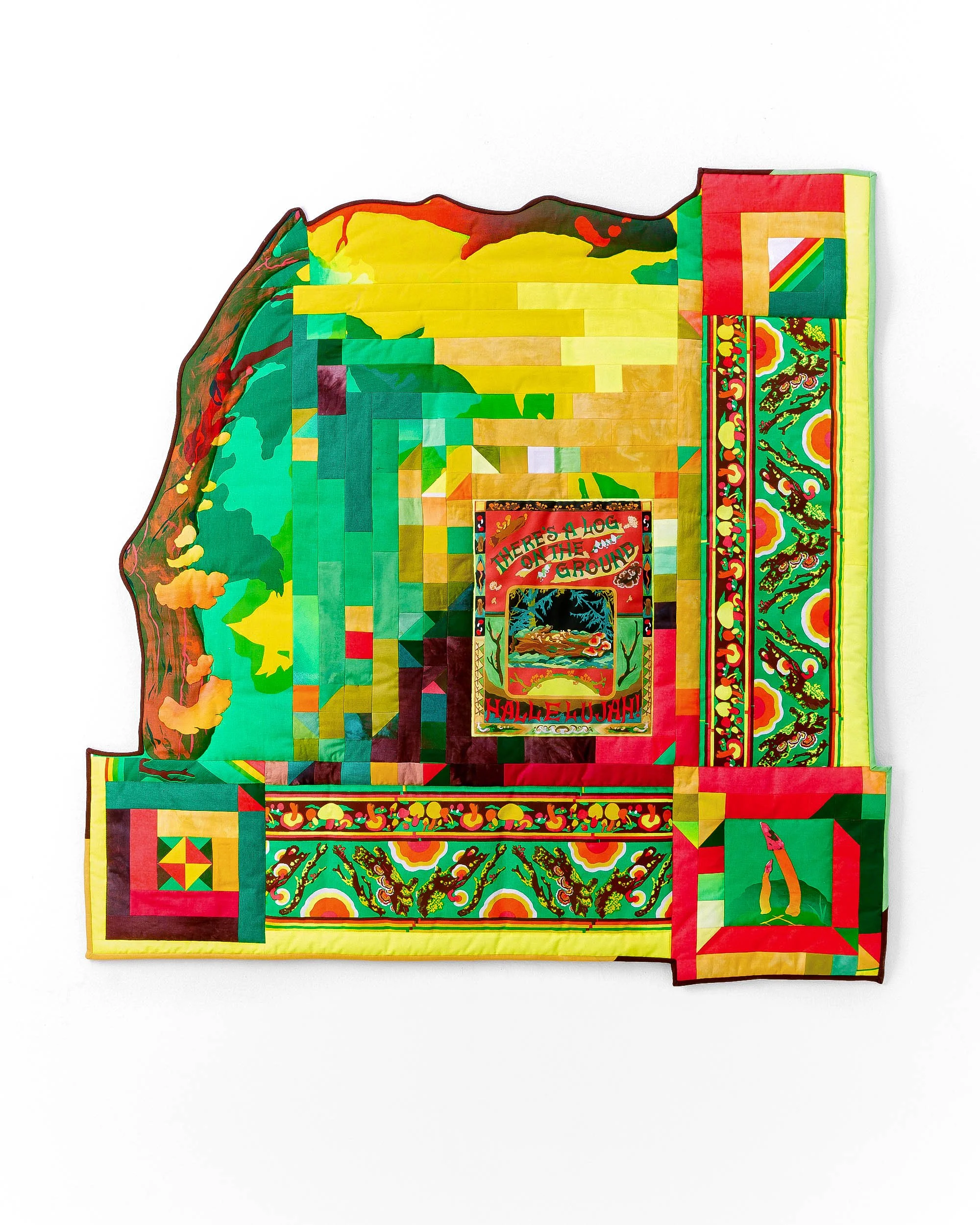
There’s a Log on the Ground (Hallelujah!), 2023. Screenprint, monoprint, digital print on fabric, dye, batting, 45 x 45 inches
Do you pursue any collaborations, projects, or careers in addition to your studio practice? If so, can you tell us more about those projects, and are there connections between your studio practice and these endeavors?
My artistic labor is deeply intertwined with cultural organizing, protest art, and mutual aid projects, as this is where I see my role in the struggle for collective liberation. Whether it be banners for large-scale protests, collaborative projects against incarceration, or an abolitionist billboard—these projects inform all of my creative output. The flat graphic qualities of movement posters, punchy use of text, and themes of justice are interwoven through the whole of my practice. I have done a few collaborations with my dear friends at People’s Paper Co-op and Performing Statistics, and these were super close to my heart. In addition to this work, I also make posters for DIY Theatre productions and occasionally punk shows.
Can you share some of your recent influences? Are there specific works—from visual art, literature, film, or music—that are important to you?
I am very much drawn to, more than ever, physical materials and ephemera, which hold an increasing interest for me. The harder it gets to pull away from the screen, the more special they become. Moss on log, the color scheme of a lottery ticket on the ground, time spent in the library performing acts of bibliomancy, instead of a google search. I read a lot of speculative fiction, which I think informs this sense of earth-centered, non-hierarchical worldbuilding and restructuring I am getting at in a lot of my work. Some perennial favorites here are Octavia Butler, Samuel Delany, N.K. Jemison, and Ada Palmer. I also love comics and graphic novels, because they remind me that I can draw however I want, and be a total weirdo. A current favorite is Brian Blomerth.
Who are some contemporary artists you’re excited about? What are the best exhibitions you’ve seen in recent memory and why do they stand out?
Since I have moved to Iowa City I’ve been enjoying seeing all the local work—a recent highlight was a site-responsive installation focused on handmade paper called Iowa Art Field. The works activated a few different alternative public spaces around the city. I am always interested in seeing the ways artists present work outside of traditional gallery spaces, and this series of works had some really profound interventions with a medium we don’t necessarily always associate with public art. And there are so many contemporary artists to be excited about right now, so I will say the artists who give me the most life are my friends I get to make work alongside in the studio.
Do you have any tips or advice that someone has shared with you that you have found particularly helpful?
One thing I often say to my students is that the most important part of any artistic work that you make, is that it is an expression of your authentic voice. I want to see my students (and everyone!) making what they desire, and I want to see their unique perspective and passion. It’s a simple proposition, but is challenging in an era where there is so much noise, so many outside voices, especially with the rise of generative AI and as people live more and more online.
What’s coming up next for you?
I’m recently back in school, getting my MFA in Printmaking from The University of Iowa. So, I will be focusing on school and teaching for the next 3 years. In the near future, I am preparing for a few upcoming exhibitions in some exciting places. The best place to see these announcements when they come is either on my website or instagram page, so please check back!
Thank you so much for sharing your work and talking with us!
To find out more about Katie and her work check out her website.