
Julie Wills
I am an interdisciplinary artist working in sculpture and installation, with a focus on found materials— especially those used in the building trades. My work explores themes of interiority, interpersonal and communal structures, and the tensions between what we build and dismantle. I am interested in tenderness and longing, which I explore through poetic arrangements of text and materials. My works balance physical pressure, fragility, and tension, mirroring the conceptual concerns at the heart of my practice. My current body of work, titled ‘Subwalls,’ is a series of wall sculptures created from cast-off construction debris. In this work, I use references to architecture, landscape and the night sky to consider what is visible and what is hidden from view, what we build, and what we take apart. I layer materials like rigid foam insulation, drywall and roofing tar in structural assemblages, as if the skin of a building were peeled back to show the infrastructure inside. I use this as a physical metaphor for the infrastructures that support our often invisible social and psychological systems.
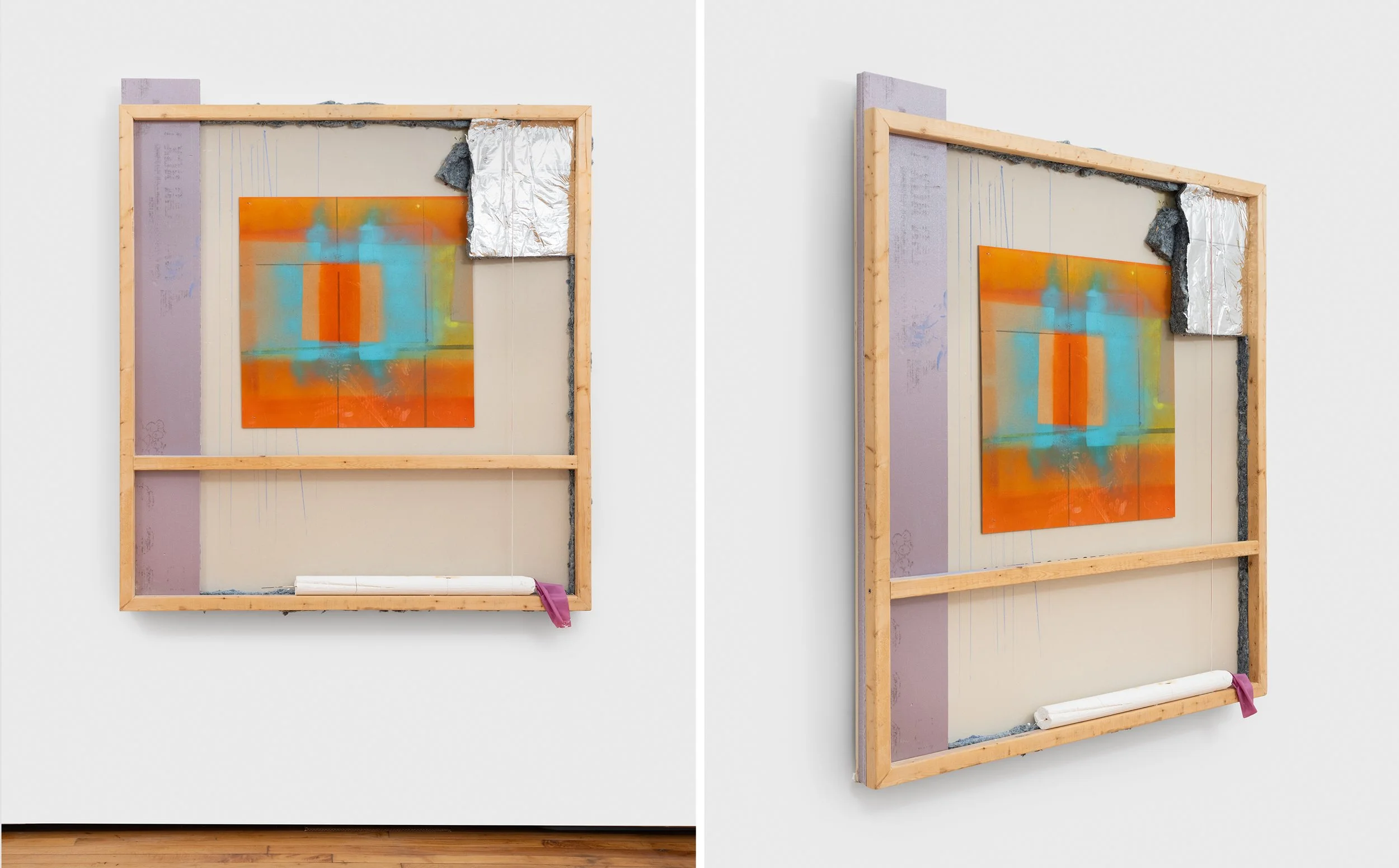
Bullseye, 2024, drywall, dimensional lumber, rigid foam insulation, recycled denim, marking paint overspray on cardboard, plaster, locator flag, builder's chalk, vinyl lettering. 54.5"h x 48"w x 4.5"d
Interview with Julie Wills
Can you tell us a bit about your background and how you became interested in becoming an artist? Who or what were some of your most important early influences?
I’m someone who knew I was an artist from an early age, so I don’t really remember how that started. My parents ran a concrete business when I was growing up, and my dad was a jack-of-all-trades sort, so we frequented a lot of junkyards, swap meets, auto salvage lots, and pawn shops, in addition to playing on the gravel and rubble piles at the concrete batch plant. These are places where you don’t know what you’re going to find, but you spend a lot of time looking at the ground so you don’t trip. Later in my adult life, I was married to a homebuilder and spent a lot of time on construction jobsites. I didn’t make the connection until recently that my material sensibility was formed by so many years looking for unexpected things that are half-submerged in the dirt.
Where are you currently based and what initially attracted you to working in this place? Are there any aspects of this specific location or community that have inspired aspects of your work?
I’m currently based in Baltimore, Maryland, but I’m from Colorado and am perpetually homesick for the West. I moved to the east coast ten years ago, primarily for my teaching job, but also because I wanted to be around other artists after years working in a remote, rural mountain community. I threw out all of my accumulated materials before I moved so I could start fresh, and this changed the character of my work. In Colorado, what I found lying outside my studio was tumbleweed; in Baltimore it is anything but. I love Baltimore, and I love that everything still feels a little foreign to me topographically and materially.
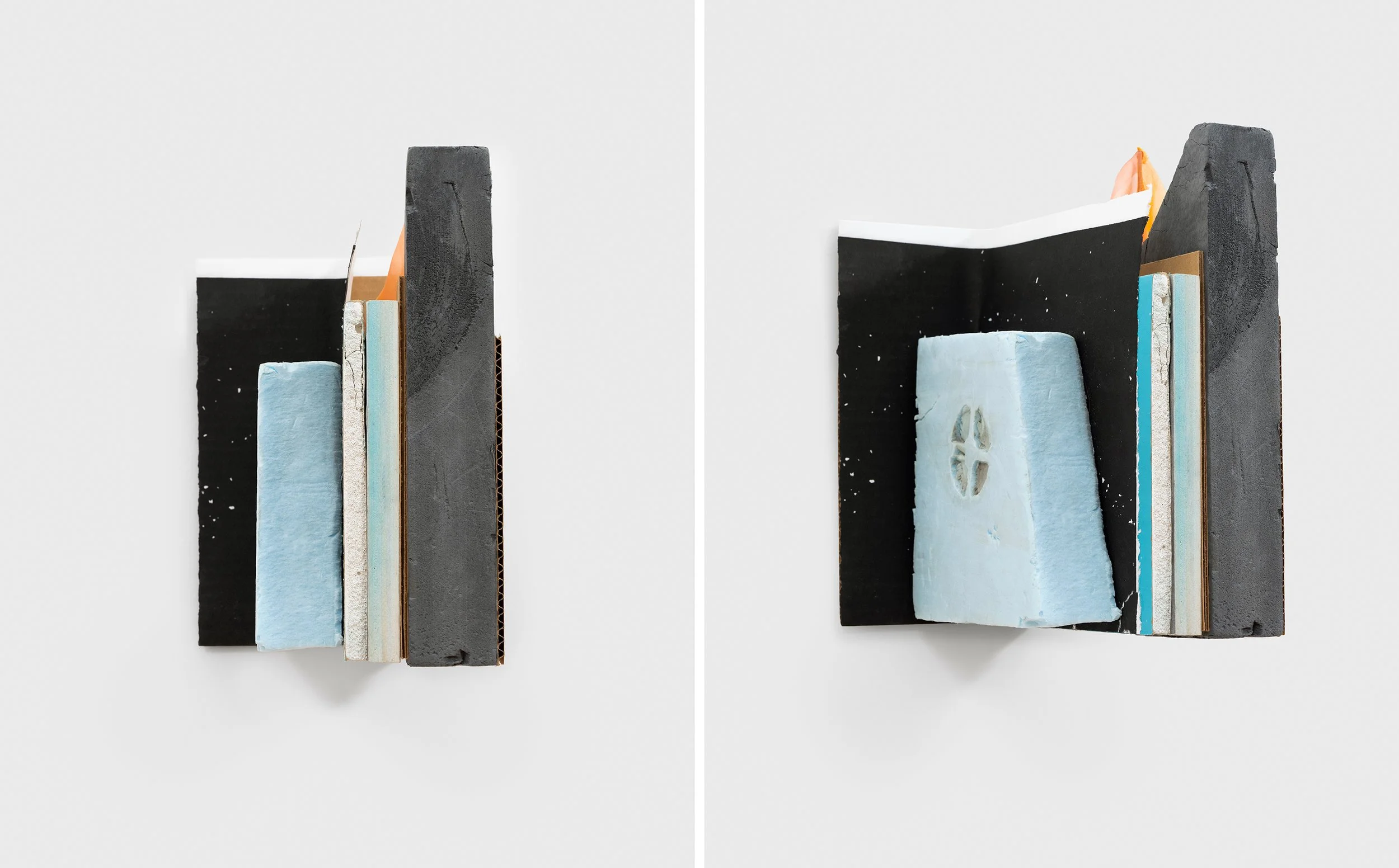
Sky Window, 2024, rigid foam insulation, drywall, intaglio print pulled from asphalt roofing felt, baltic birch plywood, cardboard, spray paint, silk locator flag. 11.5"h x 7"w x 8"d
Can you describe your studio space? What are some of the most crucial aspects of a studio that make it functional? Do any of these specific aspects directly affect your work?
Right now, I’m working in what I suspect will be the best studio of my life—I pinch myself every day. It’s in a big brick building that was an early 1900s canvas mill and is now a warren of artist studios. I feel tucked away or secluded here while knowing I’m surrounded by other artists doing their own private sneaky things. Mine is a corner studio, so I have windows along two walls and incredible light. It is dreamy. And, having a studio I love absolutely impacts my work, though I am proud of how much work I’ve made at a succession of crappy kitchen tables and other less-ideal spaces over the years.
What are you working on in the studio right now?
Sculptural assemblages on sawhorses.
What is on your mind a lot recently?
What I suspect is on all of our minds: how do we survive the structural collapse of our world and everything we have come to trust as permanent? In my work, I’m drawing parallels between architecture and social or psychological structures, and what we build/rebuild/abandon/dismantle.
What is a typical day like? If you don't have a typical day, what is an ideal day?
Ideal day: I like to be in the studio early, but I like to start slow with coffee and a notebook. Artist residencies are the best for this, because the situation is typically that I can get up, make coffee, and sit in my studio writing before I do anything else, and there are no other demands on my time. I make the best work when I get to begin this way.
What gets you in a mindset conducive to making work?
Moving materials around never fails. If I’m not sure where to start when I get to the studio, I just start rummaging and putting things in proximity to one another. This usually leads to some kind of problem-solving impulse, and from there, I’m working.
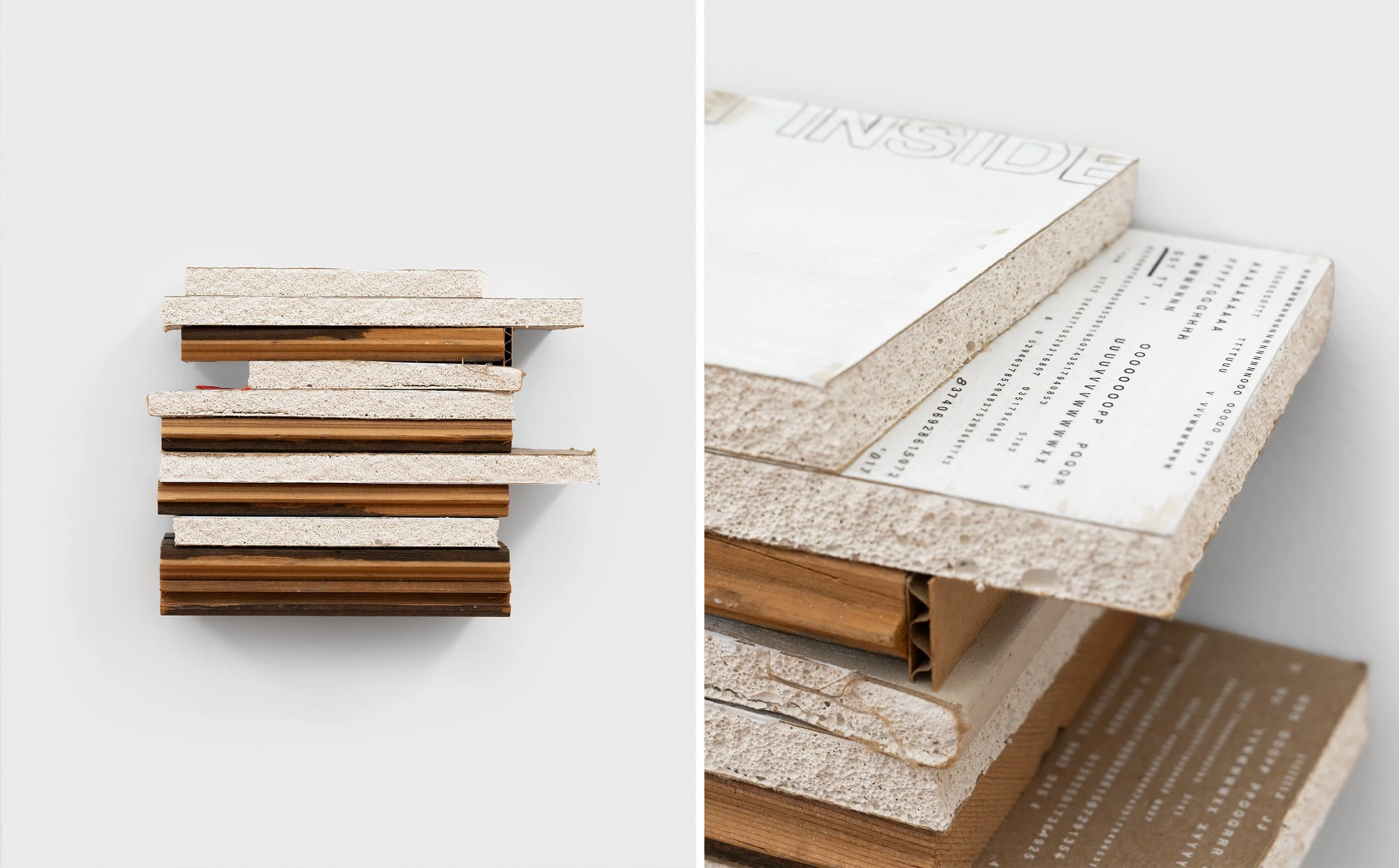
Decades. Centuries, 2024, drywall, tongue & groove wainscot boards, pva drywall primer, ripstop nylon, cardboard, graphite, dry transfer lettering. 6"h x 8"w x 3.5"d
What criteria do you follow for selecting materials? How long have you worked with this particular media or method?
My material selection is intuitive and often starts by noticing things that jump out from my peripheral vision-- for example, the yellow plastic sleeves they put around guy wires on utility poles to keep you from tripping over the cables. Those caught my attention for their bright yellow color, but also for what they do: they alert you to a hidden obstacle. I use underground utility locator flags for the same metaphor. There is a formal aspect to the way I choose materials—color, texture, mass—but I also give a lot of care to their associations: that sandpaper abrades, or that thermostat wire signals heat.
Can you walk us through your overall process? How long has this approach been a part of your practice?
My process differs from project to project, but materials are always central, as is language. I use a lot of text in my work, and writing or recombining text fragments is a big part of my process. I like to think of language as another physical material to be arranged in space, and I think a lot about what language can and cannot do. More than anything, my process involves putting materials and words into unfamiliar relationships, and responding to what happens.
Can you talk about some of the ongoing interests, imagery, and concepts that have informed your process and body of work over time? How do you anticipate your work progressing in the future?
The night sky, more than any other imagery, has been my steady over time. I’m interested in the night sky as a place of both magical and scientific inquiry, where we put our hope when we have no ready solution.
Much of my work over the years has been installation-based, ephemeral arrangements of materials. My recent work began with a challenge I set for myself, to see if I could condense the space of those porous arrangements into discrete objects—hence, the sculptural assemblages for the wall. Now, I’m moving the objects back off the wall but allowing them to coalesce as sculptures, rather than as separate materials.
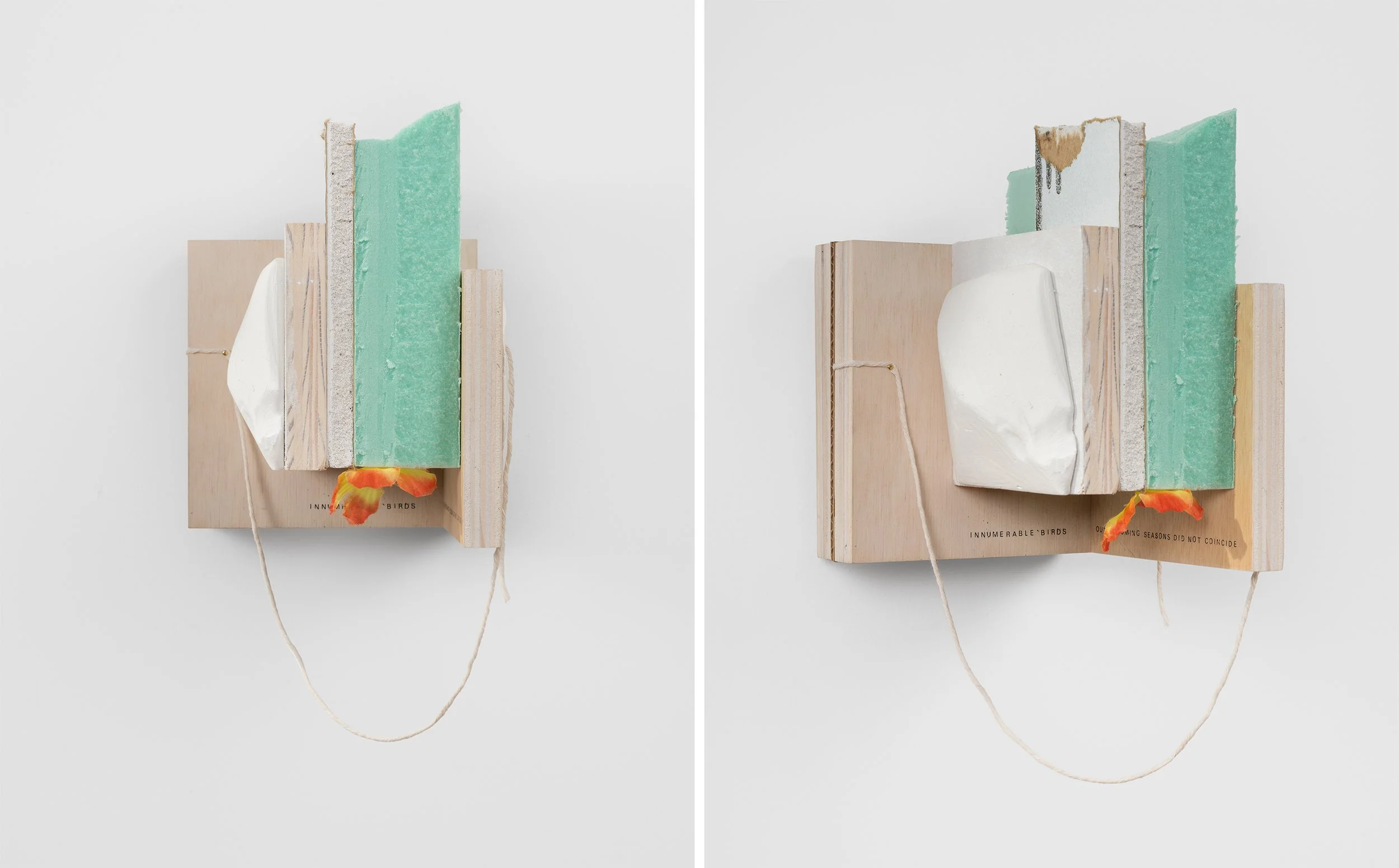
All the Birds of Paradise, 2023, baltic birch plywood, rigid foam insulation, drywall, plaster, string, hardware, petal from artificial flower lei, dry transfer lettering. 12"h x 7"w x 7"d
Do you pursue any collaborations, projects, or careers in addition to your studio practice? If so, can you tell us more about those projects, and are there connections between your studio practice and these endeavors?
I teach art at a college as my main income, but I have a never-ending succession of ideas for side hustles and am considering becoming a bookkeeper, tax planner, stained glass maker, travel influencer, color consultant, and housepainter.
Since 2004, I have been part of a four-artist performance collaborative called The Bridge Club. Over our 20+ years working together, the collaborative work has drifted further from my individual practice than it was when we began, but that collaboration remains one of the most rewarding parts of my professional and creative life.
Can you share some of your recent influences? Are there specific works—from visual art, literature, film, or music—that are important to you?
I had the remarkable opportunity two years ago to travel to the northern tip of Norway to see the Steilneset memorial, a collaboration between Louise Bourgeois (the last major work before her death) and the Swiss architect Peter Zumthor, created to commemorate the site of 17th century witchcraft trials and executions. While in the small town of Värdo, a waiter in the hotel showed me a book with full testimonies of the accused. This, and a book called ‘Caliban and the Witch’ by Silvia Federici, are recently kicking around in my head. I’m thinking about the extremes we’ll go to to make sense of the inexplicable, as well as what happens in the human psyche when fatalism sets in.
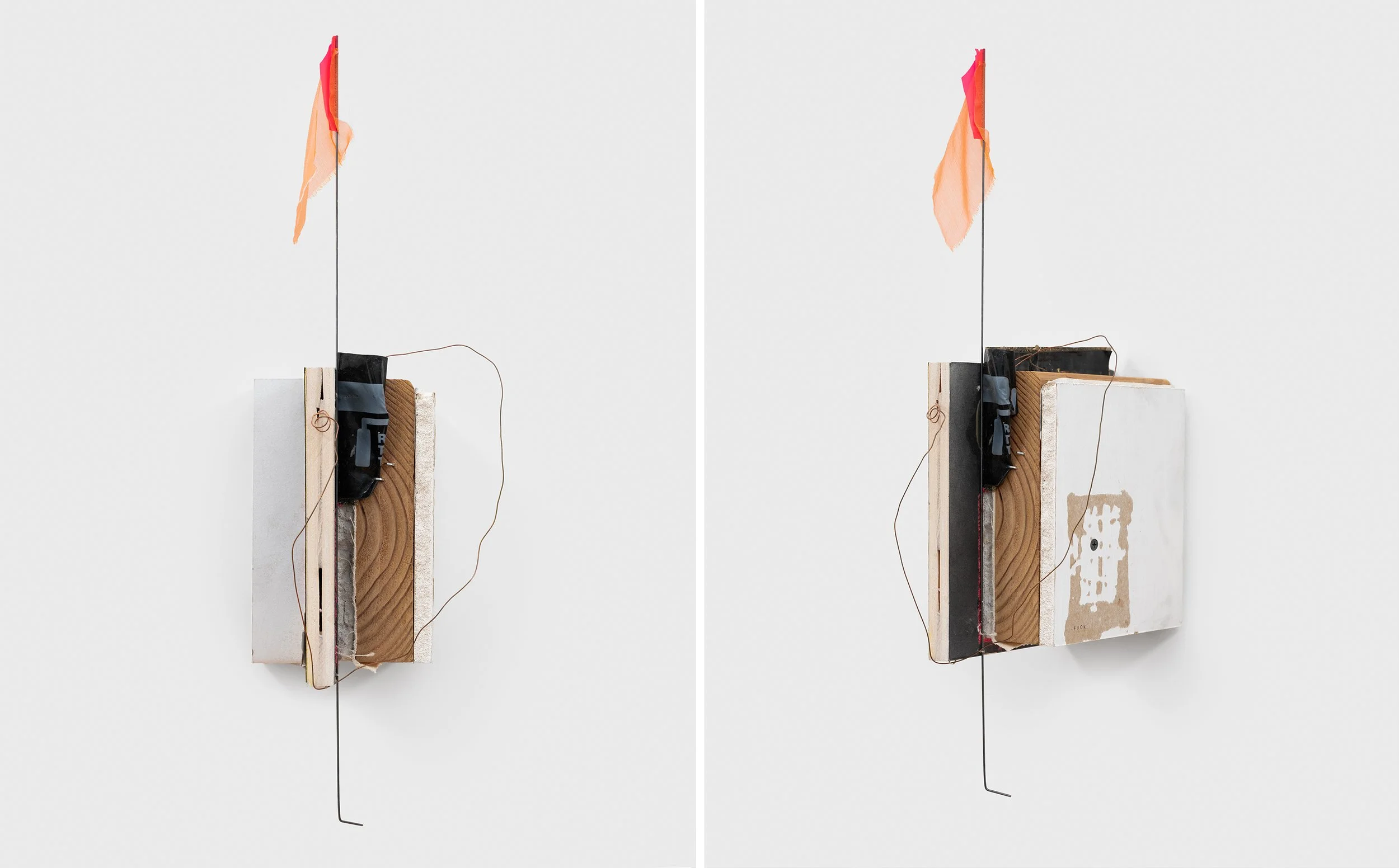
It Takes Time To Mend Something So Broken, 2024, dimensional lumber, birch plywood, drywall, roofing felt, flashing tape, silk. locator flag, ripstop nylon, copper wire, staples, dry transfer lettering. 20.5"h x 8"w x 9.5"d
Who are some contemporary artists you’re excited about? What are the best exhibitions you’ve seen in recent memory and why do they stand out?
Oh gosh—so many. I spend a lot of time seeing art. I’m particularly drawn to provisional materials and provisional arrangements in space, which I think of as being pictorial—that is, we enter a space and move through it finding the best pictorial viewing angles. I’m sure this is the result of Instagram culture, but rather than a negative I find it really interesting—I’m excited about this shift in the way artists use the architecture of the gallery. Leonor Antunes. Esther Kläs. Vlatka Horvat. Fernanda Fragateiro. A show I loved in recent memory was Roland Persson at Färgfabriken in Stockholm—all latex, all masquerading as other materials or things, and all feels so fleeting despite knowing it was all constructed.
Do you have any tips or advice that someone has shared with you that you have found particularly helpful?
The best advice I ever received, which I share with my students all the time, is to write about my work in complete sentences as part of my process. Many of us keep notebooks and can have a tendency to jot ideas in list or bullet point form, but writing in complete sentences leads me to questions that need answering and helps me spot holes in my assumptions about what the work is doing.
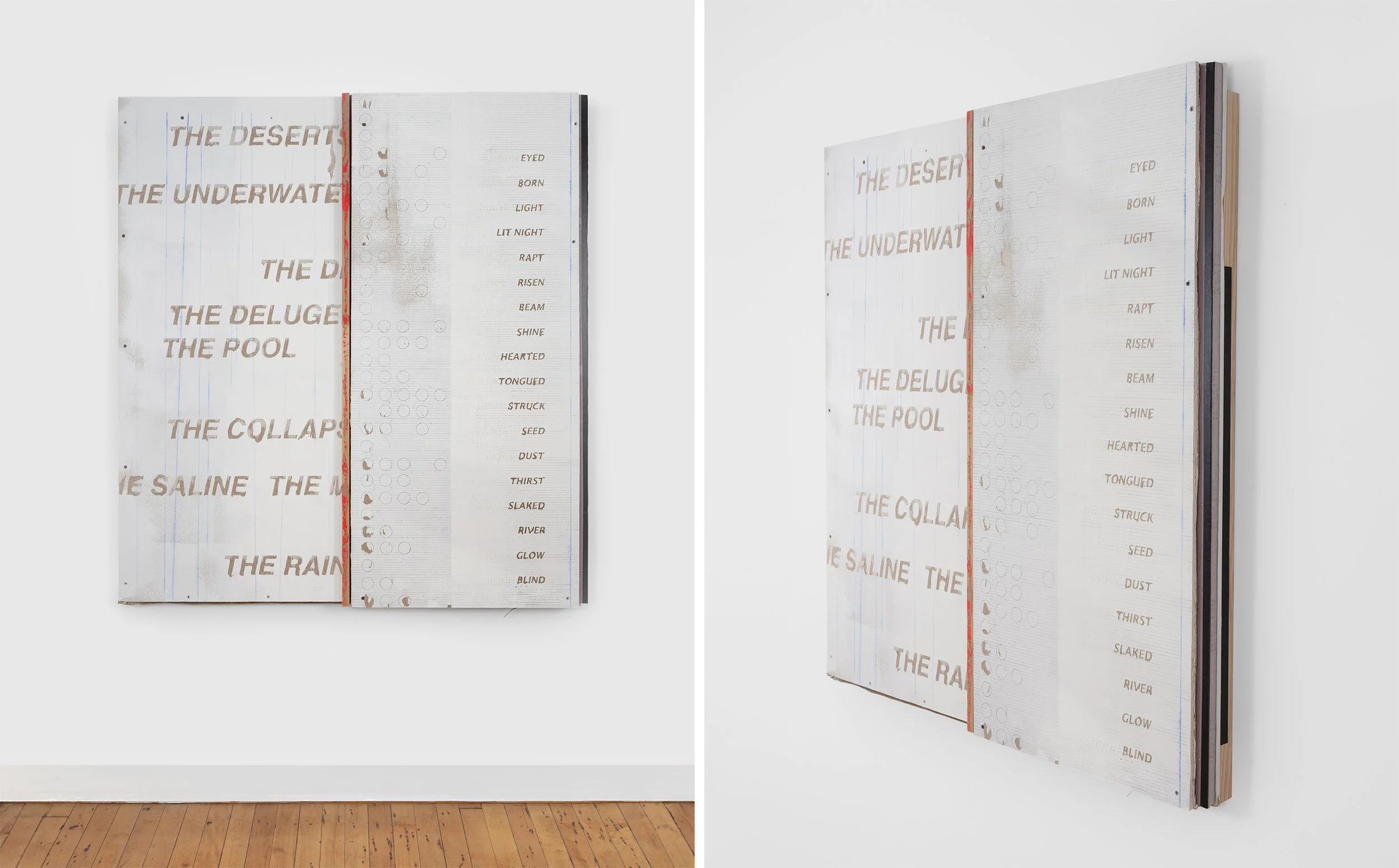
Moon Ladder, 2023, drywall, dimensional lumber, builder’s chalk, marking paint, latex, pva primer, graphite, rigid foam insulation, roofing felt. 52"h x 48"w x 4"d
What’s coming up next for you?
In December, I’m headed to Cittadellarte in Biella, Italy for a residency related to language. I’ll have a full year sabbatical from my teaching position next year, and am in a big application cycle, hoping to do several residencies over my sabbatical. I have a solo exhibition at a regional museum next fall. I’m learning Spanish and Italian.
Thank you so much for sharing your work and talking with us!
To find out more about Julie and her work, check out her website.