
JJ Miyaoka-Pakola
I construct paintings using short phrases taken from personal experiences and social media trends. The choice of words is generally quick and reactionary. I do not dwell on the writing, and my script is fast and loose. After writing the words on the canvas, I paint fields of colors and gradients of hand painted dots. The experience is painstaking, intense, and sensual. As I paint around my script, the words grow less legible. It is an act of translating; from quick thoughts to slow actions, literacy to sensorial experience, the quickly understood and forgotten to slow touches full of intent.
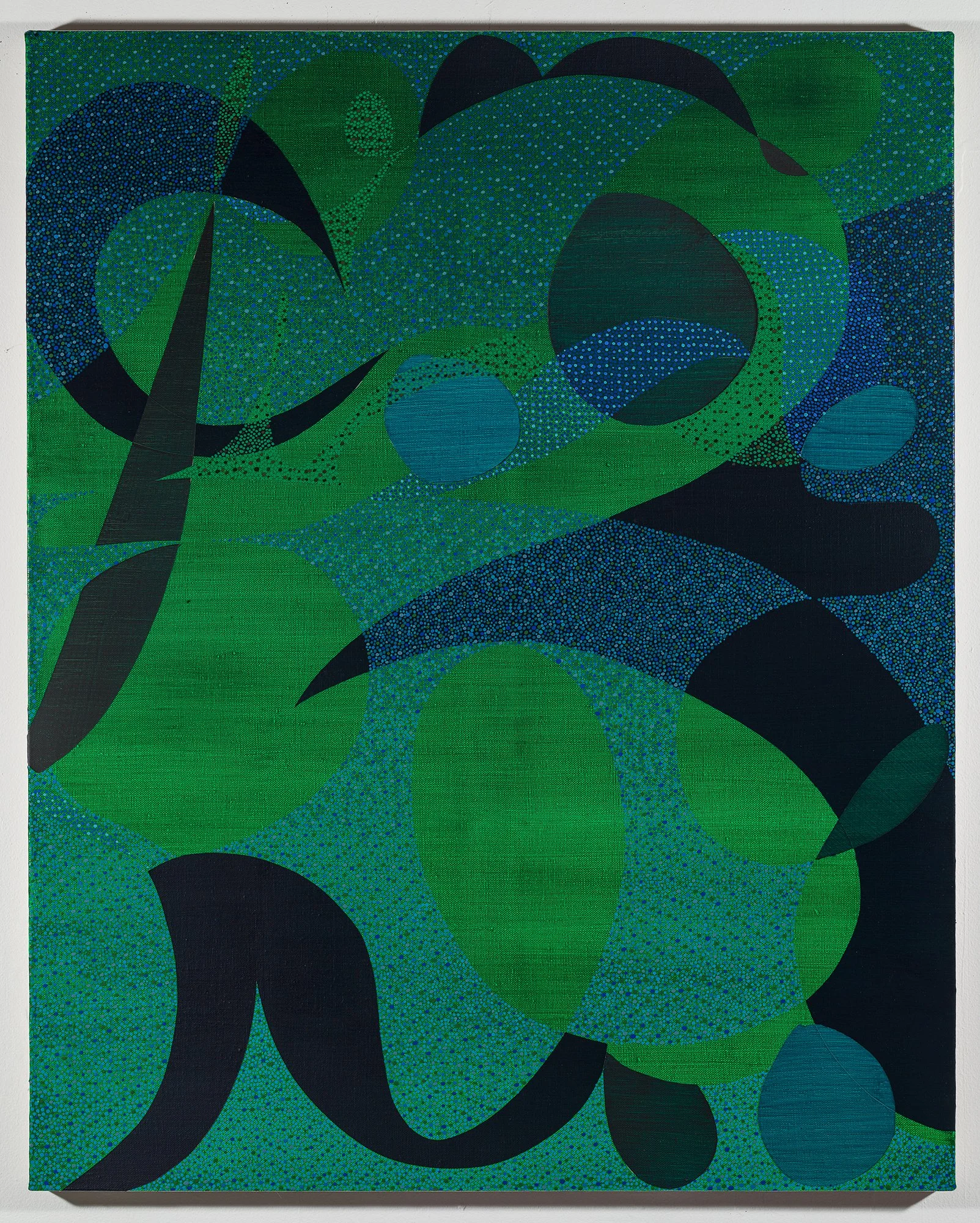
PTP #2, 2023. Acrylic and urethane on linen, 37.5 x 30 inches
Interview with JJ Miyaoka-Pakola
Hi JJ! Can you tell us a bit about your background and how you became interested in becoming an artist? Who or what were some of your most important early influences?
I grew up in a small town outside of Philadelphia. There were few opportunities to see art, and I did not imagine that it was possible to be an artist. I spent most of my time playing sports and being outside with friends. In my childhood bedroom, there was a small reproduction of a seaside painting mounted on a varnished piece of wood with rusticly scalloped edges hanging on the wall. I have no idea where it came from, but it looked like it was purchased in a quaint store in a touristy New England beach town. I spent a lot of time looking at it, and only realized it was a reproduction of a Manet many years later, when I saw the actual painting at the Philadelphia Museum of Art’s “Manet and the Sea” exhibition as an adult. Did this contribute to me being an artist? Who can tell, but it is a fact that it looked pretty out of place when I surrounded it with pages torn from punk and thrash metal magazines in Middle School.
I do not remember art being a large part of my childhood, but do remember times where I felt embarrassed by how bad at it I was. I found it so difficult that it was hard for me to even put pen to paper. I have this memory from grade school where we were all making drawings for gifts for other classmates, and when I gave mine to my friend, he politely said, “ no thank you” and handed it back to me. I think I didn’t draw again until I took an art class in my junior year in high school. The teachers were extremely encouraging, and they allowed me to raid the supply closet to make whatever I wanted. I was still embarrassed about what I was making, but I really enjoyed the challenge. It seemed impossible to make something good. I still find it surprising that when, on a somewhat of a whim, I joined a friend for a portfolio review for the Tyler School of Art and we both got accepted on the spot. That day provided the opportunity to make life long friends at Tyler, and started the path that I am on now.

Prod Poke Pound Pierce, 2024. Acrylic and urethane on linen, 70 x 51 inches
Where are you currently based and what initially attracted you to working in this place? Are there any aspects of this specific location or community that have inspired aspects of your work?
If someone would have told me 25 years ago that I would live in NYC and love it, I would have spit out my drink laughing. Looking back, it seems like I did everything possible to avoid it. I tried Philadelphia, a short stint in Europe, Tokyo twice, and San Francisco before ending up here. I don’t regret living in those other places, but NY has felt like home since the minute I arrived. All of the chaos, cost of living, and heavily leaning on capitalism is equally balanced out with a sense of community, diversity, and the possibility of art being an integral part of daily life.
My work is emotional and very personal, so it inherently reflects my environment. When I was in San Francisco the work meditated on the surrounding natural beauty of Northern California and the breaking down of boundaries with bodies moving through space. After moving to NY, I slowly shifted from the decay of matter in great expanses to enclosed spaces like caves to finally where I am now, the deterioration of language and its concurrent transfer of meaning. The representation of trees and great depths of field were replaced with words and the physicality of paint as a material itself.
Can you describe your studio space? What are some of the most crucial aspects of a studio that make it functional? Do any of these specific aspects directly affect your work?
My studio is in an old red brick factory building that housed a historic brewing company in the 1800’s, then later was a Heinz factory. The space I am in has 9 semi private studios in a larger space with a beautiful wooden ceiling that is probably 25 feet above the floor. I think my space is around 240 square feet. It is a tight fit sometimes, but a friend and I built a storage rack a few years ago that is helpful. I generally only work on one painting at a time, so one wall is dedicated to painting. The other walls are usually filled with recently finished paintings. I have a few tables for drawing, working on small sculptures, and office work. There are many other artists in the building. I wish there was more time in a day so I could spend more time learning about what they are up to both personally and artistically.
More than the space of the studio itself, the location and distance from my apartment is helpful. During the 40 minute commute, I walk through Prospect Park and a few very different neighborhoods on the way. The time provides a break in between my homelife and studiolife. My thoughts along the way can be hurried, stressed, unfocused, but also sometimes joyful or meditative. By the time I arrive, I have cycled through my thoughts and am ready to work.
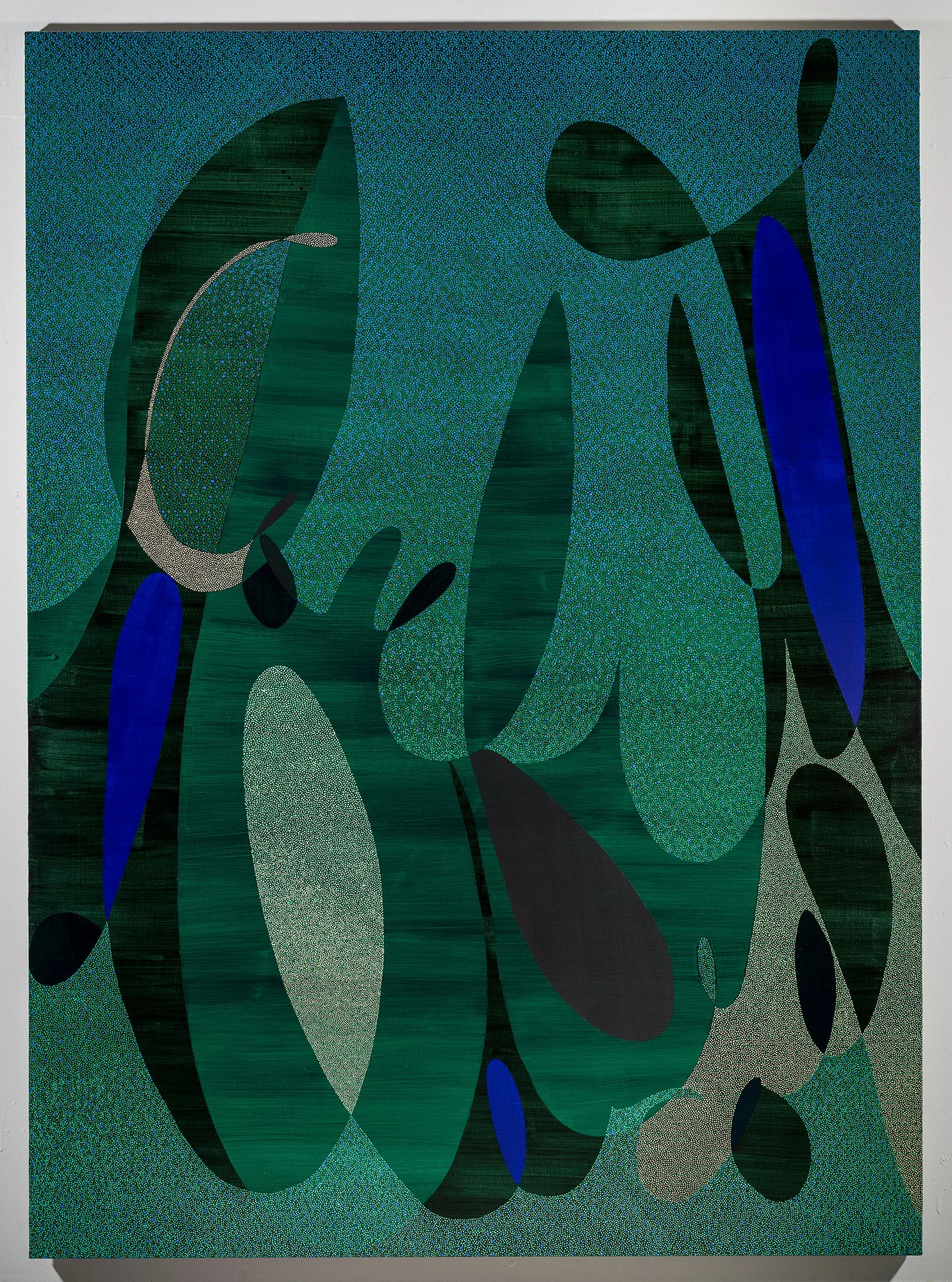
Careful Quiet Delicate, 2024. Acrylic and urethane on linen, 70 x 51 inches
What are you working on in the studio right now? What are the primary themes of your work right now? What is on your mind a lot recently?
I have been working on a large painting using the words “damp,” “darkness,” and “floating” for the past couple of months. It is the first painting in years that the size is completely outside of my reach in each direction. Like its themes of grief, being unmoored and being without light, it is difficult to grasp and move. I must have dropped it a few times already while trying to adjust it on the wall. I am pouring paint and moving it around without a brush, allowing it to be a bit more unconstrained. In the end I think it will be more a representation of perseverance and how grief is an expression of love, rather than just the pain of loss. But I am just starting, so I can not be sure where it will end. Wish me luck.
What is a typical day like? If you don't have a typical day, what is an ideal day?
Typically, I arrive just before 9am and get right to work. I keep working until I have to stop due to hunger or exhaustion. This usually means that I take a quick lunch break, and start to clean up the messes I made around 5pm. An ideal day is one with few distractions and lots of twists and turns where my plans change and I make many active decisions. Pushing and pulling ideas from what I see. I think my work can look like it has a firm predetermined plan or outcome, but they are actually quite fluid and evolve from the first mark to the last time a brush touches the support.
What gets you in a mindset conducive to making work?
When I was younger, my mindset had to be perfect for the work I was making. It was quite a hurdle, because my mindset is constantly moving, changing, wiggling out of any shape that contains it. While it was good in some ways, it made it difficult to complete artworks and was maybe even a reason to be inactive. Now, my mindset follows the art, and is set by the act of making it. It is less dependent on how I feel on a given day, and more a conversation with what is in front of me. There is a lot of back and forth.
I rarely take long breaks from the studio, because I now realize how lucky I am to have the time to focus on making the work. Apart from the last few years, I have always had to try to squeeze making work into a few little slivers of time sporadically placed over a span of a year. My studios were always in my living space, occupying most of the small amount of available area in a shared apartment. It is a privilege to have a dedicated studio and any amount of time to be creative. I can no longer take it lightly, and that propels me past any obstacle that my mind can throw at me.
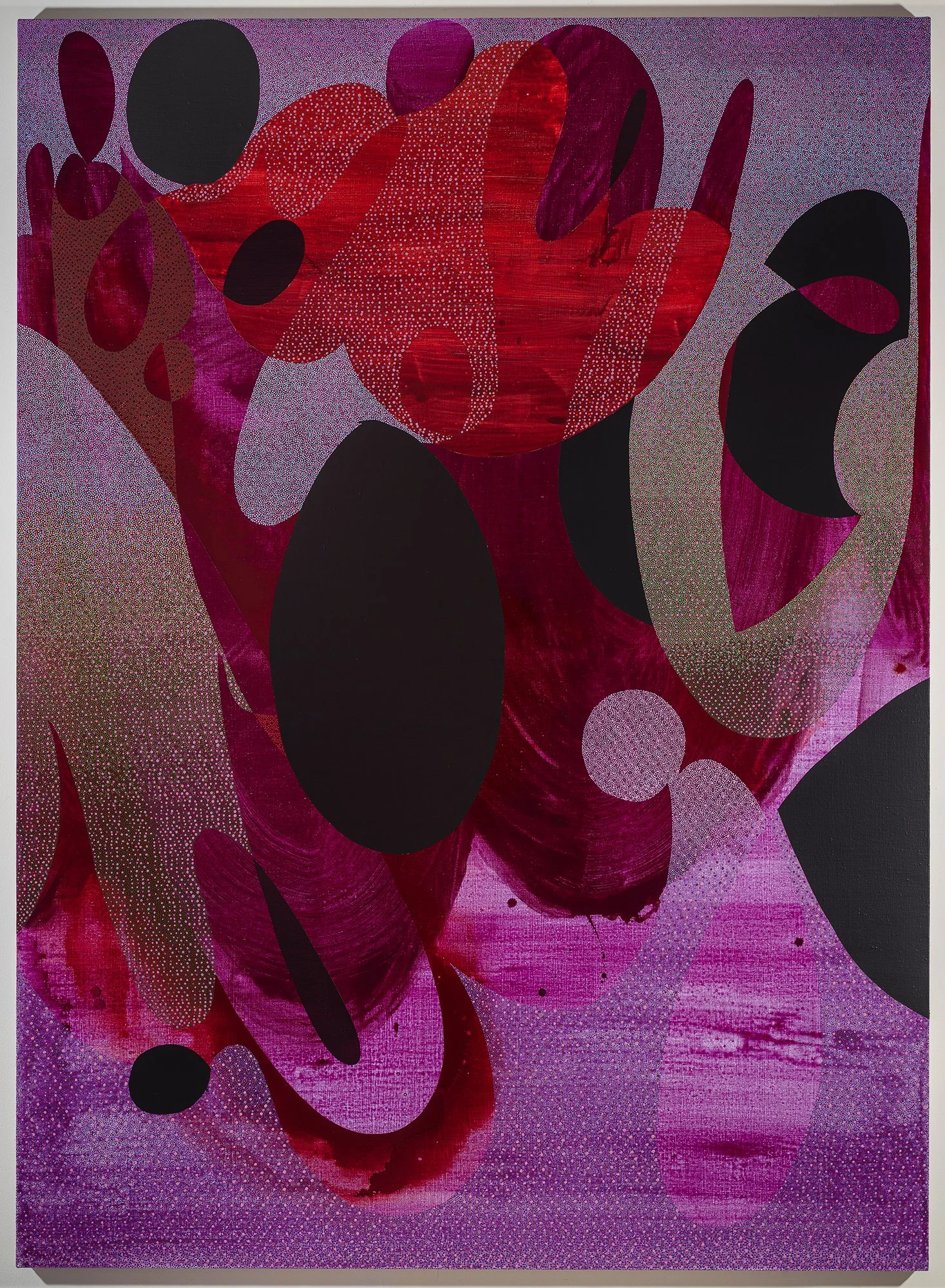
Heavy Weight, Long Shadow, 2025. Acrylic and urethane on linen, 70 x 51 inches
What criteria do you follow for selecting materials? How long have you worked with this particular media or method?
It is all about touch and color. I make a lot of my own paints by adding dry or dispersion pigments to different binders. I started using pure pigments around 10 years ago when I visited a store in Tokyo aptly named Pigment. I think they have over 4,000 colors, and it is an amazing place to visit. Then later someone suggested Guerra Paint and Pigments here in NY, which is equally magical to me. Since I am not a paintmaker, it creates a lot of unpredictable results that I have to work with. Colors turn out different, the sheen of the paint turns out different. The way the paint handles is different. It adds some variability to my use of material, and keeps me on my toes and reactive, rather than prescriptive, as a painter.
Can you walk us through your overall process? How long has this approach been a part of your practice?
I have been working with and developing a general process over the last 10 years. I start by writing words that are evocative of a mood or thought I am having. I write them in cursive, then try to write them in reverse, after a short time the most resonant words start to form the architecture of the painting. I make a few sketches by writing the words over a small rectangle, then use the drawings as references for the painting. The paintings start off with thinned down layers of transparent paint. When the many layers work together to form a rich and complex color, I start to work from the sketches to fill in the information around the lines of my writing. The lines become edges as the shapes in between them are filled with tightly packed dots of many different colors. It all comes together as a tangle of information and the words become illegible.
Can you talk about some of the ongoing interests, imagery, and concepts that have informed your process and body of work over time? How do you anticipate your work progressing in the future?
I am interested in moods more than a straight forward narrative. I want to be immersed in an atmosphere. If I were to draw a comparison, it would be similar to a painter like Albert Bierstat layering weather systems in a large landscape. Snowing in one area, clear Summer sky in another, and brewing thunderstorms near the foreground. All the weather is squished into a millimeter of paint, but also reaches 100 miles into the space of the landscape. It does not seem possible for all the weather systems to be in the same site line at the same time in reality, but in painting, I can use color and the tactility of paint with differing degrees of attention to create an emotional state, or a space to search without intending to find a specific thing. The activity of looking and being aware of looking in itself becomes important. I am not sure how this will change in the future, but I am looking forward to finding out.
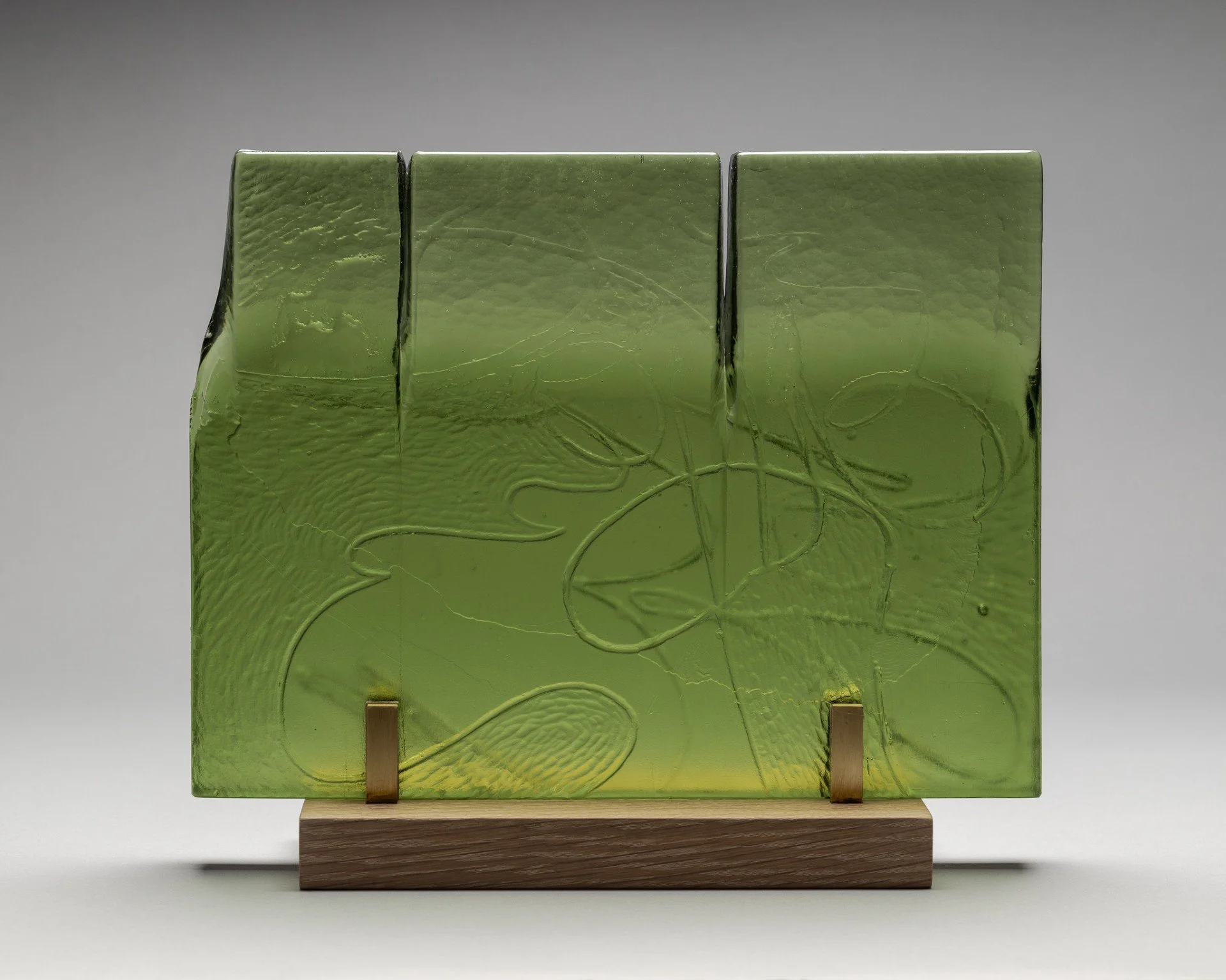
tbd (olivine), 2025, cast glass, 11h x 16w x 1.25d inches
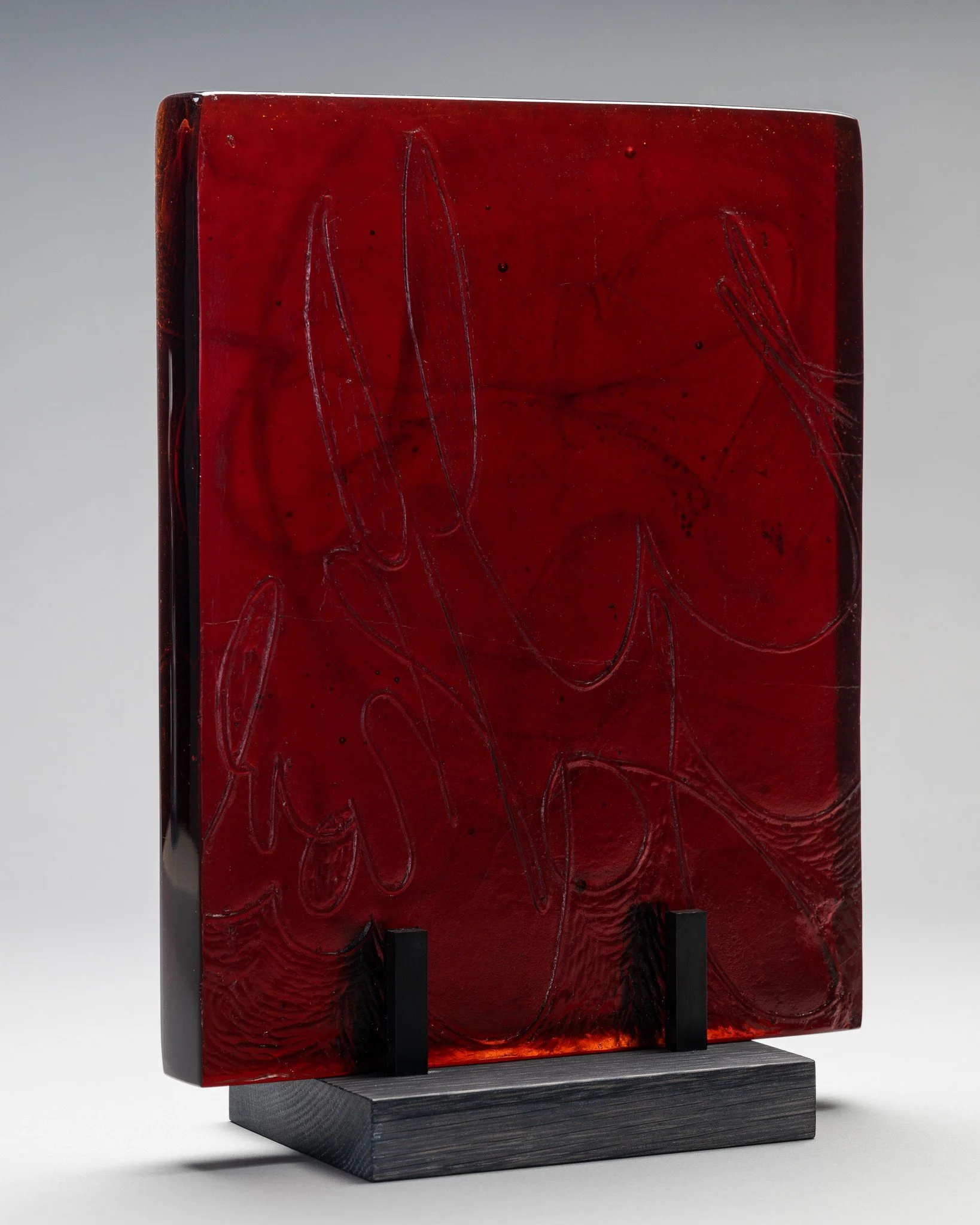
tbd (burnt scarlet), 2025, cast glass, 16h x 11w x 1.25d inches
Do you pursue any collaborations, projects, or careers in addition to your studio practice? If so, can you tell us more about those projects, and are there connections between your studio practice and these endeavors?
Over the last year I have been making cast glass sculptures. I worked with Urban Glass and Shiny Sparkle studios in Brooklyn. I feel greatly indebted to them both for all the help they provided. I look forward to working more in glass, and am going back and forth between a few ideas that I would like to explore soon.
Cast glass is very different from what I do as a painter. All of the creative work is done upfront, then it is largely reliant on the process of casting and the science and guesswork of using a kiln. I am trying to think of a way that it can be creatively active and have less predictability inherent to how I approach it. I have a few ideas right now that I will start to work with more seriously once I finish the painting I am working on.
Glass is also inherently beautiful. I start out with these perfectly gorgeous transparent bricks that look like giant jolly ranchers, and end up with a block of material muddled with my thoughts at the end. Maybe the result between my usual studio practice and the glass work is not so dissimilar after all?
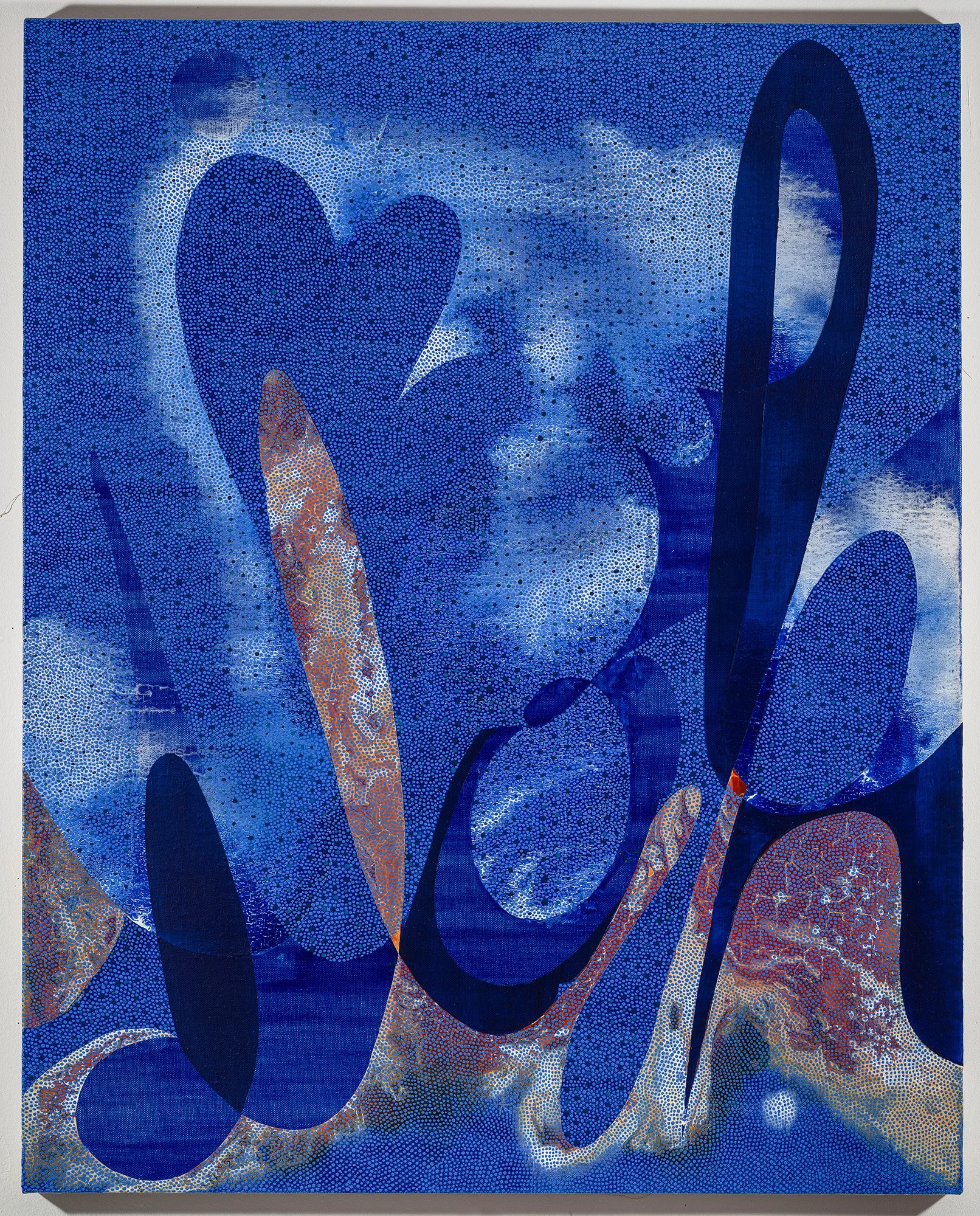
Mouth to Dirt, 2025. Acrylic and urethane on linen, 37.5 x 30 inches
Can you share some of your recent influences? Are there specific works—from visual art, literature, film, or music—that are important to you?
I have not been a consistent reader for the last few years, so I took some time this past summer to catch up and read whatever would become available in my queue at the library. One of the last books I read was Teju Cole’s “Tremor”. There is a passage where a lecturer describes T.M.W. Turner’s painting “Slave Ship (Slavers Throwing Overboard the Dead and Dying, Typhoon Coming On)”. It has led me to start reading Siddhath Kara’s “The Zorg” which is a historical account of the slave ship depicted in the painting. I am also towards the end of listening to Naomi Klein’s “Doppleganger”. The three of these books may not directly influence my work, but alone and in combination are very much in my mind right now.
Who are some contemporary artists you’re excited about? What are the best exhibitions you’ve seen in recent memory and why do they stand out?
The last exhibition that really struck me was the Jack Whitten retrospective at MoMA. I have loved his work for a long time now, but seeing more of his expansive grasp of visual language was jaw dropping. He played seriously with material until the end, and I think it was inspiring. More recently, I saw William Kentridge’s Sibyl at Powerhouse Arts. It's rare that I find artworks with hyphens interesting, but this production’s combination of visual art, film, opera, and dance really impressed me. There are parts where all the elements are cohesive, and other times where they break apart and almost compete for attention. It was also beautiful, and I hope to see more beauty in the future.
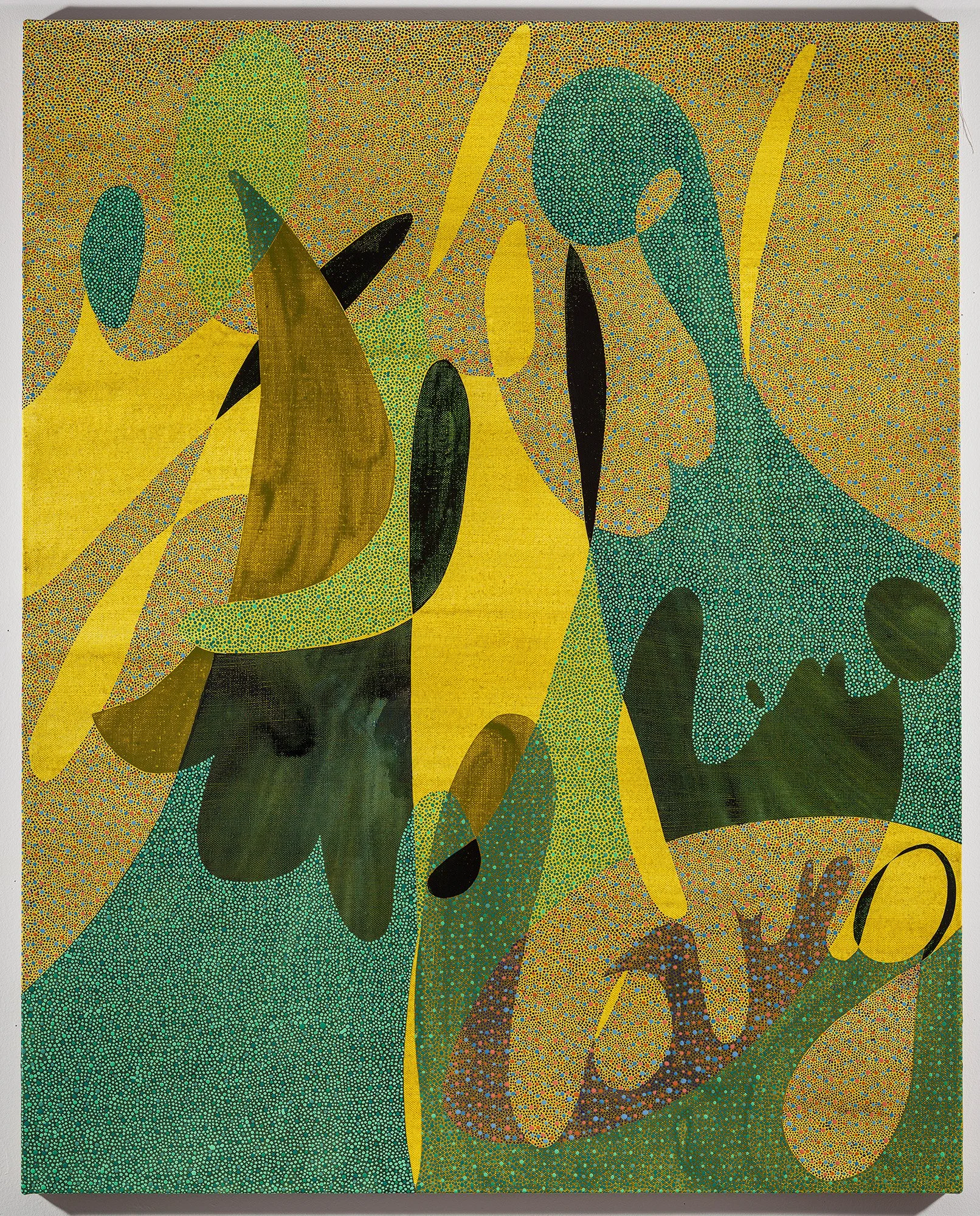
Pushing Shoving Pulled, 2025. Acrylic and urethane on linen, 37.5 x 30 inches
Do you have any tips or advice that someone has shared with you that you have found particularly helpful?
The advice that has most driven who I am today is to strive to see and experience things in person. If there is something you want to see, and can do it, do your best to get there.
What’s coming up next for you?
Right now I am very glad to be in full on studio mode. When I get a chance to come for air in a few months, I may have some news for you.
Thank you for taking the time to share your work with us!
To find out more about JJ and his work, check out his website.