Ilana Zweschi
My paintings involve math and reflections on society. Through hand-written algorithms, I am able to transform any text document into colorful oil paintings. Working with a “seed image” of a figurative under-drawing, I run my algorithms across the image, sometimes being instructed to pull shapes from the drawing, other times covering it with vertical marks or flat spaces. The algorithm is written as a series of “if/then” statements that connect my abstract visual language to the direct language of a text document. One small moment in the drawing can cause a ripple effect of painted marks echoing off of and overlapping each other, sometimes more or less depending on the designated zones in the painting.
The texts I translate are specifically chosen to be ones that represent harm in our current society. I often focus on laws or legal documents since those are written accounts which explicitly state the priorities of society or what is accepted as civil. Through the act of transforming them into paintings, I can obscure, reorder and highlight the words that make up the text, disarming them and building something beautiful and empowered out of them.
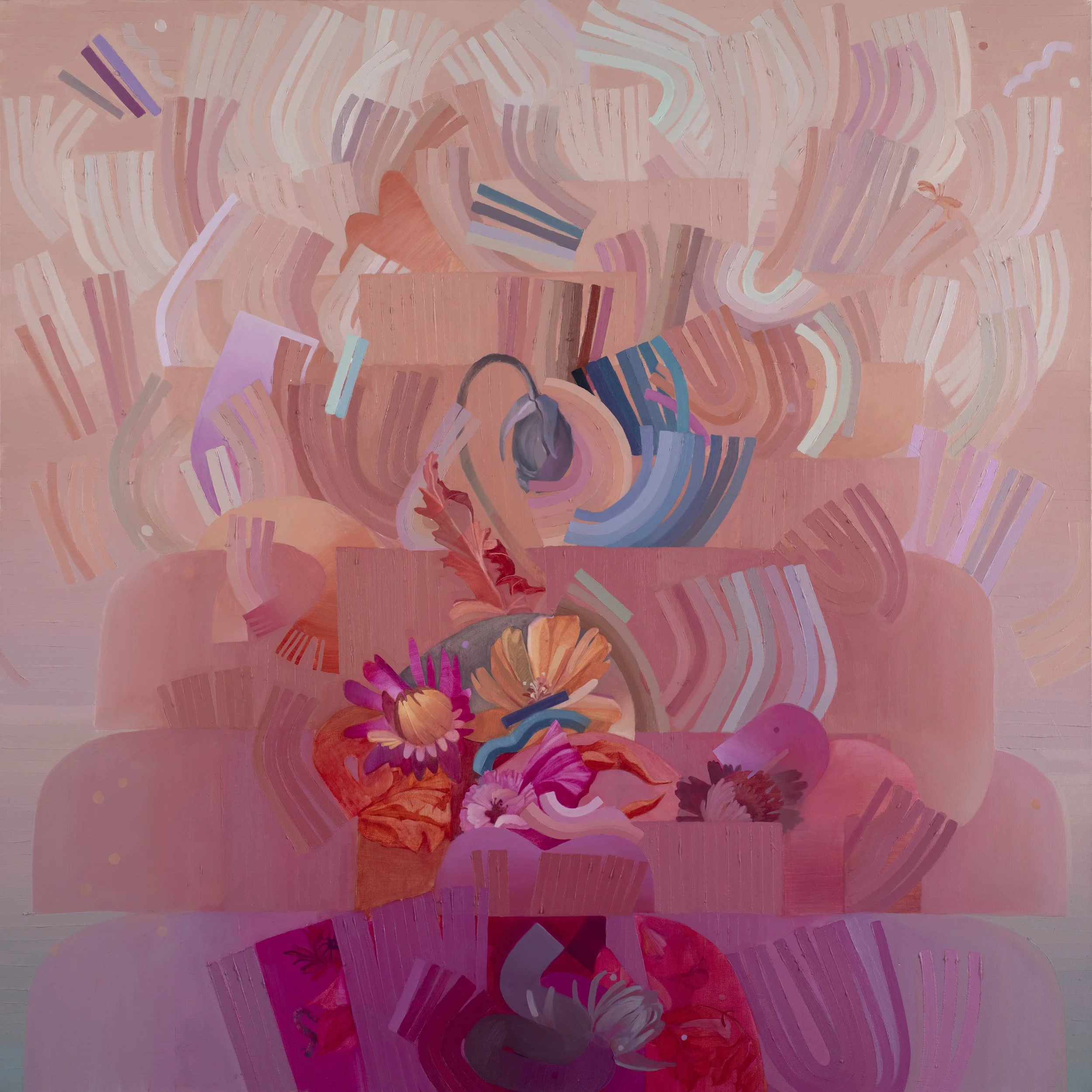
Pyre, 2025. Oil on canvas, 48 x 48 inches.
Interview with Ilana Zweschi
Hi Ilana! Can you tell us a bit about your background and how you became interested in becoming an artist? Who or what were some of your most important early influences?
My earliest artistic influence was my mom—a potter who raised my brother and me in her art studio. I grew up with two kilns and a potter's wheel in my house and there were never any restrictions on when and where to start my own art projects. I was drawn to painting earlier than I can remember. In college I was an art major and math minor but never had the intention (or even the idea!) of merging them. But once I learned of other artists using systems to make paintings (Charles Gaines, Steve Roden, Channah Horowitz, James Siena), I could close the loop of those two different interests. I now use hand-written algorithms to translate text into painterly actions. The algorithm is written as a series of “if/then” statements that connect my abstract visual language to the direct language of a text document. I write the systems but the actual result on the canvas is a surprise to me, so there’s an exciting alchemy that I get to participate in as a viewer as the painting unfolds.
Where are you currently based and what initially attracted you to working in this place? Are there any aspects of this specific location or community that have inspired aspects of your work?
I had spent the last 11 years working as a professional artist in Seattle. That city (and the college I was teaching at—Cornish) certainly was a crucial early influence on me as a young artist– encouraging activism, conceptual thinking and an academic approach. Up to that point my painting had been focused on craft so this nudge towards being a thinker in Seattle provided a much needed balance to get me in touch with my naturally logical side. And of course the presence of the tech industry might have had a hand in motivating me to make friends with algorithms.
But as of August I am now located in Chicago! Within one week of moving here, I found an amazing studio space among many other artists—great start to this new chapter.
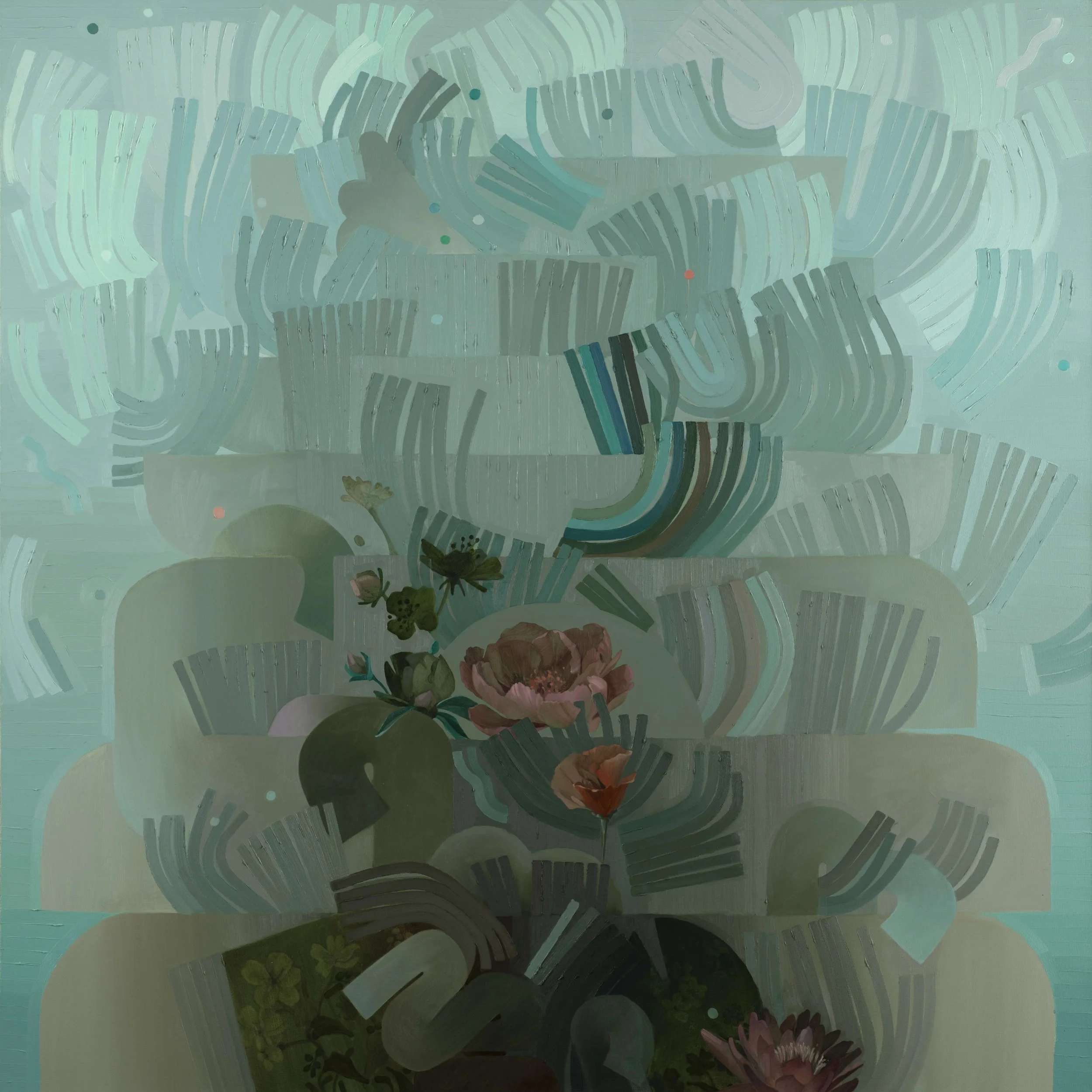
We Forgot That We Belong To Each Other, 2025. Oil on canvas, 55 x 55 inches.
Can you describe your studio space? What are some of the most crucial aspects of a studio that make it functional? Do any of these specific aspects directly affect your work?
My studio offers the sprawling real estate that we moved to Chicago fo—coming in at 700 square feet with tall ceilings. In my old studio, I made a very large diptych that I was never able to see side by side until I brought it to the gallery. I am excited about the chance to work that large again in my new studio without those restrictions. My studio also has a standing desk for computer work and a tall work table that I keep my saw on for building stretchers. And as a final cherry on top, I can bring my cat who I get to spend more time with now than I ever have before. Nothing quite so lovely as a furry studio buddy.
What are you working on in the studio right now?
For the last 10 years I have been working with a “seed image” of a figurative or floral under-drawing to give the painting system some organic shapes to pull from. I would travel in a grid across the underdrawing and the system would tell me to either ignore those lines underneath or pull one out and echo it off itself. This allowed for the representational image to become abstracted and for complex biomorphic forms to emerge from the somewhat cold system. But my most recent body of work is a departure from this method. I had never in the last decade involved any form of computer in my process– my algorithms are handwritten and everything happens with pen and paper or brush and canvas.
But last year I started playing with a children’s drawing machine. It is a cute little box with a smiling face and arms that hold a pen. The user can put a card in the top of the box with a pre-programmed picture on it and the machine will draw the picture. This machine offers my process a whole new fertile ground of opportunity. So far, I have been using a chance system to disrupt the pathway of this drawing machine– moving it around while it is drawing, letting the lines overlap from the one before, and stopping it early and then putting another card in its place to finish the form. This process accomplishes something similar as my underdrawing before– a system based placement of representational lines that are taken out of context. I also conceptually love the interaction of me as a human using logic to make the paintings and this purely logical computer appearing to have life and humanity. It plays into my use of systems but also feeds my exploration of the feasibility and mortality of a Cartesian body/mind separation.
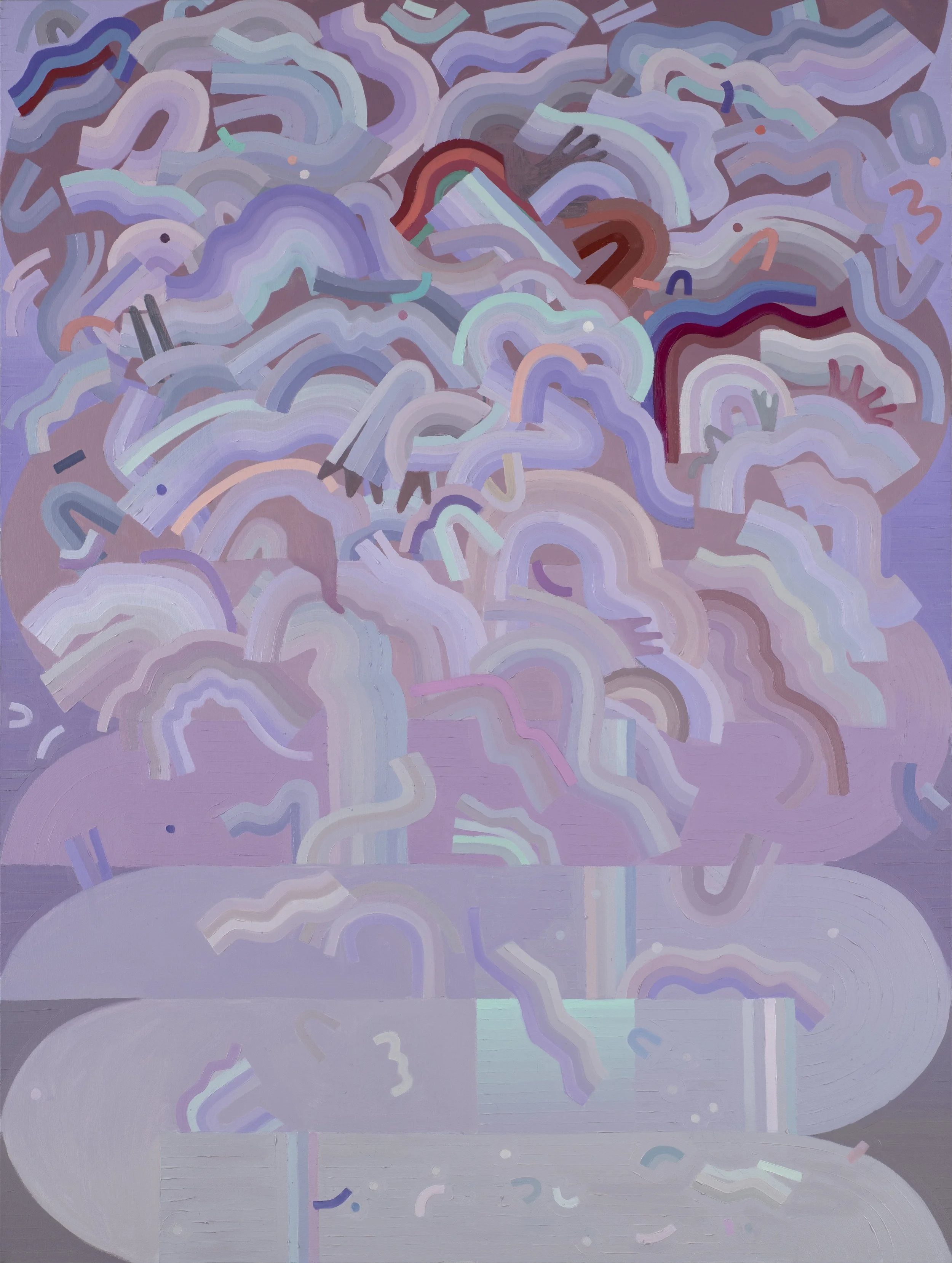
Cut Us All in Half, 2024. Oil on canvas, 48 x 36 inches.
What is on your mind a lot recently?
As briefly mentioned above, I have been mulling over texts from Descartes relating to his famous body/mind separation theory and how it has had a lasting impact on our contemporary society. Where do we currently relate to bodies as if they had no minds? And how is this new frontier of AI going to function when we treat it as a mind without a body? And most importantly, what are the moral consequences of this separation in either direction?
I believe math can weigh in on this exploration as it does the same thing philosophy does which is try to understand ourselves and our universe. It tries to apply some order and predictability to what can feel like utter random chaos. It helps us see what humanity imposes on nature and what is inherent in nature itself. One of my favorite ideas to consider along these lines is Chaos Theory– described as deterministic disorder. It is the way mathematicians have figured out how to write formulas that play out non-periodic systems that we previously thought had no predictability to them. That is what it feels like I am doing in my paintings– adding a predetermined formula to an otherwise spontaneous and intuitive practice.
What is a typical day like? If you don't have a typical day, what is an ideal day?
I am at the studio Monday through Friday 9 to 5 with very few exceptions. This is partially due to my natural body rhythm but this schedule is very rigid because I have four year-old twin girls at home and I am the sole-income earner. I make it my goal to make enough money and enough art within those 40 hours a week that I can fully enjoy my girls the rest of the time. An ideal day is when I truly feel I have ended the day having accomplished this goal—which is very elusive but somehow over the years has seemed to work.
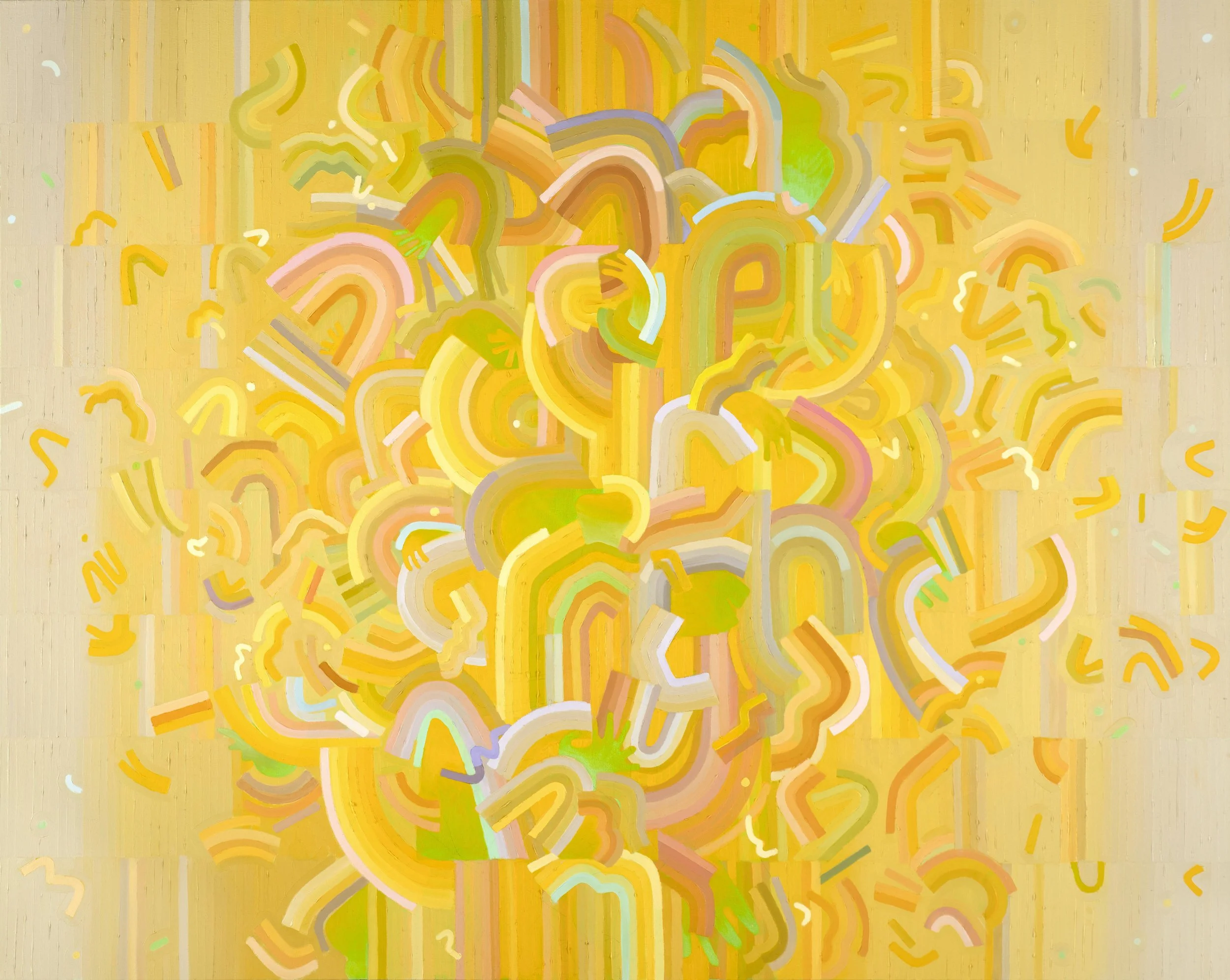
Love + Power, 2023. Oil on canvas, 48 x 60 inches.
What gets you in a mindset conducive to making work?
When I arrive at my studio at 9 AM I do a little bit of computer work to keep on top of that aspect of owning a business and not having weighing on me when I’m painting. And then I pop my headphones in for an audiobook and start unwrapping my paint and brushes from the day before. Those two things are an anchor for me so that even if I don’t know what exactly I’m going to do that day, I will have no choice but to move forward. I find an audiobook is a tool to focus rather than a distraction. When I have it in my ears I am not tempted to answer another email, send another text or generally daydream.
What criteria do you follow for selecting materials? How long have you worked with this particular media or method?
I have been oil painting since middle school. I’ve also been listening to melodic death metal since middle school. For some reason I can’t grow out of either. The wonderful thing about oil paint and about color is that the craft of those two things seems impossible to master, so I get to continue to learn from them as the years go by.
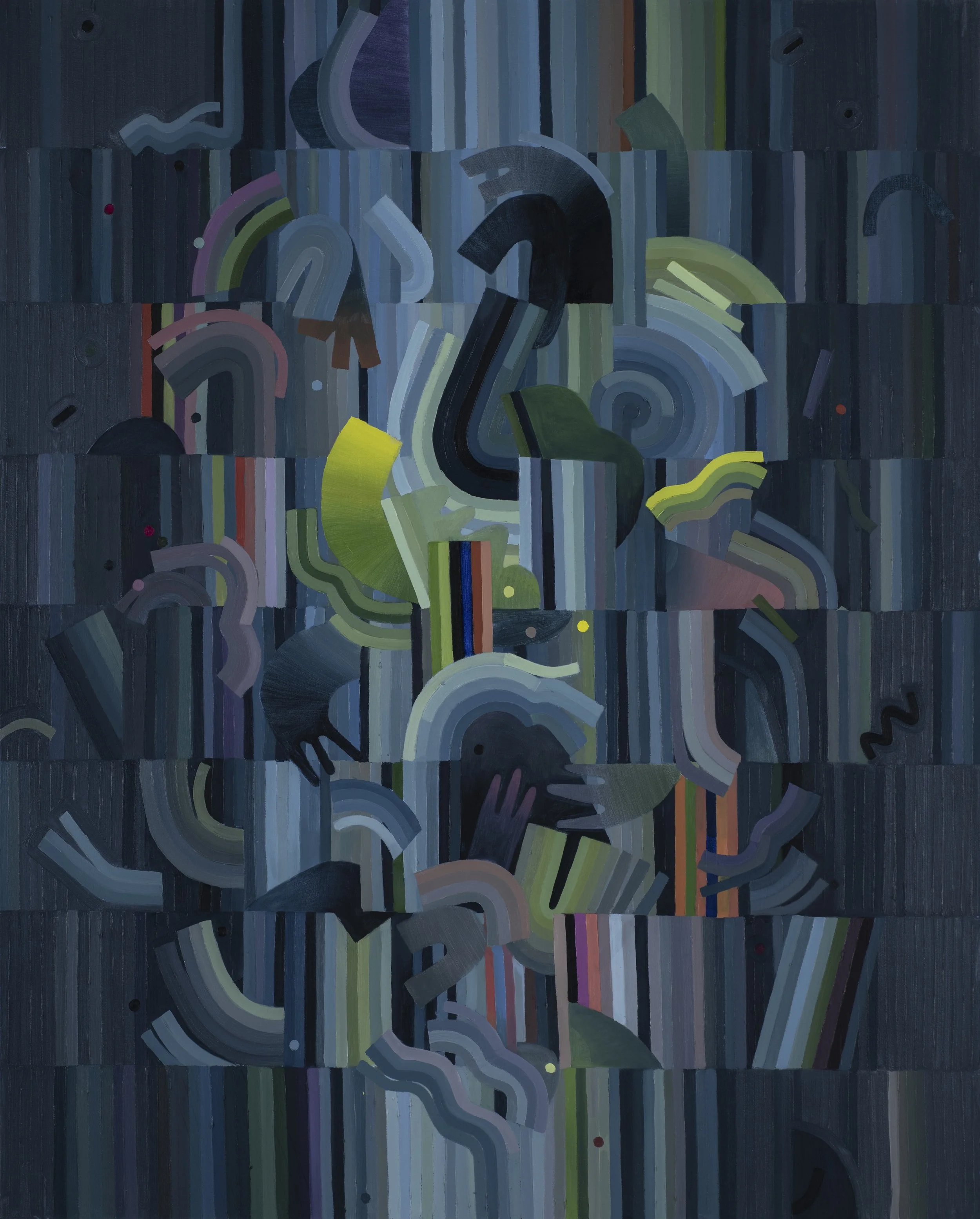
Anaesthetic By Immersion, 2024. Oil on canvas, 50 x 40 inches.
Can you walk us through your overall process? How long has this approach been a part of your practice
My process starts with a text document, which acts as the input for my algorithm. So before I can apply paint to canvas, I have to first select the text, wright the algorithm, and decide how the algorithm will interact with the design. There are three aspects to my process:
THE TEXT: I have criteria for these texts that they need to be influential, cause harm, and be current or have an impact on our current society. Recently, I have been getting more specific about the kind of harm I am targeting by working with official primary sources that show both objectifying and violent language. One letter in the text equates to one brushstroke in the painting, which I then mark off on the text as I complete the brush stroke. So the document naturally gets redacted. However, I leave visible the violent and objectifying words creating a poem that allows the viewer to be able to try to make the connection between those two concepts. But since the rest of the document is redacted, the viewer can be freed from the normalcy they are blinded by in the original context. Sometimes these texts occur to me without any effort. TwiceI have been reading children's books to my girls that were such shocking examples of this societal harm, that I wanted to stand up and throw them in the trash. Instead—I turned them into paintings. Other times I do more formal research to find my text sources. I am mostly interested in laws and in order to discover these particular laws, I will listen to legal podcasts or attend online critical theory conferences.
THE SYSTEM. I have to decide what the algorithm will have control over and write the system that connects the text to my visual language.
THE DESIGN. These paintings are not pure chance based—they are designed for visual effect. The biggest effect I can have on the aesthetics of the paintings is by establishing different zones on the surface that will have different rules. So I can cause the painting to get more detail towards the top or center, and to be higher contrast in certain areas. I also can play with the shape of the grid to get more complex and stylized. In other words, I set up all the dominoes, but I don’t actually know how they will get knocked down.
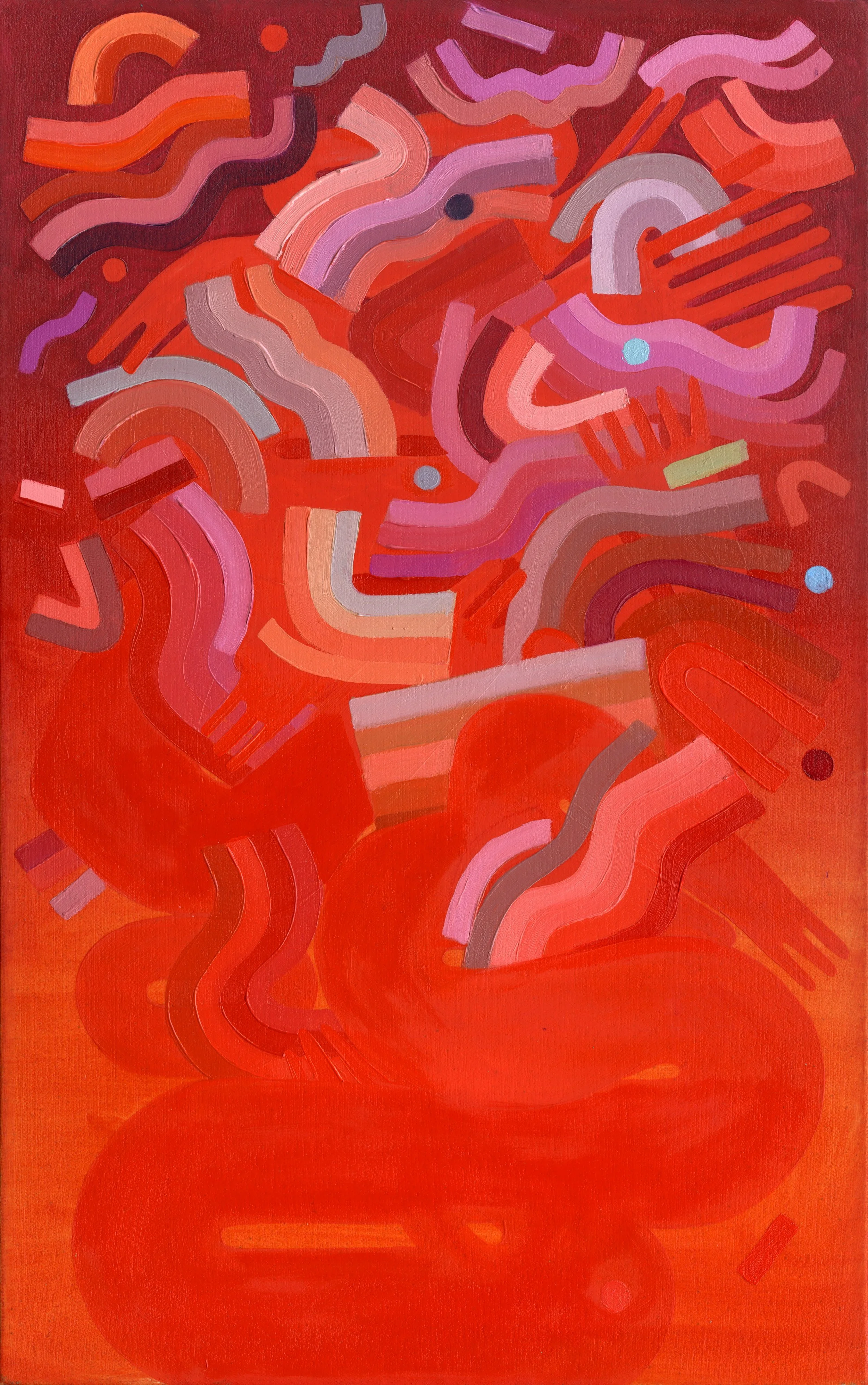
Red Block Tower, 2023. Oil on canvas, 18 x 11 inches.
Can you talk about some of the ongoing interests, imagery, and concepts that have informed your process and body of work over time? How do you anticipate your work progressing in the future?
I have been dealing a lot with floral imagery the last few years. It started when I used a Diego Rivera lily painting as the under drawing for a work that ended up becoming a whole series. The resulting painting resembled an abstract bouquet of flowers, which of course it was originally, but it also looked like a mushroom cloud. I titled that work and the subsequent series “Beauty + Violence” to refer to this dual image and the duality we live with in the human experience. Since then, flowers have become a much more overt and representational part of the finished painting. This recent iteration seems to relate to the body/mind separation theme. The earth and the natural systems on it are a vast body with no language to speak and therefore terribly exploited. I am hoping to reference the wisdom of this ancient body as well as the way our best human attempt to understand it through mathematical systems only scratches the surface.
Do you pursue any collaborations, projects, or careers in addition to your studio practice? If so, can you tell us more about those projects, and are there connections between your studio practice and these endeavors?
Yes! For the last 10 years, I have been teaching drawing and painting at various colleges. I feel very strongly that there is a feedback loop between the teaching and my studio practice. Some days I’m in my studio thinking about painting and the various related concerns of craft, color and concept. And I use that experience directly to create a curriculum that I bring to the students. And then other times, I watch the students paint all day, listen to their questions and ideas about craft, color and concept, and my cup is full when I am back in my own studio.
Can you share some of your recent influences? Are there specific works—from visual art, literature, film, or music—that are important to you?
In addition to the previously mentioned influences, I also have been thinking about John Conway’s The Game of Life. Through a few simple rules, he made a grid of black and white squares look alive and moving. It looks like an animation but the life-like movements of these squares were not designed, they simply occurred by following the rules. I love the way that math can mimic– and then possibly explain–life.
Who are some contemporary artists you’re excited about? What are the best exhibitions you’ve seen in recent memory and why do they stand out?
As far as systems artists go, I love what Charles Gaines has done with systems across many media using the combination of theory and how it collides with visual or audio media to create an emotional experience of something important in society that might be too easy to normalize or dismiss. In the realm of painting craft, I saw a Zoe Frank exhibition at Robischon Gallery in Denver in the spring. I have been following her work for a long time, but I’ve never seen it in person. It held all of the beauty that I had seen in digital images but a shocking amount of sensual/wild painterly energy that I didn’t expect. I think they are both pushing the field of painting in important contemporary ways while building off of what has made painting endure for thousands of years.
Do you have any tips or advice that someone has shared with you that you have found particularly helpful?
Yes, so much advice! First and foremost, do not stop making work. Make work even if all you have is 30 minutes a week. Make work even if you are not inspired. Make work even if what you’re making is terrible. As long as you keep making work, you will eventually make something good. And you will keep up the most important aspect of our making which is momentum. Momentum is more important than total time spent. Secondly, art friends are the best way to succeed in the art world. So invest in other people–build each other up. Finally, get smart about business. It's not always taught to students and so you might have to teach yourself–a book I recommend to get started with this is called Art/Work.
What’s coming up next for you?
Currently, I am working on a few commissions and building towards my next solo show with Foster White in Seattle in fall of 2026.
Thank you so much for sharing your work and talking with us!
To find out more about Ilana and her work, check out her website.