
Gail Spaien
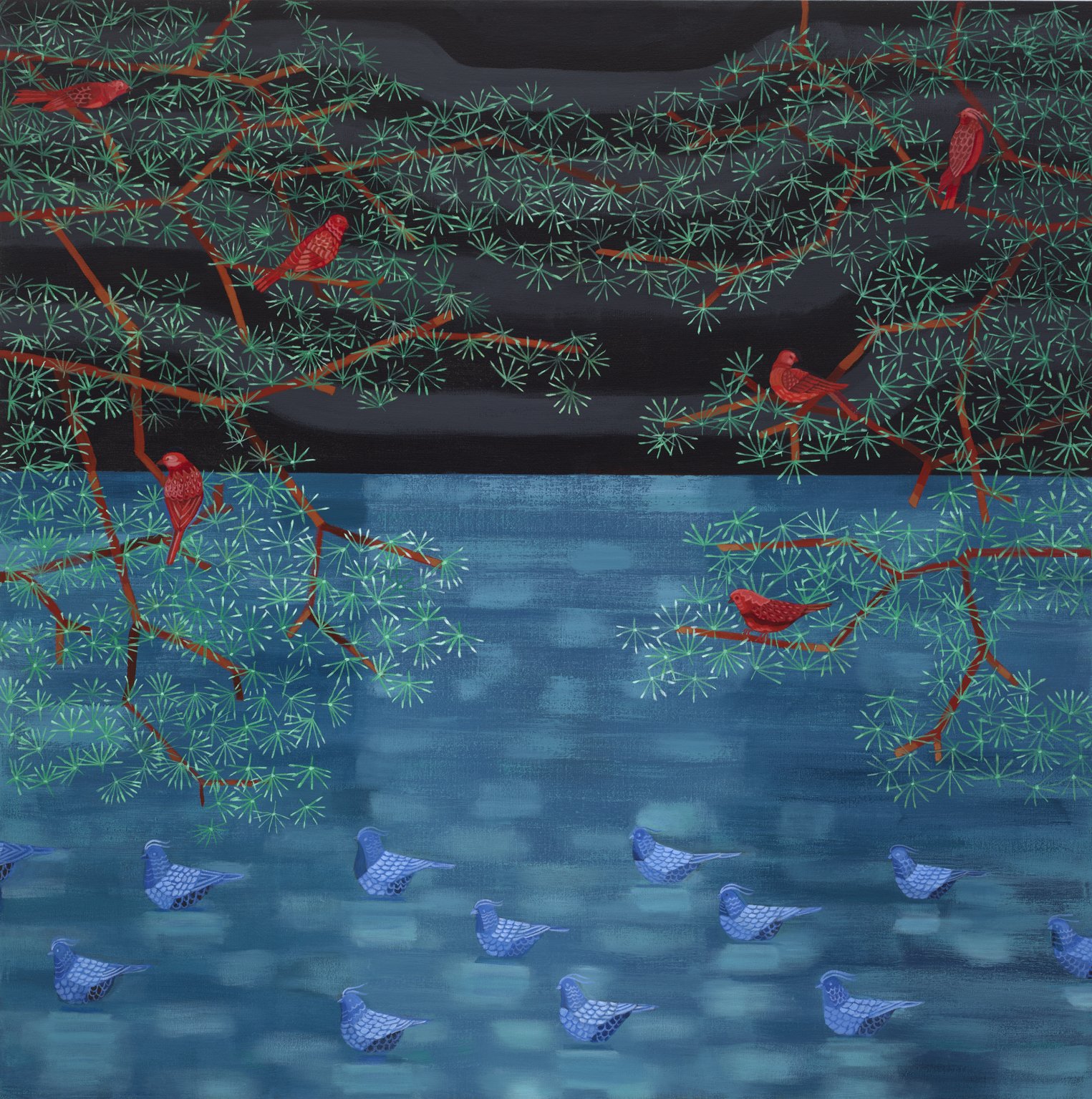
Looking Out, 2025. Acrylic on linen, 48 x 48 inches
Interview with Gail Spaien
Maake Issue 17 Interview Questions
Can you tell us a bit about your background and how you became interested in becoming an artist? Who or what were some of your most important early influences?
It’s hard to answer this question — so many moments, people, and experiences have shaped my becoming an artist. But here are a few pivotal influences.
I learned about visual order and creating spaces as a kid, watching my parents furnish our empty living room. They didn’t have much money, so they bought things slowly, one thoughtful piece at a time. The room began as a bare white rectangle — white carpet, white walls. The first piece of furniture they bought was a velvet yellow-ochre couch with down cushions, followed by a pair of olive-green love seats, a glass coffee table, a throne-like high-backed chair, and a few wildly gaudy lamps. Seeing this room materialize penetrated my visual field and turned out to be very instructive. I build my paintings the way my parents furnished that room — I compose and arrange spaces, both real and imagined, and populate them with carefully selected iconography. I think artists spend their artistic life reinventing the visual events that we were exposed to at a young age.
I learned about living a creative life in Sausalito, at Galilee Harbor — a forty-boat, member-run community of artists, writers, theater makers, and maritime workers. Living aboard my boat, Mudlark, I learned to sail and supported myself by painting and varnishing boats. I worked with a diverse range of artists and creatives, including Chris Harman’s Antenna Theater and Laura Farabough’s Nightfire Theater. I got my MFA at the San Francisco Art Institute, studying with Sam Tchakalian, Barbara Rogers, Carlos Villa, Deborah Oropollo, Irene Pijoan, and Pat Klein. I did my breakthrough painting — the observed landscape outside my studio window at Fort Cronkhite in the Headlands — which is what I am still working on today, painting what I observe in my immediate surroundings. That decade in the Bay Area grounded me in an artistic lineage of independence, intellect, and instinct. It grounded me in a regular studio practice and taught me to navigate my own path. (And I had a really great time!)
I learned to paint when I started teaching. My teachers in undergrad and graduate school were more like philosophers; they offered a few material and formal pointers, but mostly the lessons were conceptual. As a young adjunct faculty member at the Maine College of Art and Design, I learned to teach painting by reading the assignments posted by full-time faculty in the painting studio and by watching how students developed their work. And, I observed the careers and teaching methods of senior faculty.
Having said all that… the learning never stops. Unexpectedly, leaving academia has informed and deepened my studio practice. Painting consistently every day has opened up my approach — how I apply paint, how I structure the picture plane, and how I challenge myself to engage with new iconography. I am in contact with new artists and learning from them. I am more tuned into the art market and witness to how careers are made. But most importantly, stepping away from the energy I funneled into teaching has deepened my understanding of my creative process. And has me thinking about how to define success at this age.
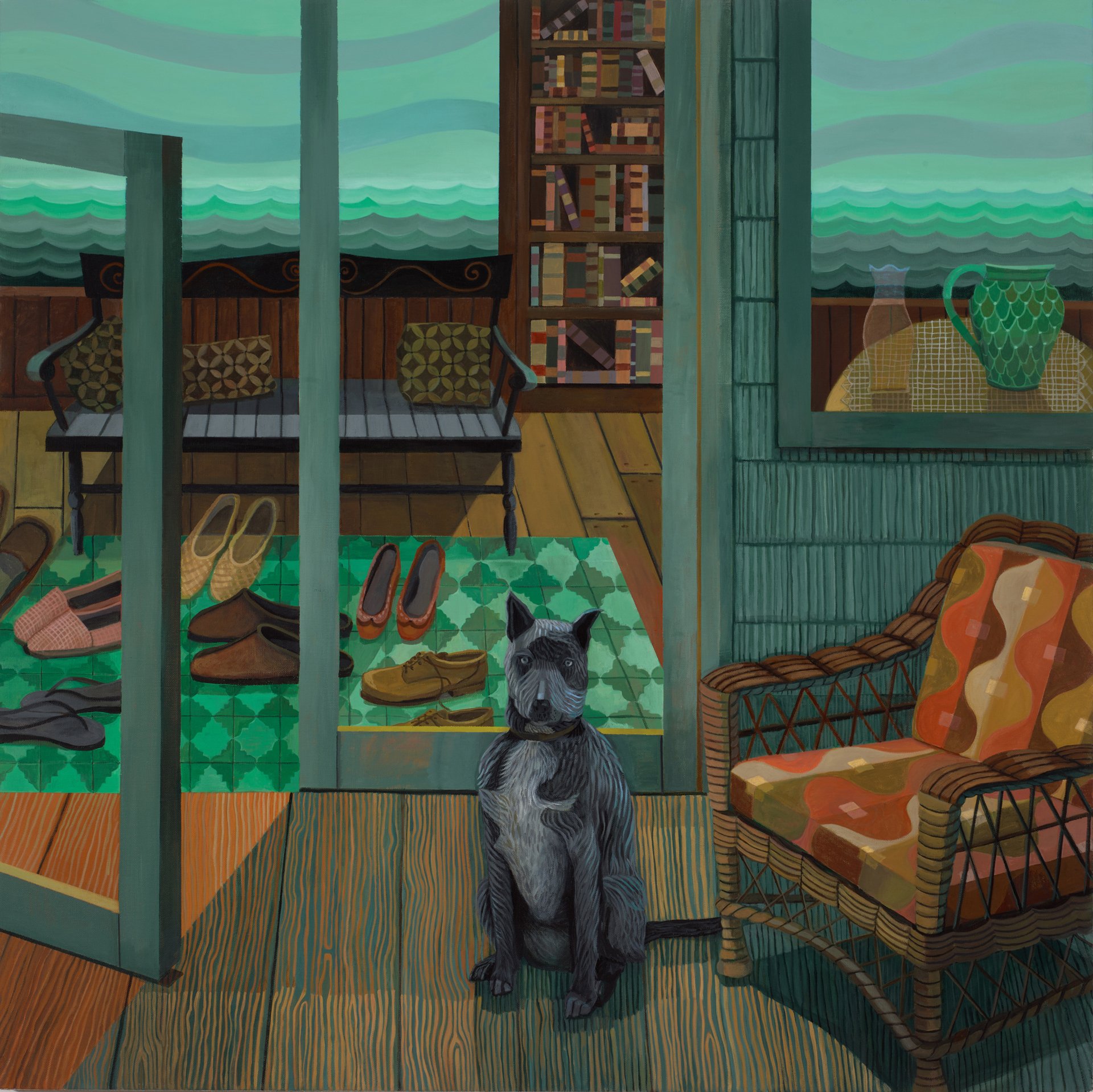
Pearl with Shoes, 2023. Acrylic on linen 48 x 48 inches
Where are you currently based and what initially attracted you to working in this place? Are there any aspects of this specific location or community that have inspired aspects of your work?
I live in South Portland, Maine. I originally came here to go to the University of Southern Maine, where I got my BFA. I’ve lived here happily for the last thirty-five years, thirty of which I spent teaching at Maine College of Art and Design. Maine is a place that supports inward contemplation and nurtured me as a young artist. Nature and culture are deeply intertwined here, both of which inspire and inform my practice. Maine holds a rich art historical lineage that sits alongside the contemporary. The state has so much cultural depth, and I love being part of that continuum. Also, many of my former students are now prominent artists working locally, nationally, and internationally. I love watching them put Maine in the spotlight as a place that fosters serious studio practice and the careers of artists.
Can you describe your studio space? What are some of the most crucial aspects of a studio that make it functional? Do any of these specific aspects directly affect your work?
My studio has been in my home for the last seven or eight years. Painting is integrated into my daily routine. I cook, I clean, I go for a walk, I paint. This is the most crucial aspect, that it is in my home. It Painting for me is a domestic, spiritual and intellectual act.
What are you working on in the studio right now?
I just finished seventeen paintings for a solo show at Taymour Grahne Projects in Dubai. I am hunkering down for the winter to make new work for Art Dubai, and then in September, I will have a solo show at Ellen Miller Gallery in Boston.
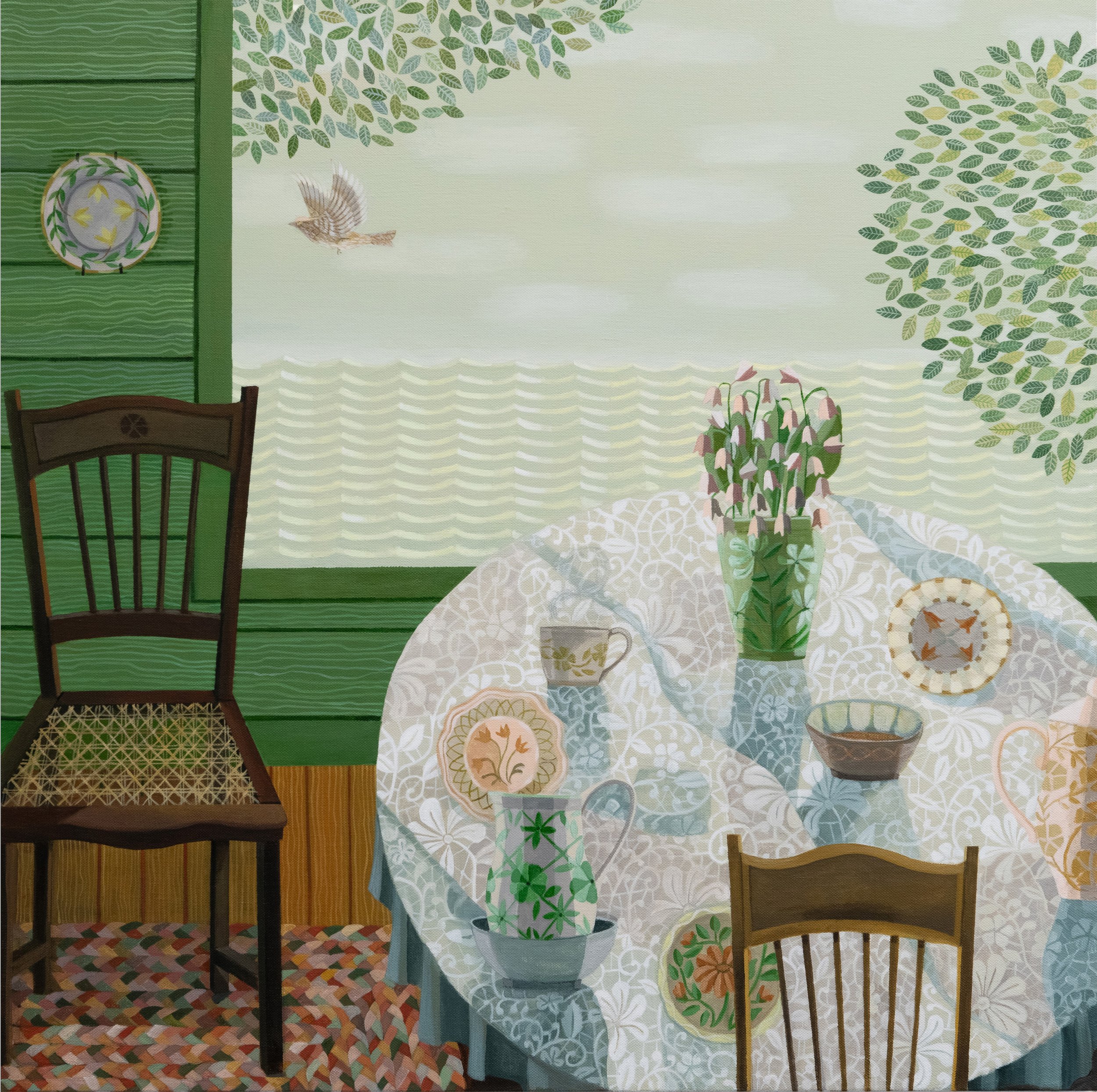
Habitat, 2025. Acrylic on linen, 48 x 48 inches
What are the primary themes of your work right now?
The imagery in my paintings comes from fragments of my own experience — a chair from my family home, a view from a landscape I know well, the feeling of a particular moment.
I work mostly in the genres of landscape, still life, and interiors. These genres lend history and meaning to the work. In other words, a landscape painting may convey the artist's relation to the natural world, the politics of land, or connection to the spiritual and the ephemeral. A still life may evoke domestic space, material culture or time and transcience. I pull from craft traditions — textiles, folk art and ornamentation.
Painting is, at its core, a perceptual experience. I use flattened space and slight distortions to create worlds that are visually alive. I like composing an optically decadent viewing experience that is activated by a back-and-forth between flatness and depth, so viewers shift how they’re seeing.
Pattern and decoration play structural, emotional, and thematic roles. As a structuring device, pattern establishes rhythm, cohesion, and spatial logic. It can serve as an armature that organizes the composition. Pattern can anchor the viewer, offering a steady pulse that makes the pictorial world legible. And because it arises from touch, labor, and accumulated gesture, it conveys intimacy and care. The decorative has a long cultural history tied to the domestic, the handmade, and the bodily. Depending on scale, density, and color, pattern can soothe, overwhelm, seduce, or activate. In this way, pattern shapes not only how my painting is built, but how it feels.
Several overlapping themes recur in the work: home and its contradictions, balance and imbalance, absence and presence, the impossibility of utopia, capturing time, evoking place, and poetry as a form of activism. I’m interested in beauty in daily life—not denying complexity but instead proposing that attention to the ordinary dimensions of daily life, like arranging a bouquet, can be an act of resistance and renewal. Anxiety, reflection, memory, and dreams are themes too. Also, my work has been called saccharine and sentimental. I like leaning into those terms as themes.
Having said all this, my formal and material expression is in service of the activity and the object that we understand to be a painting. Each time I make a painting, I am researching how to paint, what a painting is, and how it functions. This inquiry is at the heart of my practice and one of the central themes of the work.
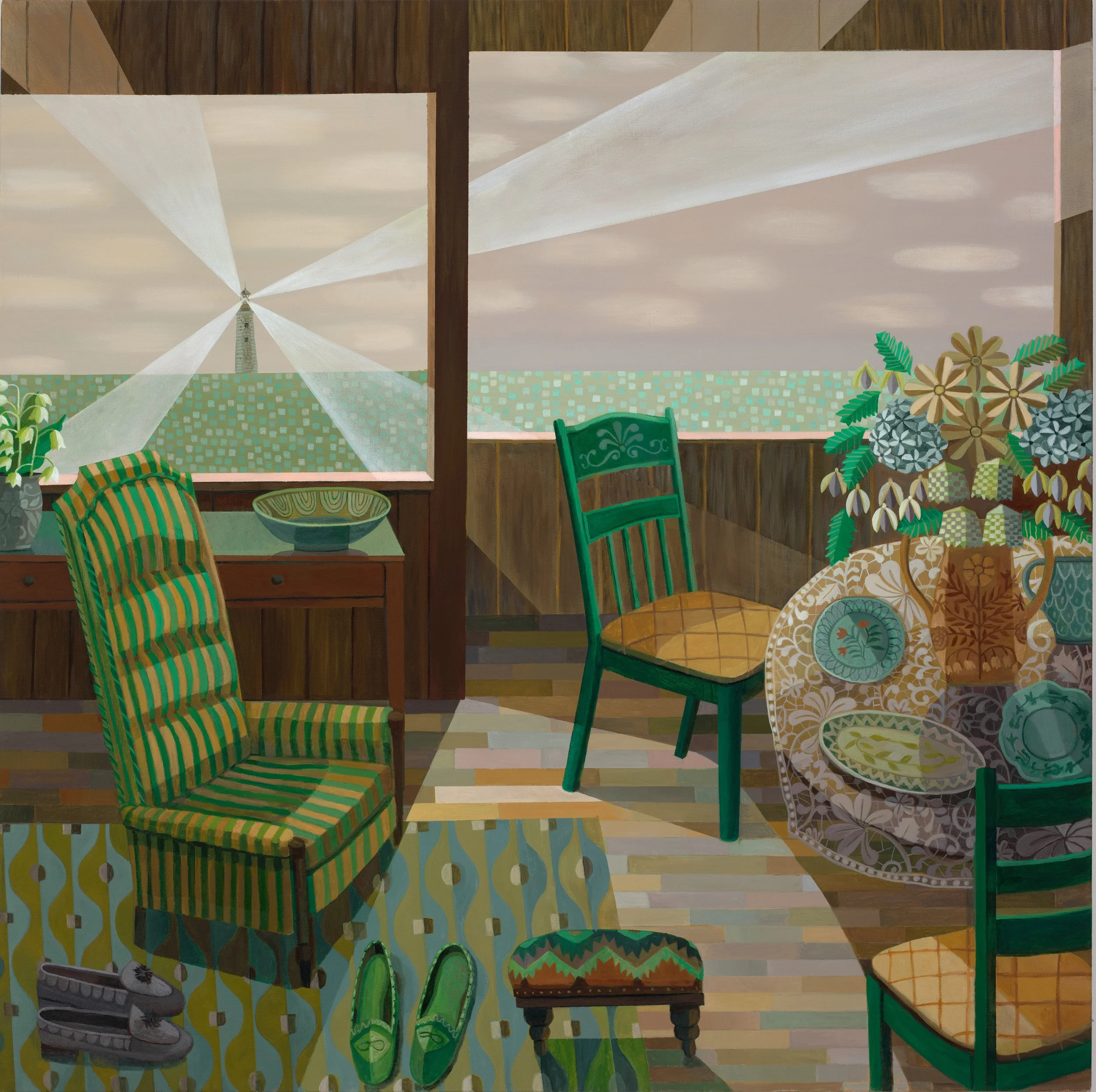
Green Chairs with Lighthouse, 2024. Acrylic on linen, 48 x 48 inches
What is on your mind a lot recently?
I think daily about the chaos in the US and the needed change in our government. And about the oppression of those who deem themselves the people in charge.
After my recent show in Dubai, I am thinking a lot about how art can resonate across borders, what it means to show artwork in different parts of the world, and how many art worlds there are, and how little I know.
I am thinking a lot about my age and stage in life and the difference between ambition and satisfaction.
I am still trying to figure out how to make a painting and how to compose an image that isn’t too self-conscious. Or how to make a composition that is so self-conscious and literal that it becomes vulnerable — how to get as close to the bone with the work as possible.
I think a lot about how to manifest more physicality alongside precision in my material use.
What is a typical day like? If you don't have a typical day, what is an ideal day?
My typical day starts around six in the morning with a cup of coffee and a little time just looking out the window. And I do wordle. I’ll check my email and calendar, see what’s ahead, maybe read something—something art-related, or about what’s happening in the world, or just something that lifts me emotionally.
The morning is my clearest time of day for writing or doing anything that needs real focus, so that’s when I take care of administrative work. Then I need to do something physical—I swim regularly, walk the dog, and in spring and summer I’ll garden. Sometimes I run errands, and around one-thirty I head to the studio. I usually paint for a few hours, feed and walk the dog again, have dinner with my husband, and go back to the studio until around nine.
Since leaving teaching, it’s like I am on an extended residency. I paint every day — I’m definitely a creature of routine. Having said that, I schedule time throughout the year when I do not look at art and take time away from the studio. Distractions and new experiences are an important part of generating the creative process for me. I love taking time off.
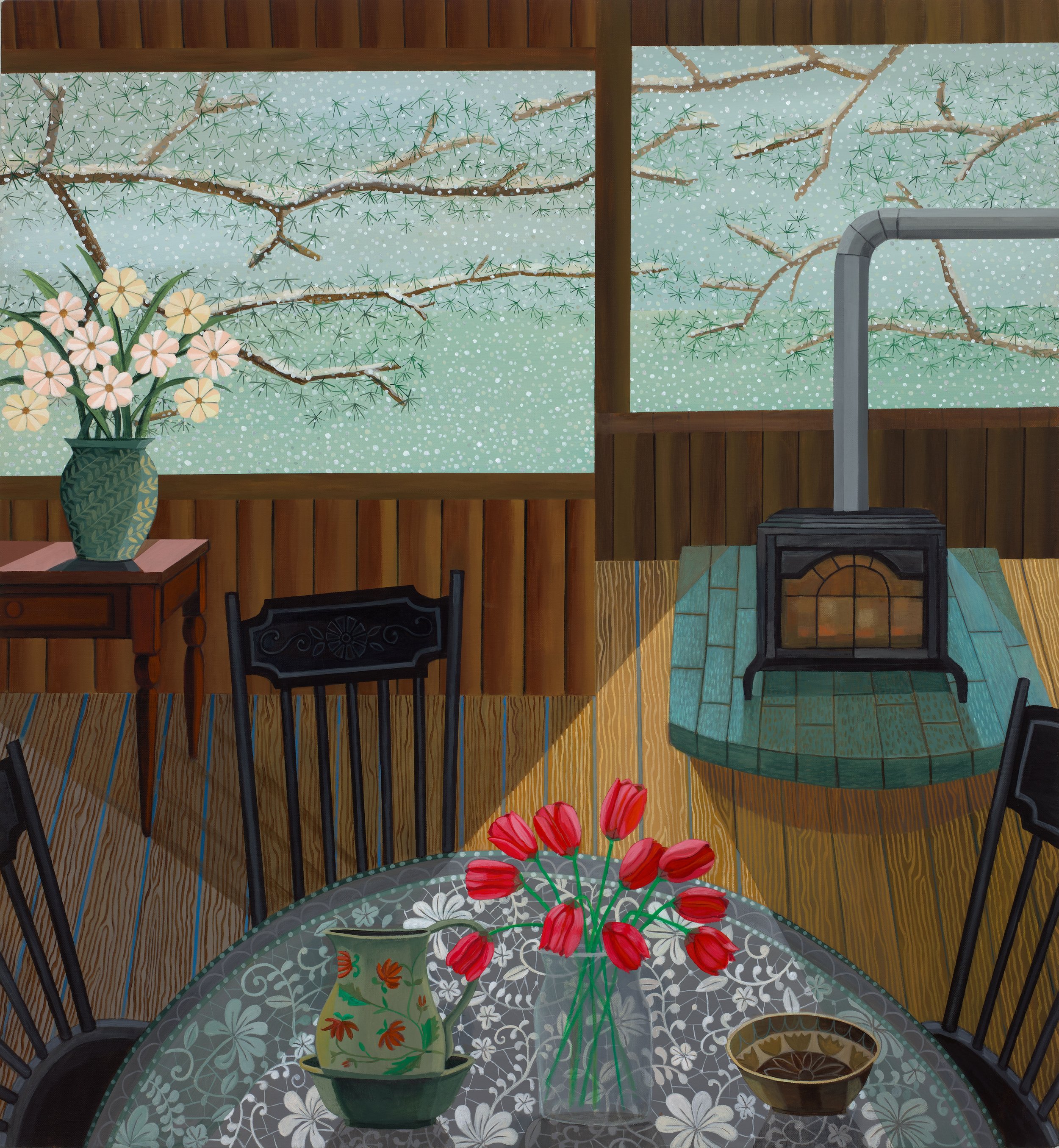
Red Tulips, 2024. Acrylic on linen, 52 x 48 inches
What gets you in a mindset conducive to making work?
Having a deadline causes me anxiety, so it gets me into the studio. I don’t need to get myself in a mindset conducive to making work. I like the challenge and want to do it.
What criteria do you follow for selecting materials? How long have you worked with this particular media or method?
I have worked with acrylic on linen for the last fifteen years. Before that, it was watercolor on handmade paper installed on the wall alongside living plant material, and before that, it was collage and acrylic on paper, and before that, it was oil paint. I have been working with some form of painting or drawing since I was sixteen. The criteria I use to select the materials? I like paint and I understand how to use it.
Can you walk us through your overall process? How long has this approach been a part of your practice?
When I have a show I am working towards, I start with a map of the space the paintings will occupy. This is of primary importance. I want to choreograph the spatial action in the room where a group of my paintings will be hung, so the audience might have a spatial experience moving in and out of each piece. Painting is kind of like sculpture in this way for me.
I get all of my surfaces at once. I work on many, many at a time. And while I never really know what the result will be, I do start with some specific subject matter in mind. For example, right now I am making paintings about a waterfall that I see on my daily walk.
Composing the paintings takes a long time. In rare occasions, it happens in the first pass. But that is rare. To start, I will often peruse other artworks or look at my past work to spark compositional ideas. I start each painting with geometry, dividing up the picture plane to create a container for an imagined or observed space. During the composing phase, if I cannot solve a visual problem, I am okay with erasing large parts of the painting and starting over again. I sometimes do this when a painting is 90% complete. I hear the voice of Sam Tchakalian in my head saying, “paint out the problems.” Throughout the process, I take photos. I can see my work more clearly in a photo. When I get stuck, I use Photoshop on my iPad to help solve design problems.
Once the composition is done, it is time for the craft phase. Painting the patterns. Using color to pull shapes and areas forward. Pushing other areas back. Defining edges. Putting light in. The way the color is designed on the picture plane is important. I do think about directional light source, but it is always in service to the flat color design. (I really am a geometric abstract painter) I rely on saturation at the end of the painting to provide the spatial action and illumination.
I do work through iteration, although I am not like some artists who make paintings where iteration is very obvious. The subject matter may be the same, but I try to make each painting unique in some way … which is actually impossible. Maybe a better way to say this is that I try to evolve my work in some way each time... material, formal, iconography. The evolution happens in micro moves. Occasionally, a bolt of lightning will strike, and I will make a big shift. Or have a breakthrough in material handling, or color use, or in the way I use space on the picture plane. I call these visitations. But mostly change happens through micro shifts.
I am most successful when I listen to the painting rather than impose my ‘excellent’ idea on it.
I try to rely on my eyes, not my head.
Doubt and exhilaration happen along the way. Those emotions alternate the whole time. Especially in the middle of the process and then again at the very end. Doubt is a big part of my process. I think paintings are objects of doubt.
For as long as I can remember, I have used the same approach.
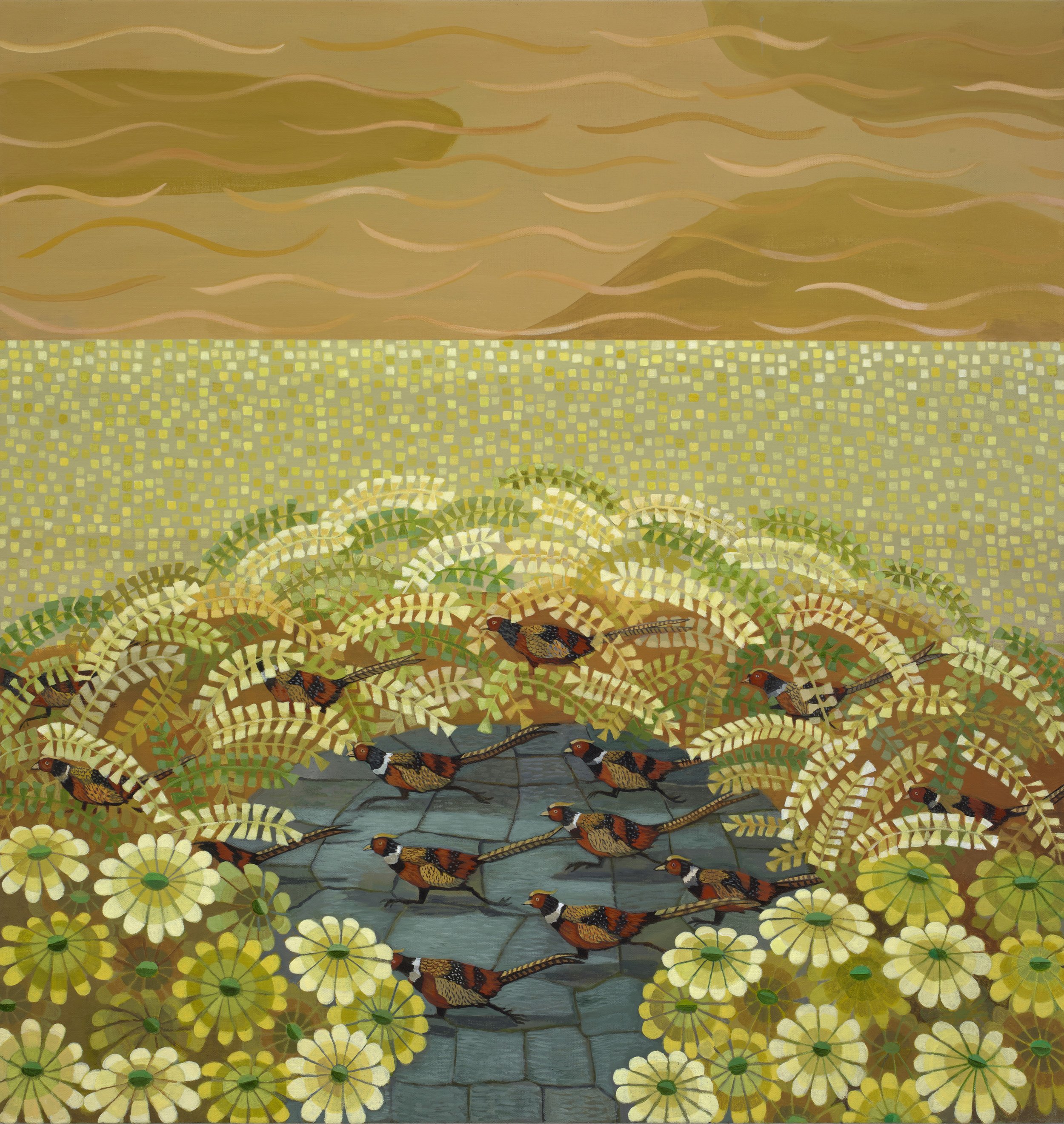
Wyoming Dream, 2024. acrylic on linen, 40 x 38 inches
Can you talk about some of the ongoing interests, imagery, and concepts that have informed your process and body of work over time? How do you anticipate your work progressing in the future?
I think about the creative process and how to make work that has total freedom. Rick Rubin is someone I read or listen to when I get stuck.
The Pattern and Decoration Movement informs my work. Helen Molesworth's book Open Questions is on my nightstand. A particular essay she wrote about the artist Lari Pittman, about the decorative as an antidote to violence — this idea is embedded in my work.
Helen Moleworth's essay for the exhibition (Nothing But) Flowers, is a touchstone for me. She talks about care and acknowledging beauty in the everyday.
Mono No Aware is a Japanese concept that has to do with the awareness of the poignancy of things. This is also a touchstone.
I am interested in contemporary romantic painters like Peter Doig, Laura Owens, and Karen Kilimnik. I would put Mathew Wong in that camp, too. They deal with the edge between utopia and melancholy — the recognition that we are always toggling between those states. The Ukiyo-e artists did this too, as did the Intimists in the early 20th century. These artists translate the poignancy and poetry of it all
Painting is an ordinary activity. Barry Schwabsky talks about this. Laurie Fendrich calls it moving colored shapes around. Barry Schwabsky, a poet, is one of my favorite critics. Poetry is a sister to painting. Poetry as activism is where I think my work fits.
And how do I anticipate my work progressing in the future? Maybe more simplicity? I hope for some unexpected visitation that happens because my brain is shut off. And that I can keep painting until I die.
Do you pursue any collaborations, projects, or careers in addition to your studio practice? If so, can you tell us more about those projects, and are there connections between your studio practice and these endeavors?
Mostly, I paint. I am pretty mono-focused. However, on the side, I attempt to make quilts. I intend to make twelve, one for each month, as a gift for my daughter. I am not a quilt maker. They are very irregular and wonky.
Recently, I have had several opportunities to get together with friends or colleagues to talk about creative practice, over a meal or coffee. These are not formal collaborations, but they inspire my own creative practice in ways that are subtle and affirming.
On my recent trip to Dubai, I went birdwatching. The birds I saw there will enter the work. I am not an active birdwatcher, but I do make note of them when I am in a new environment, and they find their way into the paintings.
Can you share some of your recent influences? Are there specific works—from visual art, literature, film, or music—that are important to you?
Being outside, in the weather, walking in the woods. Being in the water and looking at the ocean horizon. Seeing works of art in person, especially works that I don’t like. I look at a lot of art.
My source material ranges from the animated movies of Hayao Miyazaki and Walt Disney to the symbolism of Dutch still life paintings. I reference quilts, samplers, mourning paintings, Japanese embroidery, early American wooden furniture, decorative metal work, wooden boats, and the architecture of simple cottages. The Pattern and Decoration movement, Intimism, and the ancient artists of Ukiyo-e. Textiles and folk artists like Morris Hirschfeld and Shaker Drawings. Early American portraiture, Joan Brown, and many Bay Area artists like Roy DeForest, Robert Arneson, and the funk artists, and Chicago imagists who gave me permission in the mid 80’s to paint in a representational way during a time when Abstract Expressionism, Minimalism, Geometric Abstraction, and Conceptual Art were in favor. The meditative and precise quality of paint-by-numbers, which I did as a child, also informs my work.
Who are some contemporary artists you’re excited about? What are the best exhibitions you’ve seen in recent memory and why do they stand out?
Shows stand out to me because they move me emotionally or inspire me artistically. Like, how did they use that material to make that effect?
Recent shows have stuck with me — Alex Katz at the Guggenhiem; Matthew Wong at the MFA Boston, Neil Welliver at an Alexadre Gallery pop up in Rockland, ME; Salman Toor at Luhring Augustine; Tender Loving Care, curated by Michelle Millar Fisher at the MFA Boston, (and I am looking forward to seeing her current show at the Museum of Arts and Design called Designing Motherhood); Morris Hirschfeld at the Folk Art Museum; a door left ajar; diambe, Michael hol, Thiago hattner at kurimanzutto, New York; Setsuko’s show Kingdom of Cats at Gagosian. in the cacophany of all the work in Miami last year, a small painting by Tony Huynh touched me. As did Milton Avery’s work in Karma’s booth — Lion Tamer, Trapeze Artist, and Snake Charmer. And also Fay Jones' recent show at studio e gallery in Seattle, which I could only see virtually.
Do you have any tips or advice that someone has shared with you that you have found particularly helpful?
In graduate school, my teacher Barbara Rogers asked how each of us defined success. That question has stayed with me and continues to shape the way I think about both my personal and professional life.
What’s coming up next for you?
I am currently in a few group shows, one in Seattle at studio e gallery, and one in San Francisco at Berggruen Gallery. Upcoming in March I will have some work at Art Dubai. Then a solo show in Boston at Ellen Miller Gallery.
Anything else you would like to share?
For me, painting is a domestic, spiritual, and intellectual act. Domestic in the sense that it is an ordinary act, one that is embedded in my own day, much like knitting or sewing might be. It is a spiritual act because art is a transmission between strangers. It reaches across time and space and sometimes connects two people together through the object, the material, the touch, and the image. It is an intellectual act. It’s an activity that enables me to problem solve, make sense of my world, and communicate with others. It is a field of study.
At a gathering of women painters in Maine, I said I wanted to be more vulnerable in my work. As soon as I said that, I realized trying to think my way into vulnerability is like trying to decide to be intuitive — it just doesn’t work that way. One needs to set up the conditions for the creative process to relax. This is when some kind of combustion occurs. Vulnerability cannot be a primary aim. It is a natural byproduct of the creative process.
The project is always to get myself out of the way, to be the hollow bamboo, to see something new. To come to a new understanding of a painting's underlying structure. To do the best I can do. I could never have predicted how my paintings would change over time. In the Buddhist sense, the goal is the path, and the work of art is not an endpoint in itself. Each work is a transition to the next. Maybe, along the way, I will make something that resonates deeply.
One thing I’ve come to understand is that if an artist keeps at it — keeps working and engaging in the field — something will happen. We each find our own art worlds.
Thank you so much for sharing your work with us!
To find out more about Gail and her work, check out her website or you can see her work at Taymour Grahne Projects.