
Erin Castellan
I move through the world searching for anything that heightens my sense of being here. I give special attention to shifting atmospheres: the quality of light, temperature, wind, fog, or lack thereof. I marvel at the wonder and beauty of being alive in this particular moment, at this particular time. As an artist, I use paint, hand-embroidery and beading to craft physical images that encourage slow, intimate viewing experiences. I am interested in the idea of slow seeing. Particularly, I am interested in how efforts to slow and more fully engage with the physical world can inspire a sense of bodily presence and connection. My images are made with tenderness and care. I patiently work their surfaces until dream-like worlds seem to breathe on their own, pulsating with color and light. The most successful images feel alive, vibrating with an energy as if they grew from within, while containing measurable evidence of my hands at work. The images flicker between being solid, stable, physical things to something elusive I can’t quite gather, touch, or confine.
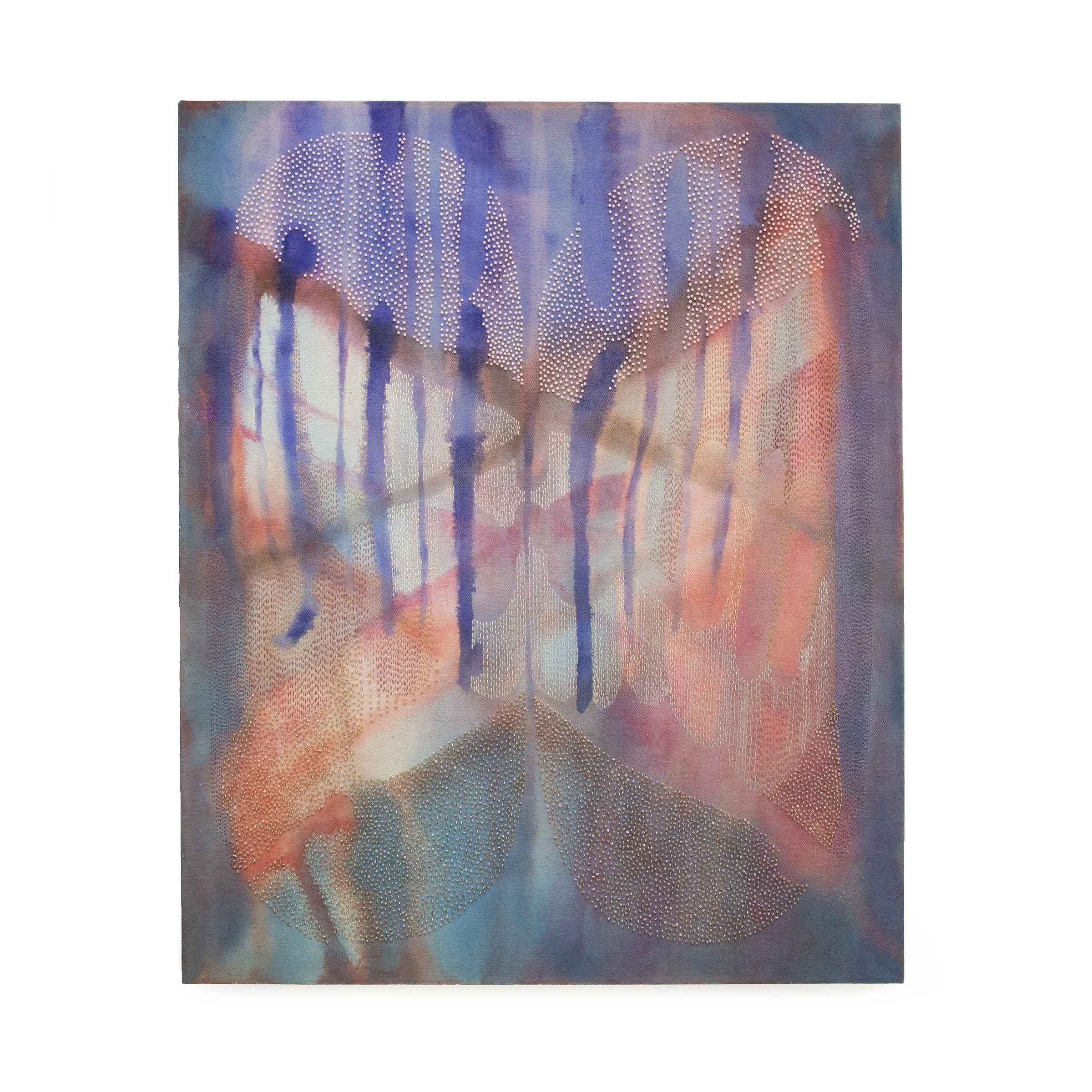
There Are Two of Us Here, 2024, hand-embroidery, glass beads, acrylic paint on canvas, 34 x 28 Inches
Interview with Erin Castellan
Hi Erin! Can you tell us a bit about your background and how you became interested in becoming an artist? Who or what were some of your most important early influences?
My mother was involved in the fiber arts when I was young. I grew up learning how to sew, spin, dye, knit, and weave, but it was my love for painting and drawing that led me to art school. In art school I felt compelled to choose a major that would lead to a job. I chose Textile Design, imagining a stable yet creative design career. After one internship, I knew a job in the textile industry was going to bore me and I couldn’t shake my desire to make art at all times. Fortunately, when I was 22, I did a summer studio assistantship at a craft school where I met artists who modeled a variety of creative life paths. I found their approaches to making a living more appealing than a design career, and never looked back. For 20+ years, I’ve maintained an active studio art practice while also working as an arts administrator, educator, and small business owner.
Where are you currently based and what initially attracted you to working in this place? Are there any aspects of this specific location or community that have inspired aspects of your work?
I currently live in Spruce Pine, NC. It’s a small, rural town in Western North Carolina, about an hour outside of Asheville. I moved here to work at Penland School of Craft. It’s a pretty fabulous place with an amazing community of artists and makers. I lived in cities as a younger adult, but the rural lifestyle suits me. I love hiking, digging in the dirt, and connecting with nature on a daily basis. I think being in relationship with the natural world has greatly inspired my working process. I surrender all outcomes, embrace presence, and stay open to new possibilities. I feel my role as an artist is to be alert. Not to control, but rather to pay attention, to tend. It is very similar to the way that I garden or move through a landscape while hiking. I enjoy getting to know a place intimately and watching it change slowly over time. This is similar to how I approach my art practice.
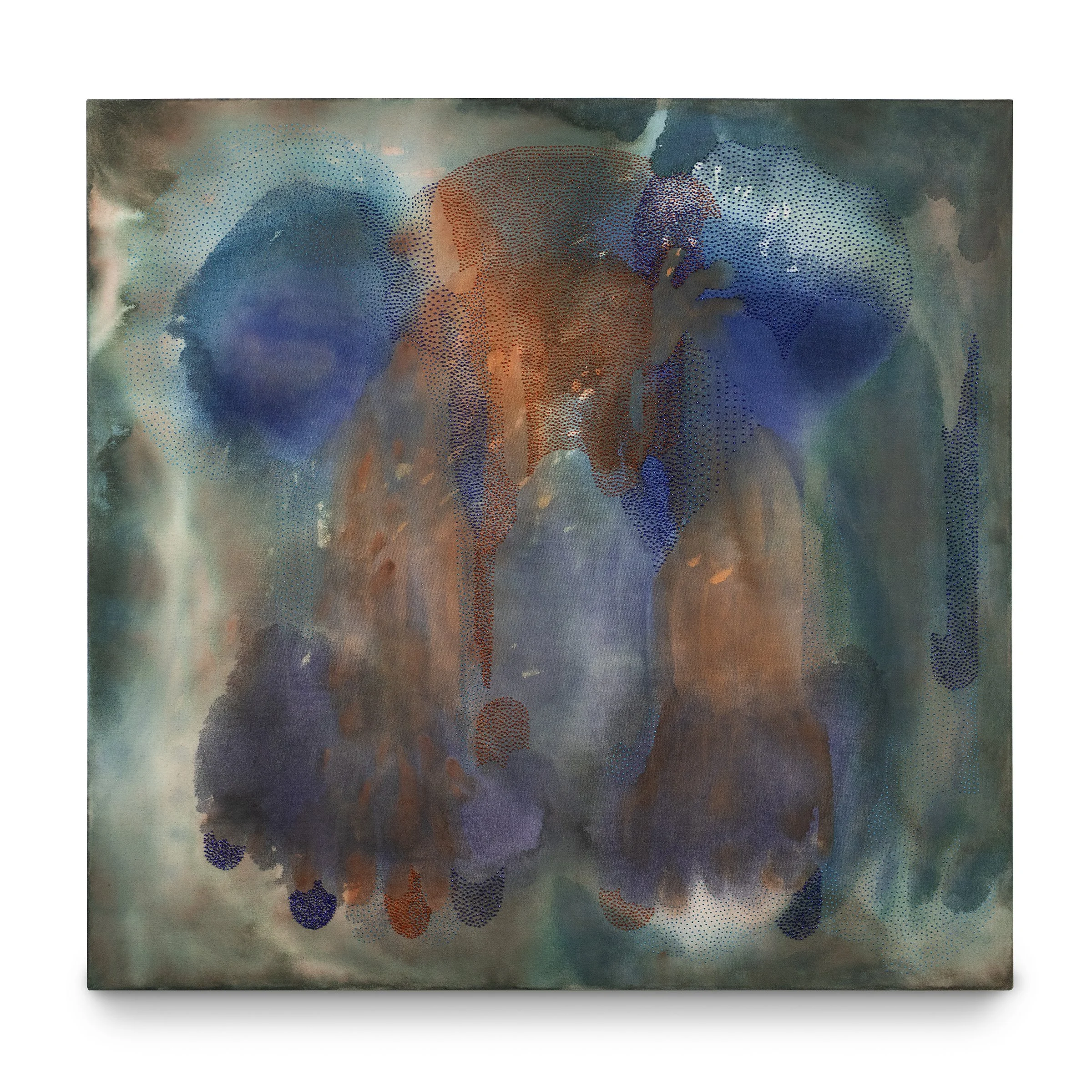
Night Watch: Smoke & Fog, 2025, hand-embroidery, glass beads, acrylic paint on canvas, 46 x 47.75 Inches
Can you describe your studio space? What are some of the most crucial aspects of a studio that make it functional? Do any of these specific aspects directly affect your work?
I do a lot of the embroidery work out of my home, but I also rent a small studio in a building shared by a group of artists. I don’t require much in the way of equipment — just a few white walls and the ability to be a bit messier while I paint. I like having multiple projects going at once, and find that the work feeds off of itself as it hangs side by side on the studio walls.
What are you working on in the studio right now?
For most of this year I’ve been working on a large-scale commission. This is unusual for me. It is unlikely that I’ll do something like this again. I am grateful for the income it is providing, but I am eager to get back to making a slew of experimental images.
What are the primary themes of your work right now? What is on your mind a lot recently?
I am interested in the idea of slow seeing. Particularly, I am interested in how efforts to slow and more fully experience the physical world can inspire a sense of wonder that connects humans to their surroundings and each other with empathy and compassion. I use paint, hand-embroidery and beading to craft physical images that encourage intimate and slow viewing experiences. Lately I’ve been thinking a lot about connection and care.
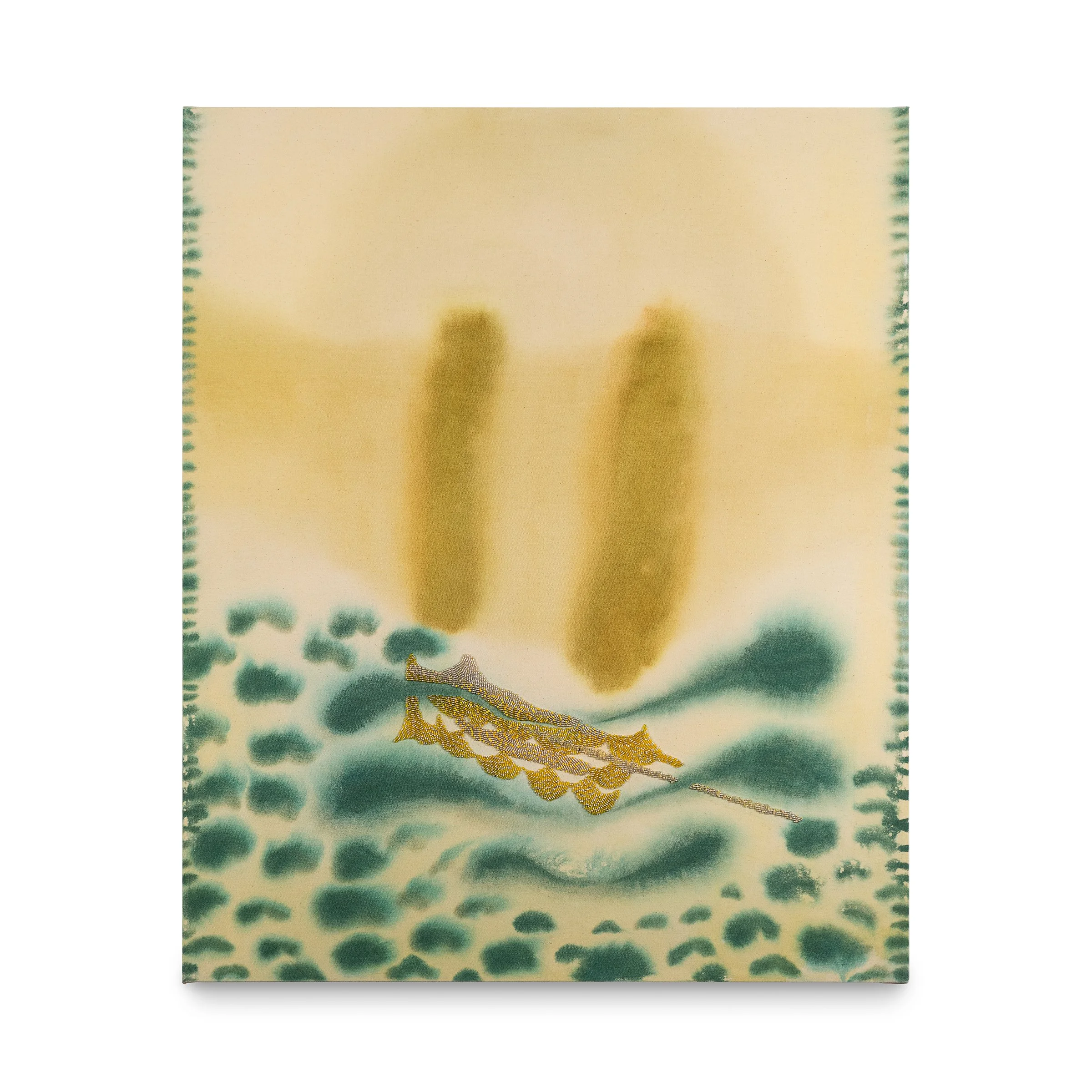
Strained Honey Light Puddle, 2025, hand-embroidery, glass beads, acrylic paint on canvas, 34 x 28 Inches
What is a typical day like? If you don't have a typical day, what is an ideal day?
My ideal day involves waking naturally with the sun, poking around in my garden for an hour or two, then heading to the studio. A late afternoon/early evening social break (walk with friends) is welcome. Evening may involve some quiet stitching or reading at home, but if I make it up my favorite mountain with a friend to catch the sunset and stars, even better.
What gets you in a mindset conducive to making work?
I work best when all of my “must-do” tasks are complete. Often that means doing laundry, cooking food for the week, or mowing the lawn before being able to fully immerse myself in the studio.
What criteria do you follow for selecting materials? How long have you worked with this particular media or method?
I’ve never been one to seek out or buy specific materials. Rather, I work intuitively with materials that are “at hand”. I naturally gravitated towards working with textiles because old clothes, curtains and bedsheets were always free. Initially I began stitching and beading to use up a stash of materials that I had inherited from my grandmother. I’ve worked with painted, embroidered fabrics for over 20 years. Beads were added to the mix about 10 years ago.
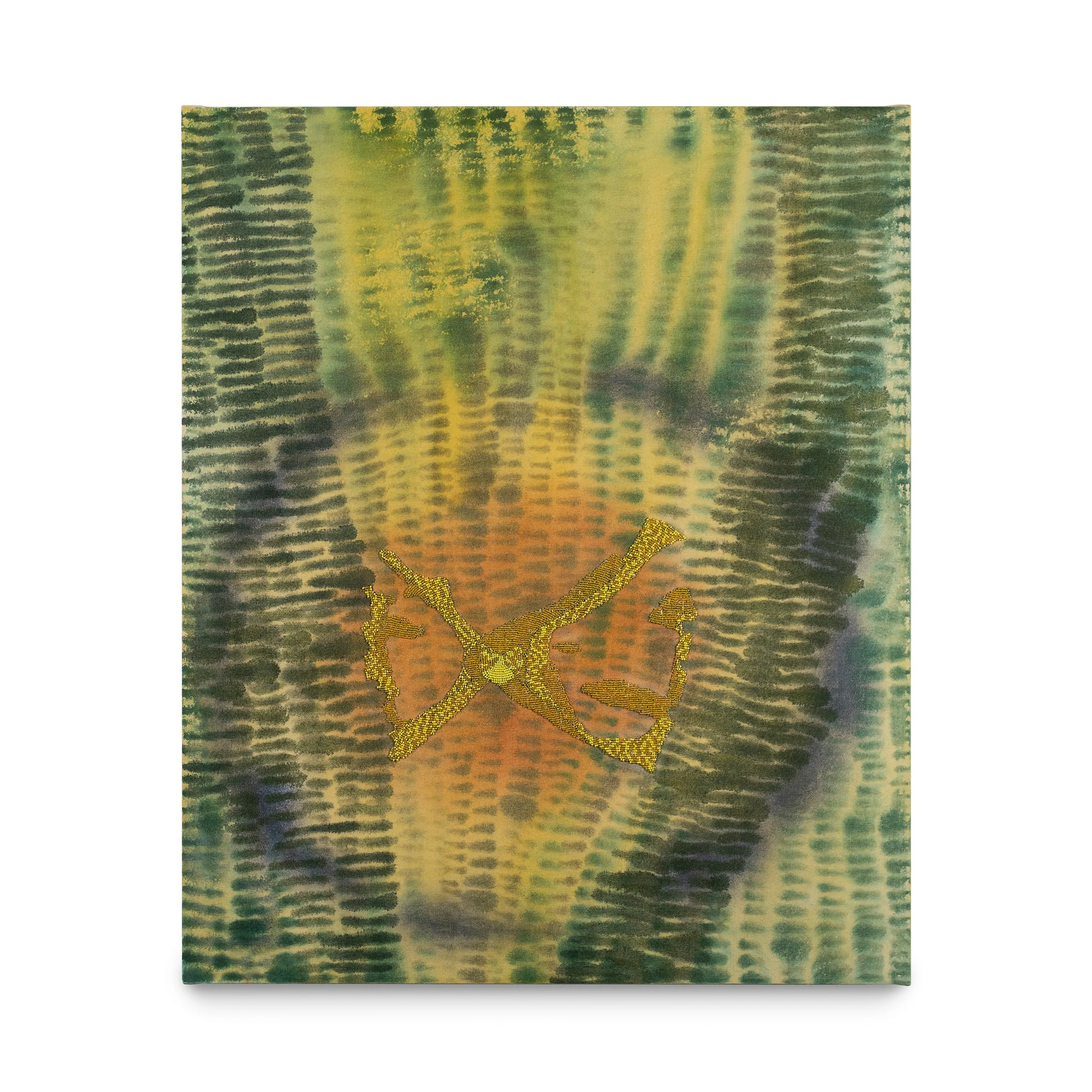
When Fireflies Were Our Candles and Love Was the Only Way Out, 2025, hand-embroidery, glass beads, acrylic paint on canvas, 34 x 28
Can you walk us through your overall process? How long has this approach been a part of your practice?
I start by applying thin layers of watery paint to damp, unprimed canvas. These colorful stains are gentle and responsive. Nothing is planned in advance. The painted marks soften and bleed depending on the wetness of the canvas. Later, I embellish the painted surfaces with repetitive marks, stitches, and beads. I work intuitively, but also slowly. Each piece takes months, sometimes years to unfold. I patiently work my surfaces until their dream-like worlds seem to breathe on their own, pulsating with color and light. The most successful images feel alive, vibrating with an energy as if they grew from within. At the same time, they contain measurable evidence of my hands at work. This has been my approach since 2022. Before that, I was making organically shaped fiber collages. These older works were more tactile and chunky, incorporating a mix of painted textiles, knitting, crochet, hand-embroidery and beading.
Can you talk about some of the ongoing interests, imagery, and concepts that have informed your process and body of work over time? How do you anticipate your work progressing in the future?
I gravitate towards images and experiences that are somewhat mysterious and take time to unravel. Ones that force me to be present, watching, sensing, and open to wonder. I am curious about the point where the physicality of my chosen materials (paint, thread, beads and fabric) gives way to a larger intangible experience. My ideal images flicker between being solid, stable, physical things and something elusive I can’t quite gather, touch, or confine. I enjoy switching back and forth between looking at the surface of an image with my eyes to relaxing into a deep immersion, or sensing of an image, with my body. To me, this repeated dive into full body immersion and presence is grounding. I seek it as I move through the world, and I seek it as I make my art. I look forward to continuing to work in the studio without any predetermined expectations. When I slowly build images, I root myself in my body and heighten my sense of being here.
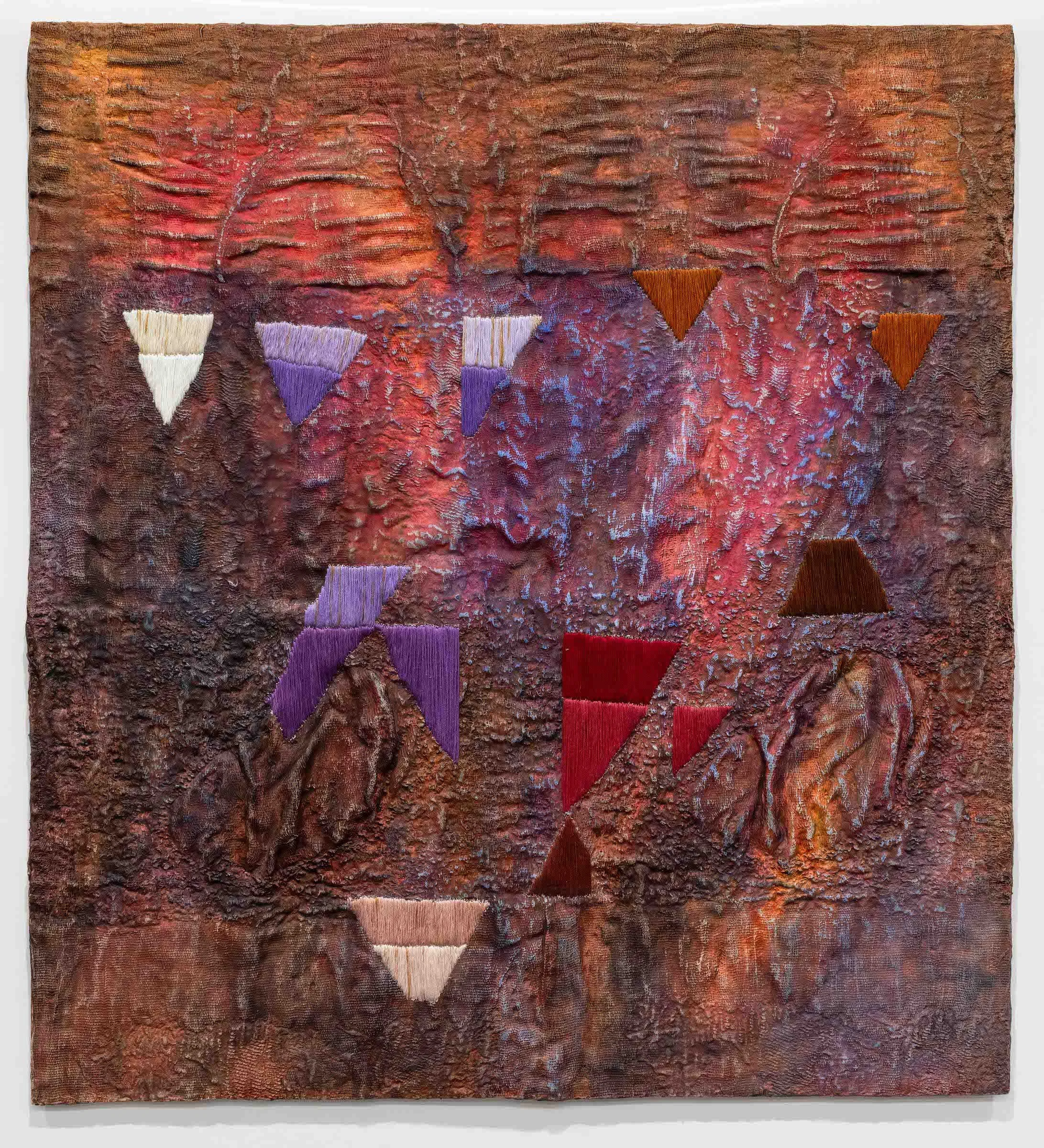
Dark Was the Day, 2022, hand-embroidery, acrylic paint on jacquard woven fabric, 25 x 22.75 Inches
Do you pursue any collaborations, projects, or careers in addition to your studio practice? If so, can you tell us more about those projects, and are there connections between your studio practice and these endeavors?
For many years I have run a small knitwear business using a hand-powered knitting machine to create hats, scarves, sweaters, and tank tops. Prior to the pandemic I was traveling around quite a bit, selling knits at craft shows and teaching workshops at craft schools and art centers. Currently I work in the gallery at Penland School of Craft. I have always had jobs in addition to my studio practice. I prefer having my basic needs met through some sort of stable employment so I can create artwork that isn’t market driven. I also really value the relationships and communities that have developed from my various jobs and business ventures. I wouldn’t want it any other way
Can you share some of your recent influences? Are there specific works—from visual art, literature, film, or music—that are important to you?
I am inspired by so many things. Mary Oliver, Annie Dillard, Italo Calvino, Pina Bausch, Anselm Kiefer, Giorgio Morandi, Iris Eichenberg are some old standbys. Recently, Max Richter’s ‘Sleep’ performances and Celia Pym’s mending have been on my mind.
Who are some contemporary artists you’re excited about? What are the best exhibitions you’ve seen in recent memory and why do they stand out?
Again, it’s hard not to rattle off a slew of names. Instead, I’ll mention Rachel Meginnes and James Henkel, two artists from my current community whose work always seems to resonate with me. I value their thoughtful observations, playful conversations, and ways of seeing the world. When I was younger and lived in cities I went to a lot of exhibitions. Now, though I work with exhibitions at my gallery job, my free time is mostly spent outside - staring at the sky, watching the changing light, observing the wind.
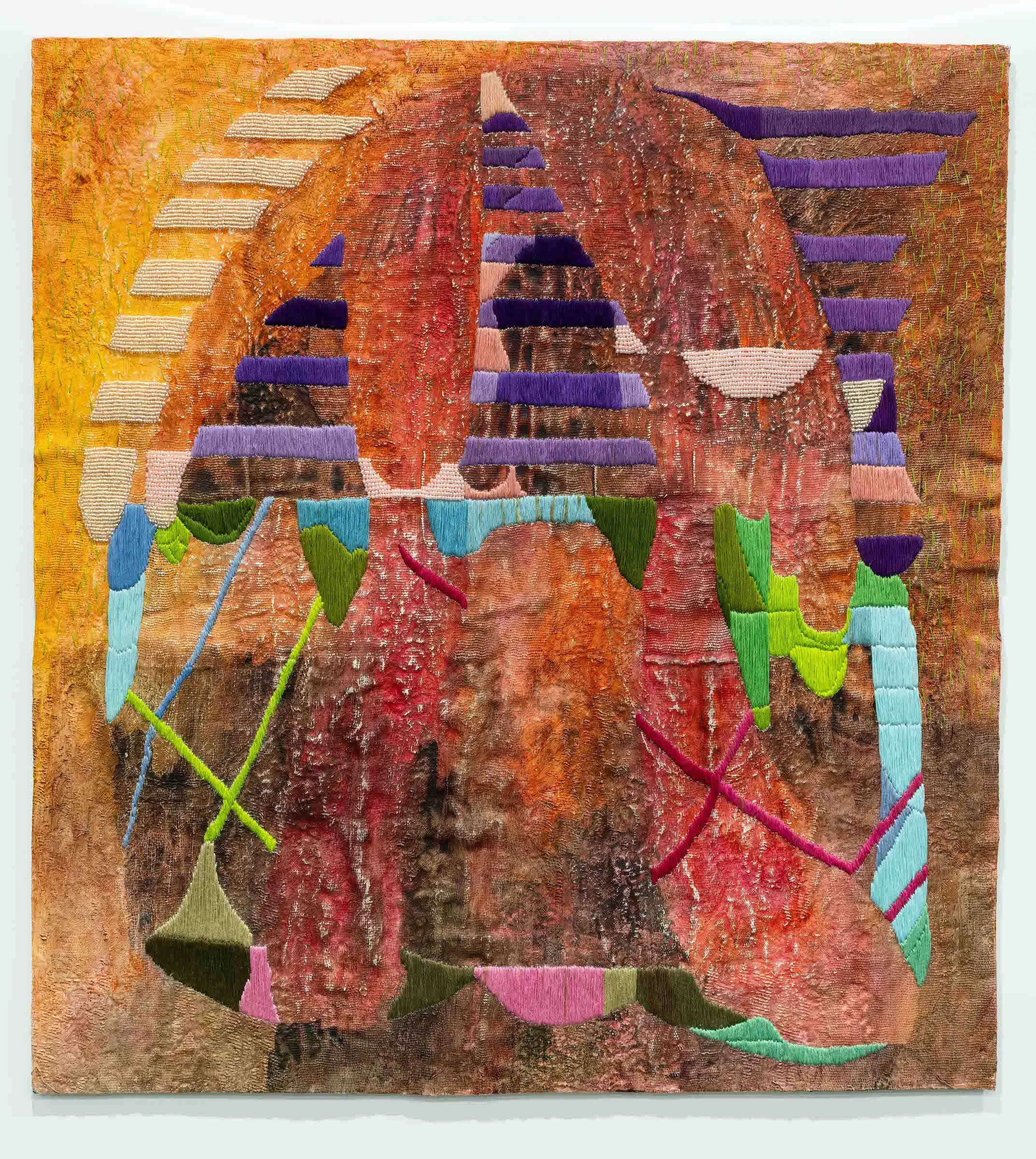
Let’s All Live Where the Grass is Greener and the Wind Blows Softly, 2022, hand-embroidery, glass beads, acrylic paint on jacquard woven fabric, 25 x 22.75 inches
Do you have any tips or advice that someone has shared with you that you have found particularly helpful?
Wake up and ask yourself what you feel like doing in the studio today…then do it. Don’t force yourself to do the type of work that you feel you “should” be doing. Allow yourself to take a meandering path. Follow your curiosities. Try new things. Maybe go for a walk instead. It might take longer to get to where you are going, but the journey will be more rewarding. When I pursue my creative work with this approach in mind, it often feels fresh, exciting, and sustainable.
What’s coming up next for you?
My job at the Penland Gallery is seasonal. I get winters off! I’m looking forward to a few months to dive more fully into my studio practice and start new work.
Thank you so much for sharing your work and talking with us!
To find out more about Erin’s work check out erinecastellan.com