
Dana Oldfather
I’ve always felt a little off-balance and untethered, like the ground is falling or a breeze could pick me up. Life moves too fast. I am overwhelmed – jumpy. Perhaps we should give more weight to our actions, no matter how small? The whole of our lives is built of innumerable events, one following another, obtusely influencing the next. In a world full of unknowns, change and impermanence are our only certainties. If I could come to terms with this, would my fear subside? I communicate the dilemma of being through landscape. I bring my insides to bear on the outside and trepidation colors the scene. Broodingly, the atmosphere is thick, and the landscape psychedelically tinted like dawn, an eclipse, or a summer storm. Flora glows and becomes bulbous and fleshy, petal-like and feathery in the waning light. Reality is more than it seems. One follows the receding landscape out and away only to wash up again at the shores of one’s skin; hope; longing; loss. While building other worlds, the sense of my impermanence in an expansive, mysterious universe stretches out into broader context and I am free.
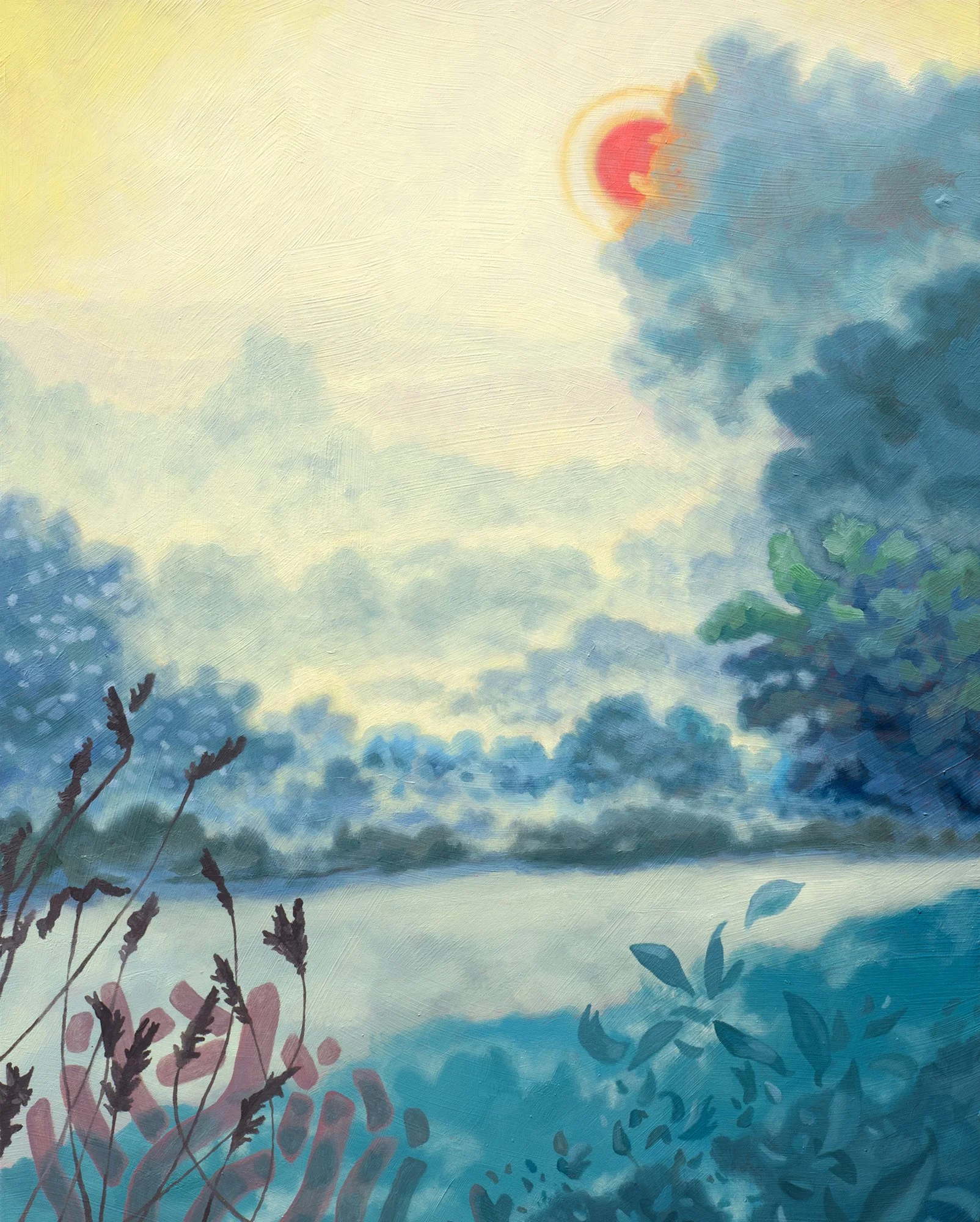
Slow Rise, 2025. Oil on panel, 20 x 16 inches
Interview with Dana Oldfather
November 20205
Can you tell us a bit about your background and how you became interested in becoming an artist? Who or what were some of your most important early influences?
My mother was a business woman and my Dad is a painter. They divorced when I was seven and Dad raised my younger brother and me. We lived in an apartment near the airport and Dad’s studio was also his bedroom. We didn’t have much but we were happy. Dad painted full time and encouraged my love of drawing and painting as soon as I could hold a pencil and a paint brush. One day, when picking us up for our weekend stay with her, Mom said to Dad, “Mark, Dana needs some toys.” He replied, “What for? She has a sketchbook.”
Where are you currently based and what initially attracted you to working in this place? Are there any aspects of this specific location or community that have inspired aspects of your work?
I live with my husband, Randall and son Arlo just outside Cleveland, Ohio in a little brick bungalow built in 1921. Two small rooms on the first floor make up my studio. The house is 6 miles from my gallery in the Clark/Fulton District and close to all the good food, museums, and gallery openings. Even though our house is only 5 miles from downtown, we live on the Metroparks and are across the street from a small golf course, so it’s nice and green here. Newburgh Heights is a small, old, completely residential village with an ageing population, so not many people know about it. Because of this and the housing crash in 2009, we were able to get our place for a song. Having not taken on a crushing mortgage makes it easier to have creative freedom and sustain an artistic career when times get tough.
Our parents and my husband’s siblings and kids live within an hour’s drive so staying in Cleveland is a must. Arlo is our only child, and he has a strong relationship with his Grandparents and cousins. The family compound where Randall grew up is a 90 plus acre tree farm in Chardon, Ohio and we have lunch with his family there every two weeks. Lots of time is spent outside on the land. We have family camping nights “on the back 40” acres, away from the house. Photographs I’ve taken of the pine groves over the years inspire my work.
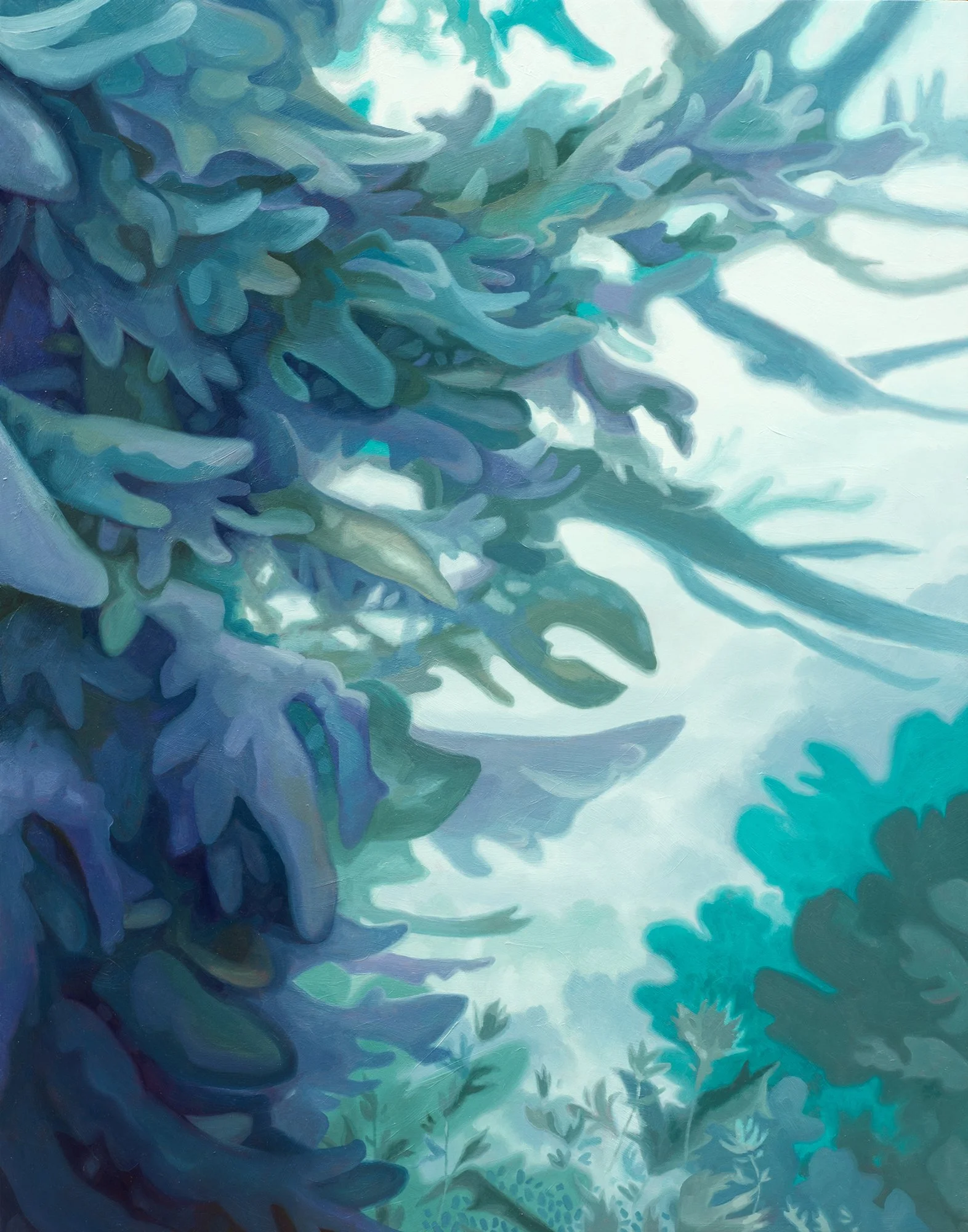
Evergreen, 2025. Oil on panel, 30 x 24 inches
Can you describe your studio space? What are some of the most crucial aspects of a studio that make it functional? Do any of these specific aspects directly affect your work?
I’ve always had a home studio. It doesn’t add to our monthly expenditure and it’s convenient. I pop in and out while I’m brushing my teeth or making dinner in addition to my regular studio hours. No barriers to entry makes it easy to work for at least a little bit every day. My studios are small, each just over 110 square feet with 9 ½ foot ceilings. The painting studio is bright with wood floors, wall easel, and one South and one West facing window. The other studio is carpeted, with a large wooden table and one West facing window. I use this second studio to build and store stretcher bars, stretch canvas, draw, box, ship, and store recently finished work.
What are you working on in the studio right now?
Each year during the cooler months I make 2 or 3 large canvases. I finished up the first one in the new grouping this month. Its 60 x 48 inches vertical with a large conifer in the foreground bowing slightly in front of a glowing sun/flower at the top of the composition. I am stretching another larger canvas this week and will begin priming a batch of 6 canvases next week.
What are the primary themes of your work right now?
I consider myself a transcendental landscape painter. Light and atmosphere are just as important as trees and plants are in these works. I use stormy or dawn-like light, thick atmosphere, and wonky shaped trees and plants to elicit feelings of awe and slight unease. I make work to myself that the world is full of magic and more than what it seems.
What is on your mind a lot recently?
I’ve been thinking a lot about the fact that I don’t always know what the hell I’m doing. Typically, I am a self-assured person, confident in my knowledge and opinions. The older I get the more I see the fluidity of knowledge and the fundamental nature of change and impermanence at the heart of my beliefs, thoughts, feelings, and physicality. Holding what I think I know in an open hand, with room for it transform and evolve, rather than in a tight fist, fighting against information, different opinions or change, has given me a greater capacity to listen to others, grow, and find peace.
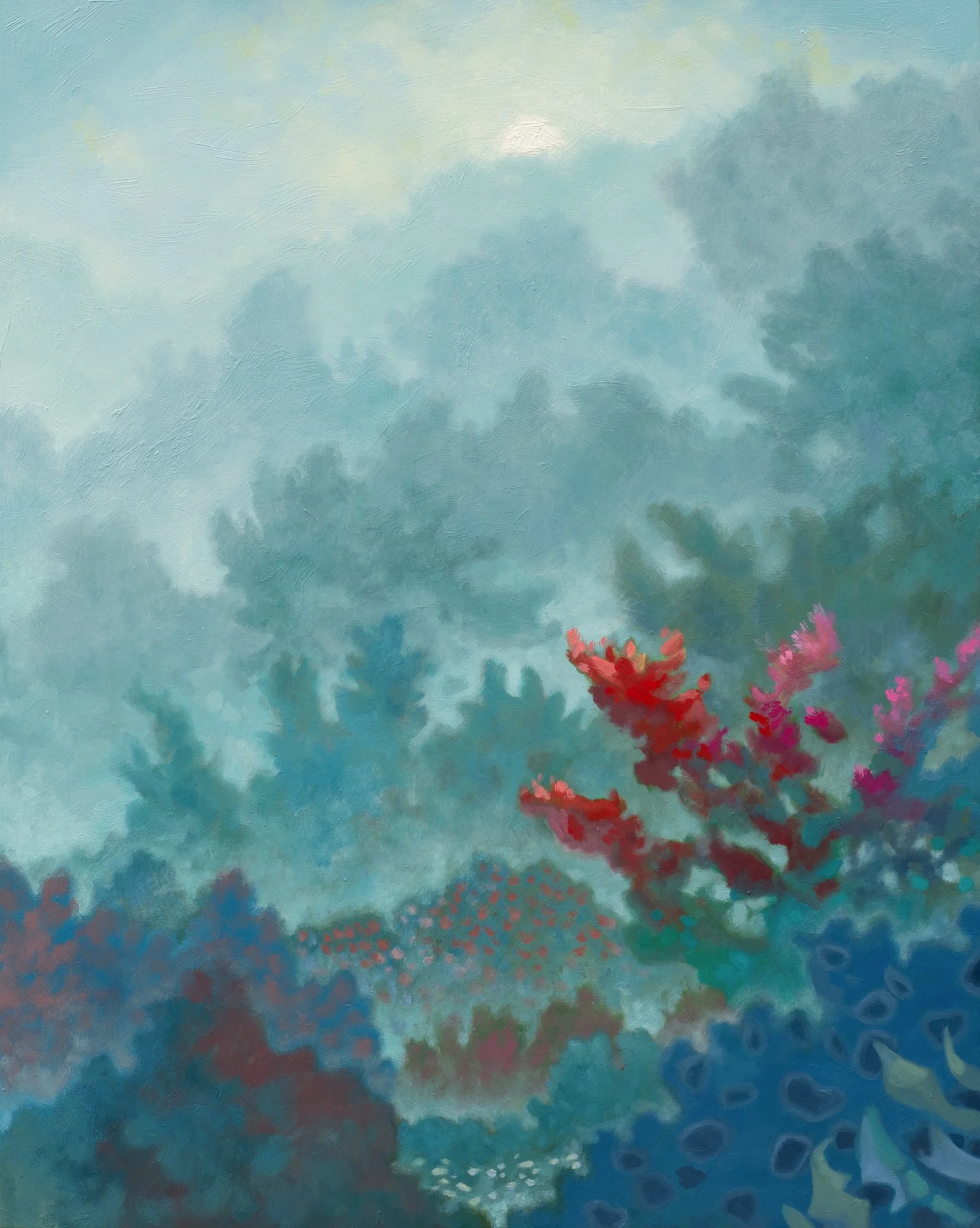
Cool Morning Hillside, 2025. Oil on panel, 20 x 16 inches
What is a typical day like? If you don't have a typical day, what is an ideal day?
My studio time is broken up quite a bit throughout the day. The habit formed while raising Arlo through infancy and the toddler years. Even though he is in middle school now, the rapid task switching has stuck.
I wake up between 6am and 6:30, brush teeth, make coffee, and sit down to chip away at Kant’s Critique of Judgement, before leaving at 7:00am to take Arlo to school. From there I go to the gym to lift weights and walk a bit before getting back home around 9:30am. I eat some breakfast, change clothes and get into the studio by 10–10:30. Work till 12:30 and heat up leftovers for lunch. Work again from 1–2:30 then leave to get Arlo from school. Work again from 3 to 4:30 or 5pm and then start making my family dinner. Relax with my guys, watch some TV, noodle on my phone, brush teeth, skin routine, crawl in bed by 9pm. Repeat. Sometimes I switch up the gym with yoga or Pilates, and sometimes the studio is drawing on the couch or doing some extra reading or research.
What gets you in a mindset conducive to making work?
Any time I need a little kick I pick up “The Creative Act: A Way of Being” by Rick Rubin. It’s easy to read, very Zen, and sets me right for jumping into the studio. I just start it again once I’m done – it’s so inspiring and uplifting!
What criteria do you follow for selecting materials? How long have you worked with this particular media or method?
I’ve worked in oil paint my whole life. In my 20s and 30s, when I made primarily abstract work, I also used acrylic and spray paint. I dropped these other mediums, however; through abandoning hard lines and tape, a desire to declutter my process, and frustration at the tendency of acrylic paint to change color as it dries. Now I work entirely with oil paint. I love the way it glazes and layers, its ability to “show the work” in the underlayers. The oil medium I use changes depending on the paint layer and drying time I require: linseed oil in the first 2 layers, walnut oil in the middle layers, and poppyseed oil in the top glazing layers. I’ve been working this way for about 2 years.
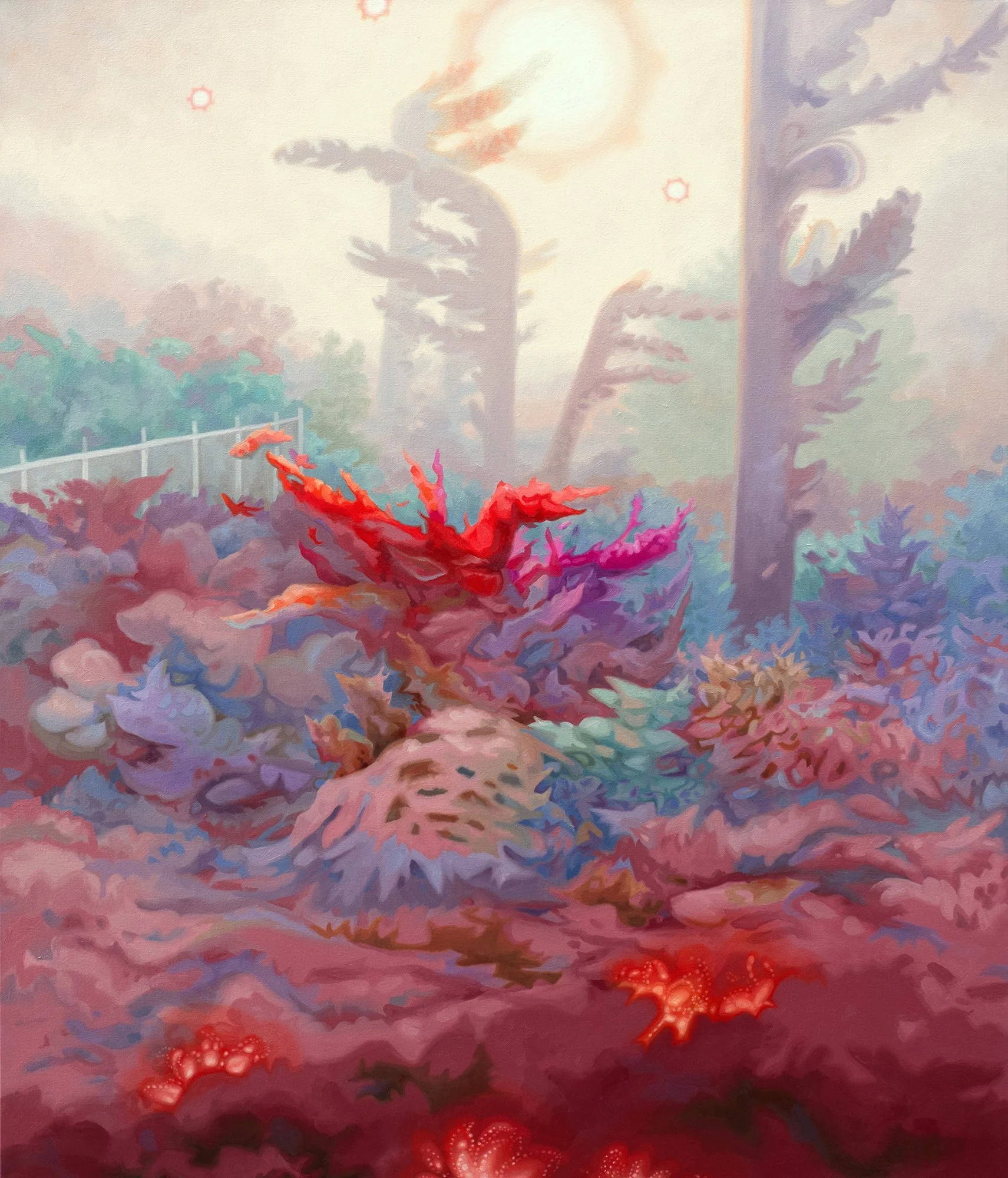
Fire Inside, 2024. Oil on linen, 45 x 38 inches
Can you walk us through your overall process? How long has this approach been a part of your practice
My process begins long before I start painting and operates in a similar manner to the way I cook. I don’t like to follow a recipe. When I set out to make a dish or a meal, I search the internet for recipes and read a handful of them to see different ways to make the thing I want to cook. I compare oven temps, list and quantities of ingredients and spices, and cooking times. Each recipe is different. I take the informational bits I want combined with the cooking knowledge that I’ve acquired over the years, see what ingredients I have on hand, and make the dish my own.
In between working, driving Arlo around, caring for the house, and exercising I take a lot of photos and internet screengrabs to gather inspiration and ideas. Every so often I go over my camera roll and make loose, graphite drawings using parts of these images and invented forms. I also consult my studio wall, covered in one-liners on Post-Its, to keep me on task with my compositions, forms, and later, color choices. After months of building up a collection of drawings, I go through them and see what goes together or what draws me in the most. I choose a few to begin painting and build, stretch, and prime my linen. I measure out the sketchbook drawing and the canvas into quadrants, mark them, and freehand the image onto the linen, infrequently referring to the drawing, allowing for change and spontaneity as I lay it out in colored chunks. The first couple layers of the painting are done in tints of red, pink, and burnt sienna. These warm colors add tooth to the cool violet and green shades of the work in its final stages. Over the last two years I’ve been able to work from general to specific and leave lots of room in the process for me to react in the moment. The final painting is always a bit of a surprise.
Can you talk about some of the ongoing interests, imagery, and concepts that have informed your process and body of work overtime? How do you anticipate your work progressing in the future?
In addition to my husband’s family’s tree farm, I find inspiration in the landscape around the Metropark trails of Northeast Ohio where I walk, The Allegheny Mountains in Pennsylvania where we camp, and the side of the roads and highways around Cleveland that I drive on every day.
I am unsure how my work will change, but I know it is changing and growing all the time. I aim to foster more risk taking in my imagery and make more stylized plant forms.
Do you pursue any collaborations, projects, or careers in addition to your studio practice? If so, can you tell us more about those projects, and are there connections between your studio practice and these endeavors?
The Museum of Contemporary Art in Cleveland reached out recently to commission me to paint a couple handbags made by renowned, local, leathergoods manufacturer, Fount. The finished bags will be auctioned at the museum gala to raise funds to support their 2026 exhibition season. The leather paint I used on the bags is acrylic-based, and I am learning some things about color searching and taking chances. It’s been a fun project that I already see giving me more guts in the studio.
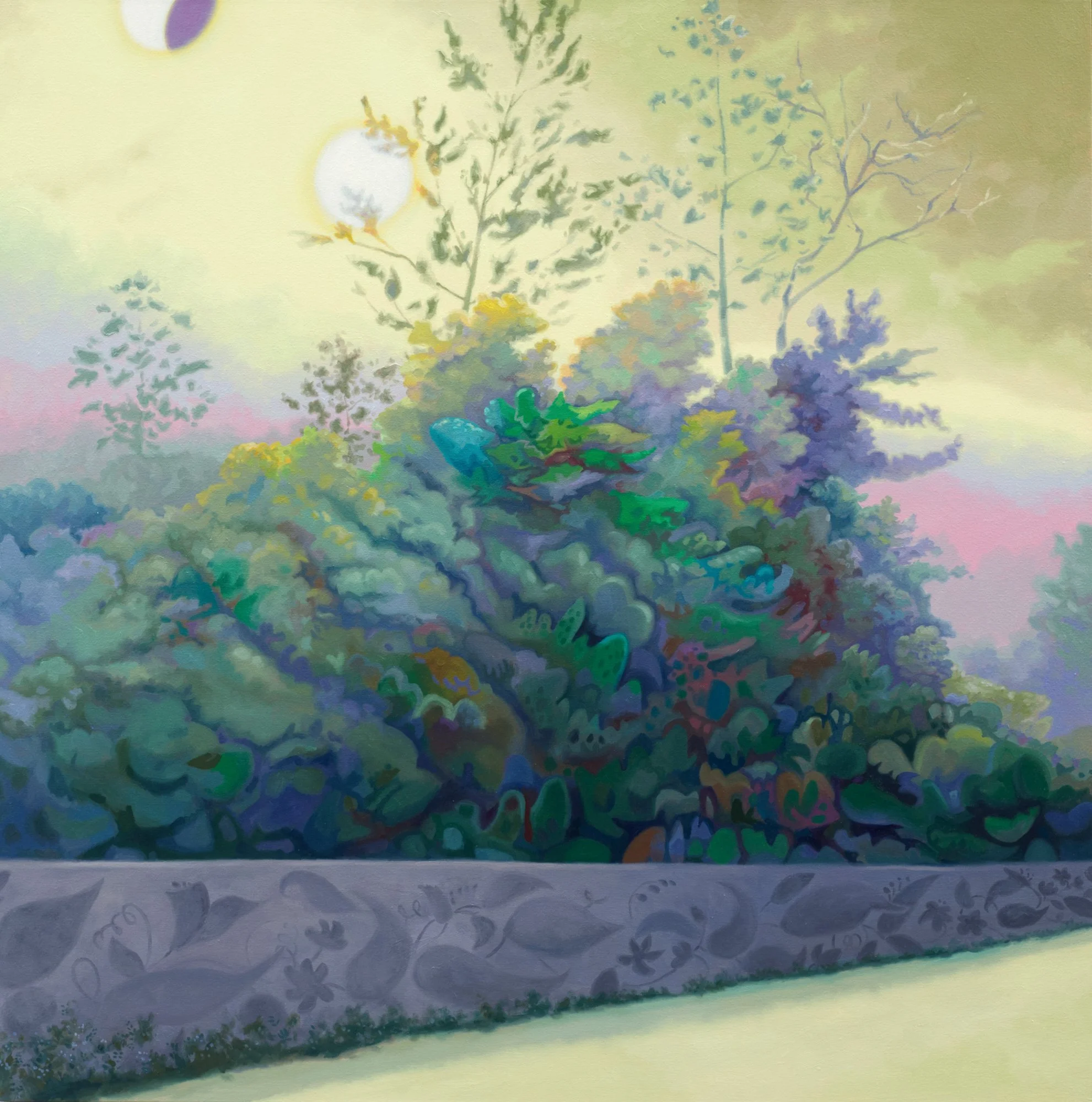
Two Suns, 2024. Oil on linen, 40 x 40 inches
Can you share some of your recent influences? Are there specific works—from visual art, literature, film, or music—that are important to you?
I‘m inspired by classical fiction writers that use seemingly mundane occurrences to illuminate profound thoughts, specifically Virginia Woolf. I believe it was in her book To the Lighthouse, she wrote a scene wherein a character pulls a rumpled leather glove from between the cushions of a couch and knows its owner by the form the fingers take. To be able to make a person feel something on a deeper level that what the art looks like on the surface is one of my ultimate goals.
Kantian philosophy and meditation practice are part of my painting practice. They have helped me know myself and understand the way I think. They’ve taught me how to pay closer attention to the world and people around me. By strengthening this muscle, I am better positioned to see what is truly important; my family and relationships.
As far as visual artists, I’m immensely inspired by Aubrey Leventhal’s compositions, Maja Ruznic’s paint handling, Lisa Yuskavage’s light and color, and Sarah Hughes risk taking and spontaneity.
Who are some contemporary artists you’re excited about? What are the best exhibitions you’ve seen in recent memory and why do they stand out?
Maja Ruznic’s work strikes like a bell both online and in person. Her paintings and drawings ring with mood, grace, power, and femininity. Her work inspires me to distill a language of forms that is my own. It was a treat to see two of her large-scale oil paintings at the Whitney Biennial in 2024. Seeing an artist’s career flourishing while they live somewhere other than New York or LA gives me hope.
Since I was a child, I’ve been interested in surrealist paintings like those made by Remidios Varo, Paul Delvoux, and Leonora Carrington. So, when I read an article in Artform reviewing the Gertrude Abercrombie exhibition at the Carnegie Museum in Pittsburgh, I made a date with an artist friend of mine to go see it at the end of May this year. The wide collection and depth of Abercrombie’s quixotic work did not disappoint. Landscapes checkered with moons, ladders, ghostly female silhouettes, whales, shells, and doors filled room after room. It was the largest museum exhibition of the artist’s work ever on display and continues to feed back into the way I see other artwork (both historical and contemporary), my practice, and the world.
Do you have any tips or advice that someone has shared with you that you have found particularly helpful?
The year I got married, 2011, I went on my first and only artist residency away from home at The Vermont Studio Center. It was a wonderful experience, and I had the pleasure of meeting and having a studio visit with Carrie Moyer. She was lively and fun to talk to and said something that has stuck with me in different ways over the years. She said, “where are all the big shapes?” Moyer is the master of “big shapes”, and her voice comes to me when I’m setting up a composition, straining in the beginning to work in the general, and noticing my tendency to needle into the specific before its time.
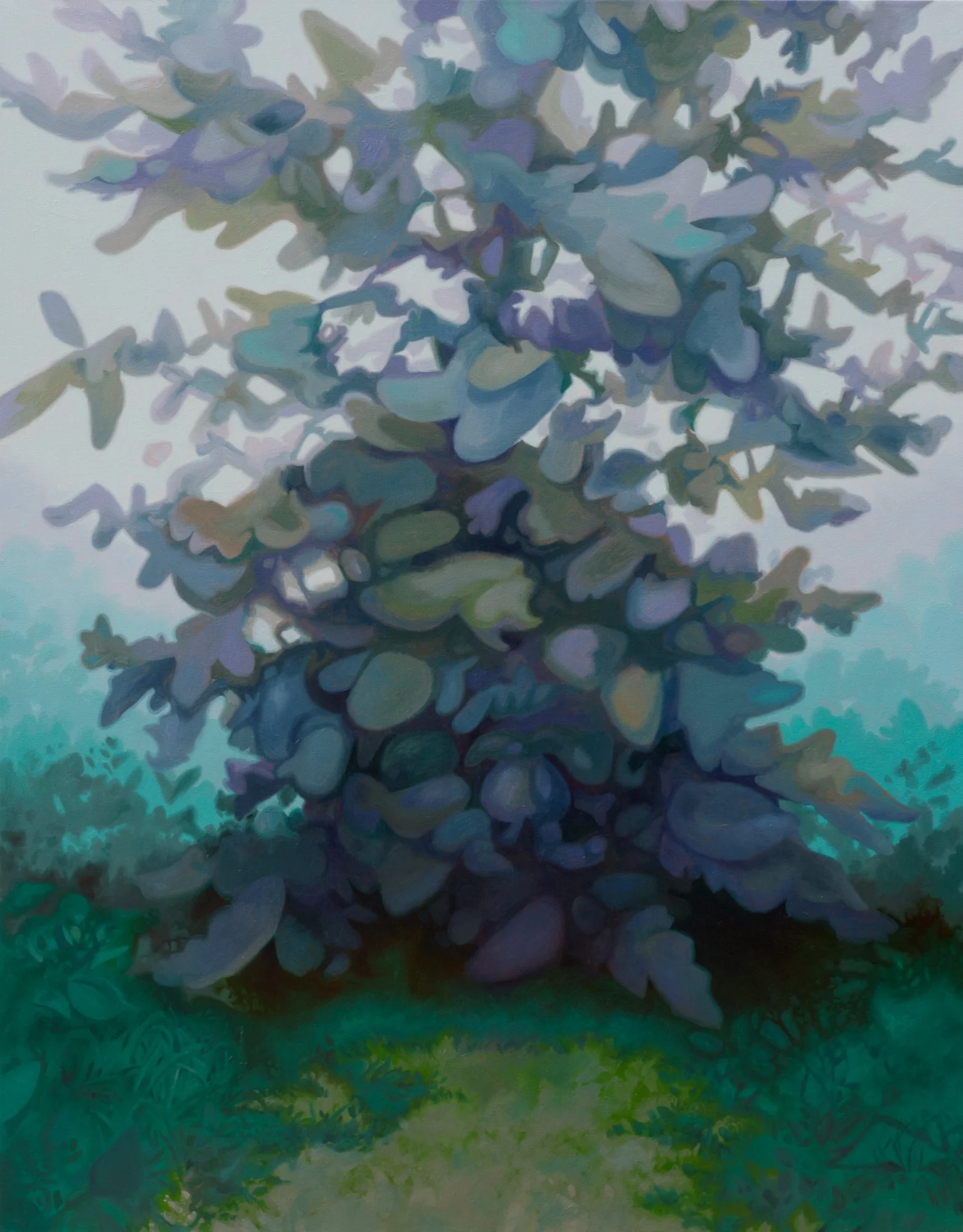
Bishop, 2024. Oil on linen, 48 x 38 inches
What’s coming up next for you?
Just making new work to send to my galleries. I’m excited to have some unscheduled time to work on a couple larger format canvases and do some smaller experiments. I will be in a group show at Abattoir Gallery in Cleveland in 2026 and will have a solo with them in 2027.
Thanks so much for sharing your work and talking with us!
To find out more about Dana and her work, check out her website.