
Annie Hayes
I work with discarded packaging that has served its usefulness in storing and transporting food and commercial goods. Using these remnants of other activities, I focus on the visual experiences of spatial placement, proximity and location. I embrace the challenge of making work that is transparent in its materiality. Random images created by my process-reliant practice produce ambiguous content, creating a passageway for the viewer. From my collection of commercial packaging, I have created an extensive storehouse of tools and methods for using them. Stencils, flattened packaging employed as shapes for outlines and code-like images found on commercial packaging deepen the work’s complexity. The connection between my work as an artist and the workers who use the boxes in their jobs to transport food is subliminal, vague and felt, not expressly spelled out. The paintings’ surfaces, with their brokenness, disturbed corners, tears and rips revealing the interior ask the viewer to move away from perfection and the expected and toward embracing in a new way material that has served a function that we all invariably depend on. The commercial packaging now lives in a new space.
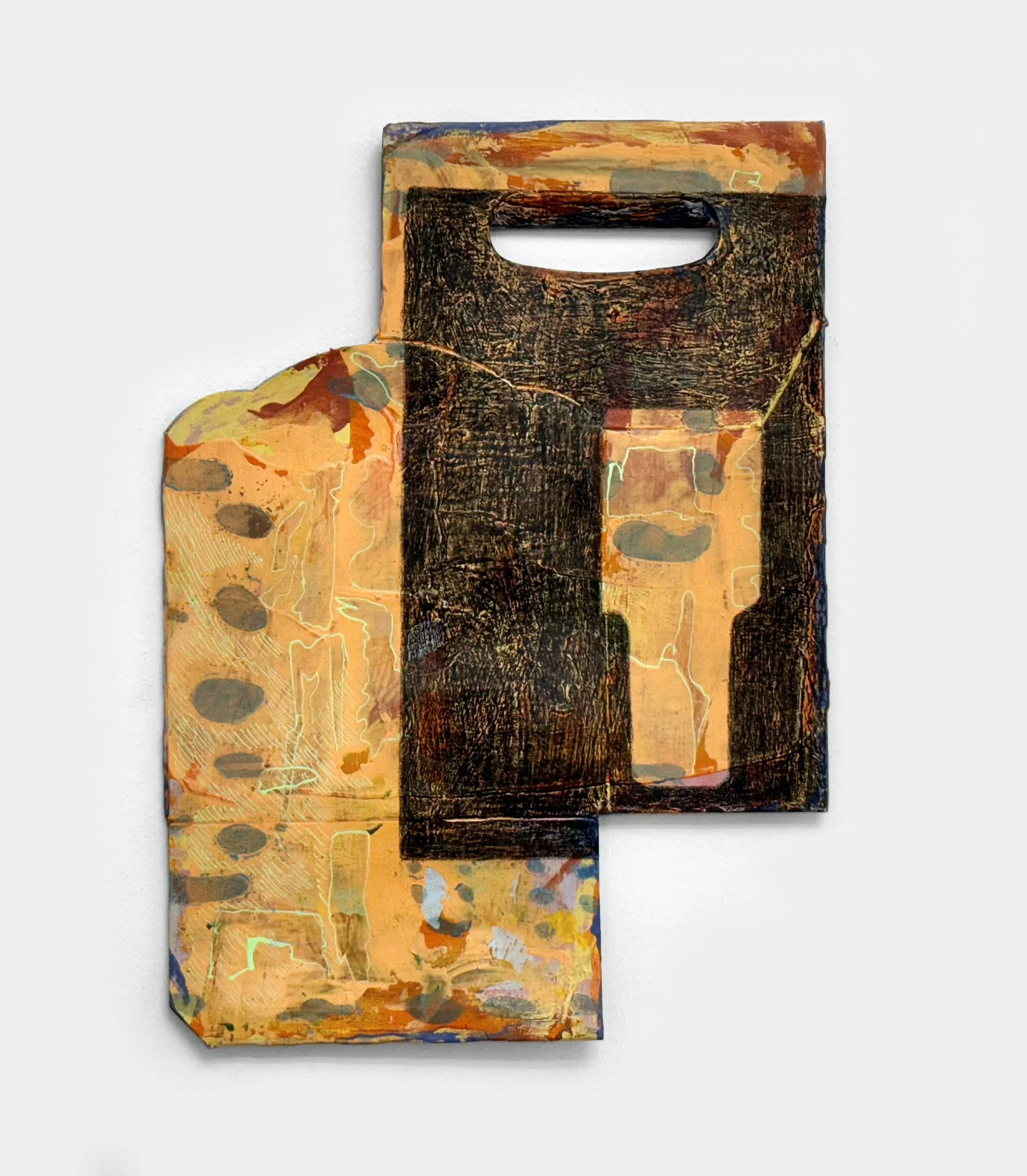
Beer-1, 2024, Paint, pastel, ink, pencil on beer caddy, 11 x 8 inches
Interview with Annie Hayes
Hi Annie! Can you tell us a bit about your background and how you became interested in becoming an artist? Who or what were some of your most important early influences?
I grew up in Ohio until I was ten. We lived in the country. I desperately wanted a pony (I was the archetypal horse-crazy girl) and so we adopted Mitty. We moved to a house north of Buffalo and there were horses, dogs, cats, sheep, goats, turtles, chickens, geese in my life that let me slip into a quiet world where I could care for them and enjoy their company. My father was an anatomist and I often looked through a microscope as he guided my visual exploration. My rural childhood and my lifelong desire to make things and to draw and paint formed the way I have lived ever since. I am one of the many artists who say there really wasn’t any decision, I was just born an artist.
Where are you currently based and what initially attracted you to working in this place? Are there any aspects of this specific location or community that have inspired aspects of your work?
I’ve lived for over thirty years in upstate New York, in the Northern Catskill mountains. My late husband and I wanted to raise our daughter in the country and so we moved from a loft on the Bowery to a house near a small town in a rural area. It was a risky decision to leave New York, but one that quickly worked out well, as we maintained our graphic design business and raised our daughter. Our situation was definitely “it takes a village”. At our house I regularly encounter deer, insects, birds of all kinds, toads, frogs, foxes, snakes, and the occasional black bear. The land and the way its light and weather are never endingly changing are important to me. While my work is primarily abstract, these aspects of my rural life are the architecture it lies on.
Can you describe your studio space? What are some of the most crucial aspects of a studio that make it functional? Do any of these specific aspects directly affect your work?
I currently am working in a large Amish-built shed that’s 14’wide and 28’ long. There are long plain walls and three windows. This space is the largest one I’ve had, after years of claiming bedrooms and basement areas for workspace. Having a dedicated space that is entirely under my control is extremely meaningful for me. I have a drawing area with a large table, flat files and storage, and the rest is open to let me make whatever I might be thinking of. My studio is in a field and I look out on trees and the sky.
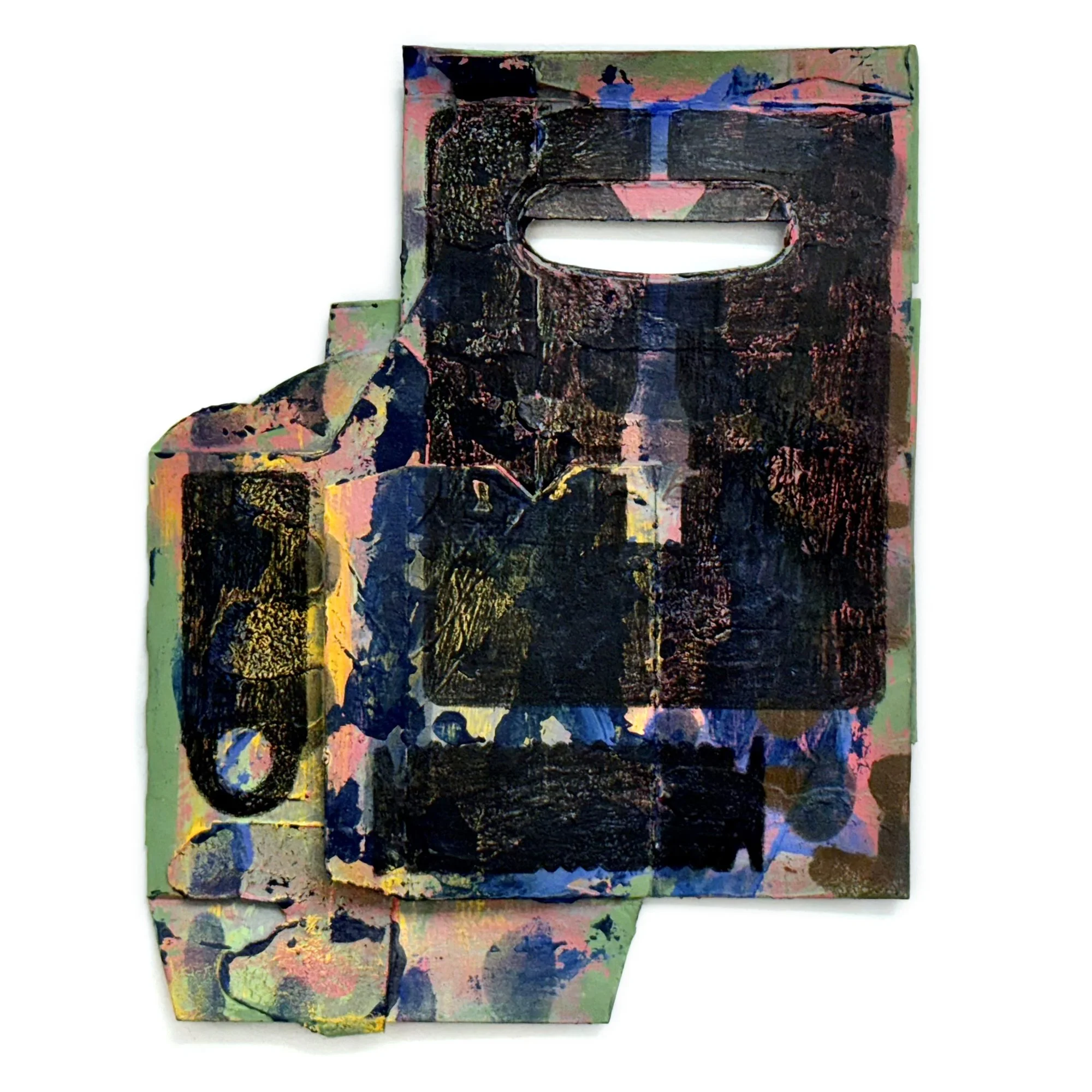
Beer-7, Paint, pastel, pencil on beer caddy, 10 x 8 inches
What are you working on in the studio right now?
Right now I’m working on a series of ink/pencil drawings, taking work that I made last year and cutting them in half and making new drawings with the new halves. I’m also painting on a variety of surfaces and substrates: wood panels, discarded cardboard boxes, paper, aluminum panels, cement board – pretty much anything that I come across. I have an ongoing body of work that uses found commercial packaging that I prepare and then paint, adding dark elements by tracing around other found packaging and making the shapes black to really build the spatial distances that are important to me.
What are the primary themes of your work right now?
I’m working with the visual concerns of distance, proximity, an abstraction of land and where we reside in imagined visual spaces. I’m working within the framework of making arbitrary decisions that lead to unexpected and certainly unplanned results that then lead to work I might never had made.
What is on your mind a lot recently?
Well, the disturbing state of the world is taking up a lot of my attention.
What is a typical day like? If you don't have a typical day, what is an ideal day?
I wake up around 7am, have breakfast and read selected articles, do paperwork and research for whatever work or project I have going, then go out to my studio. I work from mid-morning until 7pm. If I’m not tired (from doing heavy outdoor work taking care of my house), I’ll return to the studio and work on drawings. My work life right now is what I’ve always wanted, and I sometimes feel that many of my days are often like being in a residency where daily errands don’t take up much time and I have a level of concentration that I’m very grateful for.
What gets you in a mindset conducive to making work?
It doesn’t take a mindset for me. Working in the studio is the best thing I could be doing, so I don’t need any external motivation or state of mind. It’s the place I most want to be in.
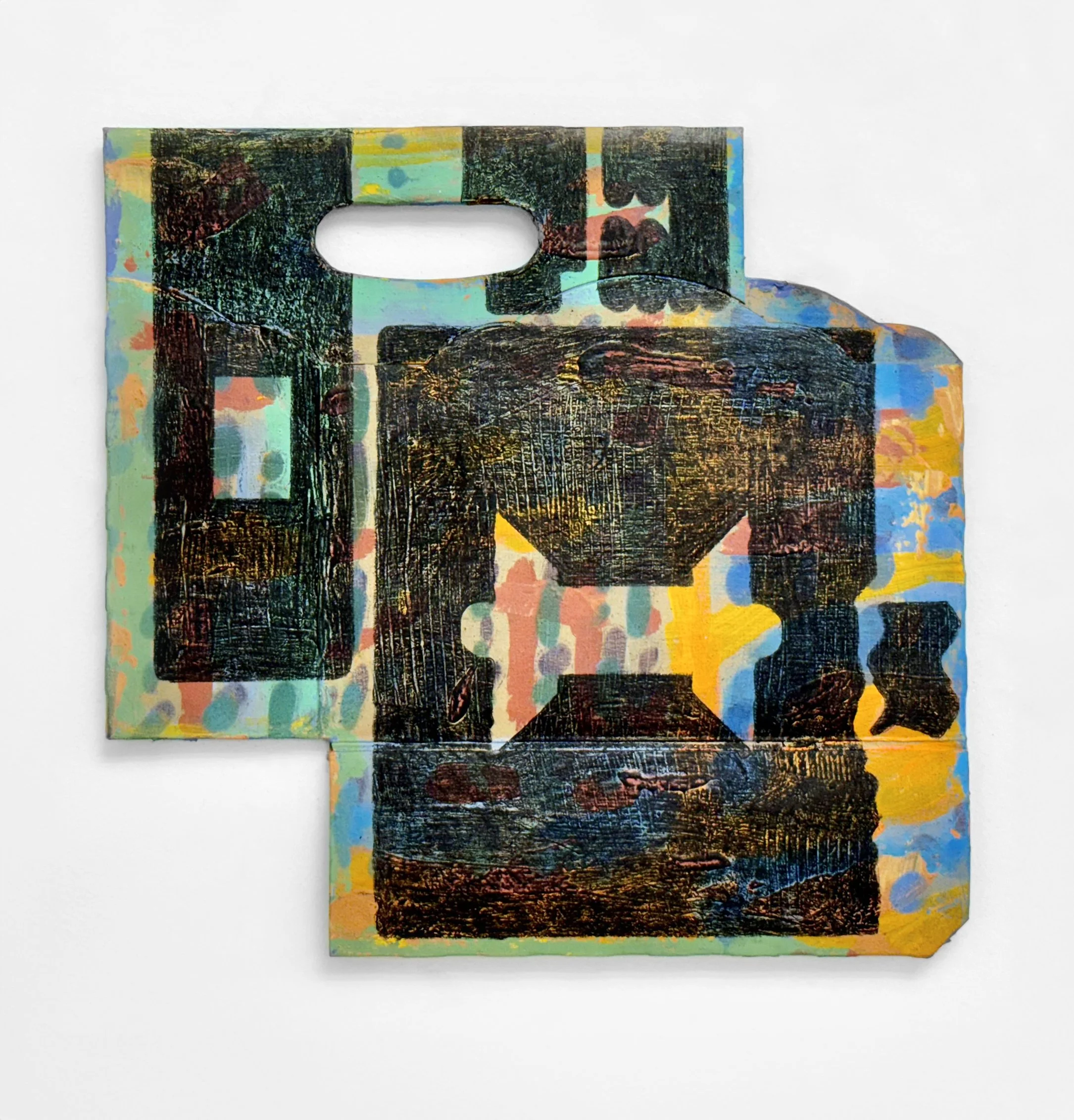
Beer-8, Paint, pastel, pencil, crayon on beer caddy, 10 x 10.5 inches
What criteria do you follow for selecting materials? How long have you worked with this particular media or method?
I use a lot of materials, some traditional (various paints, ink, pencil) and some less customary (odd substrates, found packaging, building materials). I have a looseness in selecting materials and an aversion to sticking with tradition. I like irregular, odd pieces that float through my life as opposed to perfect corners and edges. Over the past several years I’ve collected symbols I find out in the world as the basis for drawings and elements to add to paintings. I document symbols and keep prints of them in notebooks or make laser-cut stencils and use them a lot. I have collected hundreds of pieces of commercial packaging (store hangers, boxes, etc.) that I also use as stencils. I have a large stencil that I use almost on a daily basis made of drawings of the words and numbers that are punched into cardboard food shipping boxes.
Can you walk us through your overall process? How long has this approach been a part of your practice?
I tend to make arbitrary decisions to just see what happens. When a decision has a lot of potential, I just go with it as far as I can. I’ve always been eager to take chances.
Can you talk about some of the ongoing interests, imagery, and concepts that have informed your process and body of work overtime? How do you anticipate your work progressing in the future?
I’m interested in spatial relationships, finding a near and a far. My interest in collecting the detritus of our everyday – specifically discarded commercial packaging – is if anything deepening and expanding into new work.
I’m anticipating that some of my work will become larger. I’m working on large wooden panels at the moment and feel that this is an important next step. I’m also sure that my drawing practice will continue, since it’s work that stands on its own while informing, but not dictating, my paintings.
Do you pursue any collaborations, projects, or careers in addition to your studio practice? If so, can you tell us more about those projects, and are there connections between your studio practice and these endeavors?
In addition to my work as a painter, I make primitive hand hooked rugs. This craft has its own set of possibilities and qualities such as irregularity, abandon and joy that helps my painting practice. I choose to keep the art and the craft in separate lanes, but I know they contribute to each other.
I spent the majority of my professional life as a graphic designer, making graphics for attorneys to use in trial. This work created my interest in symbols and now I’m using them as an important aspect in my painting and drawing practices.
Can you share some of your recent influences? Are there specific works—from visual art, literature, film, or music—that are important to you?
The work of Phyllida Barlow is very important to me. Brice Marden’s paintings and drawings are also high on my list.
Who are some contemporary artists you’re excited about? What are the best exhibitions you’ve seen in recent memory and why do they stand out?
My favorite artist is Phyllida Barlow. I’ve always been drawn to artists from the UK – Phyllida, Daisy Parris, Frank Auerbach, Henry Ward, Rose Wylie. The Romanian artist Ana Lupas is important.
Artists that mean a lot to me include Mark Bradford, Brice Marden, El Anatsui, Leon Golub, Jennifer Bartlett, Elizabeth Murray, Judy Pfaff, Lucas Samaras, Susan Rothenberg and Nick Cave.
I traveled to see the Phyllida Barlow show in the UK this past winter. I loved the Nick Cave show in New York.
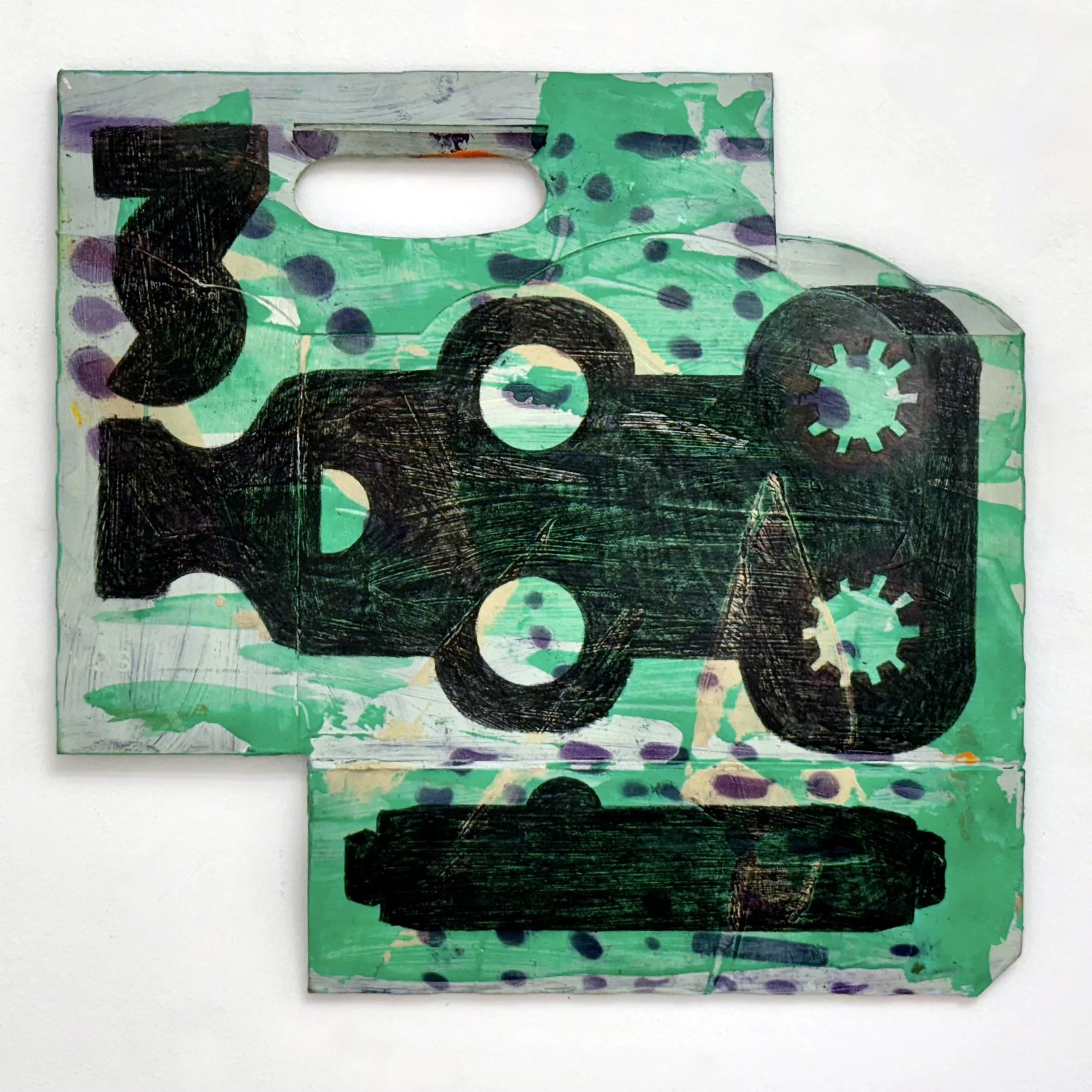
Beer-3, 2024. Paint, pastel on beer caddy, 10 x 6.75 inches
Do you have any tips or advice that someone has shared with you that you have found particularly helpful?
In 2017 my friend David Hornung took me aside at a workshop at Anderson Ranch and gave me advice that came at the exact time I needed it and was honest and caring. He warned me against feeling the urge to “do something new” (for the sake of doing something new, especially when I enter a new situation) but instead to stay with what I was developing in my painting. I had often followed the urge to sometimes change up my work just to be doing that but had not been told so clearly that I was at a point in my work life where diving down deep would be better than changing course or materials in an almost performative way.
What’s coming up next for you?
I’m not sure at this point. Work in the studio is the most essential thing for me, and I am looking forward to time devoted to that.
Thank you so much for including my work in the magazine and for this insightful interview.
Thank you for sharing your work and talking with us!
To find out more about Annie, check out her website